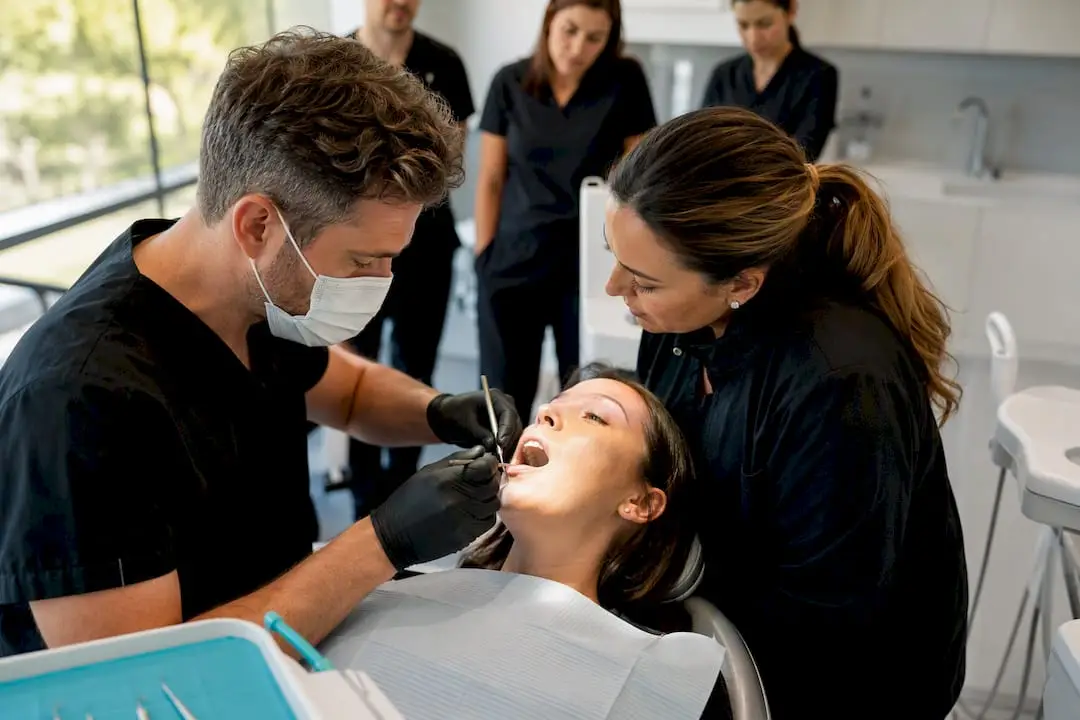
A compliant live-surgery authorization is a written document, separate from clinical treatment consent, that spells out who will observe the procedure, whether it will be recorded or broadcast, how footage will be used and stored, and how the patient can revoke permission at any point. It has to be reviewed verbally, signed before the patient enters the operating chair, and filed in the chart. If your consent form skips any of those elements, treat it as incomplete and fix it before the next course date.
What Is Live Surgery Consent in Dentistry, Legally?
Live surgery consent in dentistry sits outside the informed-consent conversation most dentists already know cold. Informed consent covers risks, benefits, and alternatives for the procedure itself. Live surgery consent covers a second, distinct question: who else gets to watch, record, or broadcast that procedure, and for what purpose. HIPAA treats video and photographic recordings of identifiable patients as protected health information, so an authorization to record or stream is functionally a HIPAA authorization, not a treatment consent form, and it needs its own signature line.
State rules complicate this further. Dental pilot project programs, like Oregon’s dental pilot project rule, require written information about the project and written consent that names the trainee’s role, confirms supervision availability, and states clearly that the patient can refuse trainee involvement without penalty. Teledentistry adds another layer: synchronous video is permitted in only 21 of the states surveyed, and patient-informed consent for teledentistry is explicitly required in 26 states and Washington, D.C. That means a course streamed from Texas to remote viewers in another state can trigger licensing and consent rules that a purely in-room demonstration never touches.
Professional guidance reinforces the same caution. A 2025 reflection published by RCS England recommends restricting live demonstrations to cases with clear, predefined educational objectives, applying independent oversight, and treating consent as an ongoing process rather than a signature collected once and forgotten. Before you schedule a live case:
- Confirm whether your state licenses the observing or recording activity as a teledentistry event.
- Check whether your institution or state board has its own pilot project or demonstration rule.
- Separate the recording/broadcast authorization from the standard treatment consent form entirely.
- Route the plan through an independent review body, not just the treating dentist.
A live-surgery authorization form earns its place in the chart only if it answers questions a plaintiff’s attorney or a state board investigator would ask later. Build the form, and the verbal script that accompanies it, around these items:
- Procedure and educational purpose. Name the specific procedure and the specific learning objective the demonstration serves.
- Who will observe, and how. List roles (residents, visiting dentists, industry reps), whether they’re in-room or remote, and whether trainees will perform any hands-on portion.
- Recording and photography scope. Specify exactly what gets recorded, camera angles, and whether audio of the patient is included.
- Access and distribution. State who can view the recording afterward, whether it will be used in a course library, marketing material, or public broadcast, and for how long it will be retained.
- Privacy mitigation. Note any anonymization steps, such as cropping the face from wide shots or using initials instead of a full name on slide overlays.
- Withdrawal rights. Explain, in plain language, that the patient can revoke authorization before, during, or after the procedure, and describe what happens to footage already captured.
- Separation from treatment consent. Include a line stating that this authorization is independent of, and does not alter, the clinical treatment consent already on file.
- Signature, printed name, date, and witness. Missing any one of these turns a strong form into a weak one during audit.
Pro Tip: Print the withdrawal clause in bold on its own line. Patients skim consent paperwork, and the revocation right is the one detail regulators check first when something goes wrong.
Concrete language matters more than legal boilerplate here. A line like “this authorization is separate from your clinical treatment consent, and declining it will not change your care” does more to reduce confusion and legal exposure than a paragraph of dense disclaimers.
Building the Workflow: From Screening to Sign-Off
Turning that checklist into a repeatable process means assigning ownership to specific steps, not hoping the front desk handles it.
- Pre-screening and oversight review. An independent committee, not the treating dentist alone, should confirm the case fits a defined educational objective before it’s added to the course agenda.
- Pre-op visit. Introduce the authorization form days ahead, not in the waiting room. Give the patient time to ask questions and, if needed, decline without pressure.
- Day-of confirmation. Re-confirm verbally before sedation or local anesthesia, and note the confirmation time in the chart.
- Platform and BAA checks. If any streaming or recording platform touches identifiable patient data, confirm a signed Business Associate Agreement is in place, and run a technical dry run to catch camera or audio failures before patients are in the chair.
- Moderator assignment. Designate one person to manage audience questions and a separate stop-broadcast protocol if the patient revokes consent mid-procedure.
Pro Tip: Assign the stop-broadcast decision to someone who isn’t scrubbed in. The operating dentist should never have to choose between managing a complication and remembering to cut the feed.
If a patient withdraws mid-stream, the moderator ends the broadcast immediately, and the clinical team documents the exact time and reason in the chart, separate from any note about the procedure’s clinical progress.
Choosing the Right Case, Protecting the Patient
Not every procedure belongs in front of an audience. Case selection is where most of the ethical risk in live-surgery teaching actually lives, and professional guidance is blunt about it: restrict demonstrations to cases with clear, predefined educational value and exclude anything with a realistic chance of unpredictable complications.
- Exclude patients with complex medical histories, anticipated difficult anatomy, or a procedure history suggesting higher complication risk.
- Match the case to a specific skill the audience needs to see, not a case chosen because it looks impressive.
- Confirm the patient has full decision-making capacity and is volunteering without financial or scheduling pressure.
- Add extra scrutiny for vulnerable patients, and require closer supervision when trainees will perform any part of the procedure.
- Consider a blended format, mixing a live segment with pre-recorded footage of the more technically demanding portions, which lowers real-time risk while preserving teaching value.
Independent oversight matters here too. Committee review, separate from the presenting dentist, keeps case selection tied to education rather than to sponsorship interest or the appeal of a dramatic case.
Documentation That Holds Up Under Audit
The chart entry is what protects both the patient and the practice if a complaint surfaces months later. At minimum, file the signed authorization form, a brief written summary of the verbal review that took place, and a dated note confirming when and how consent was reconfirmed on the day of the procedure.
- State a retention period for recordings in writing, and restrict access to named individuals or roles, not “the whole training team.”
- Anonymize footage wherever the educational goal allows it, and label stored files with the retention date so old material doesn’t linger indefinitely.
- If a patient withdraws consent after footage exists, document the withdrawal request, the date it was processed, and whether already-distributed material could be recalled or had to be flagged as unusable going forward.
One World Dental’s Resources for Course Organizers
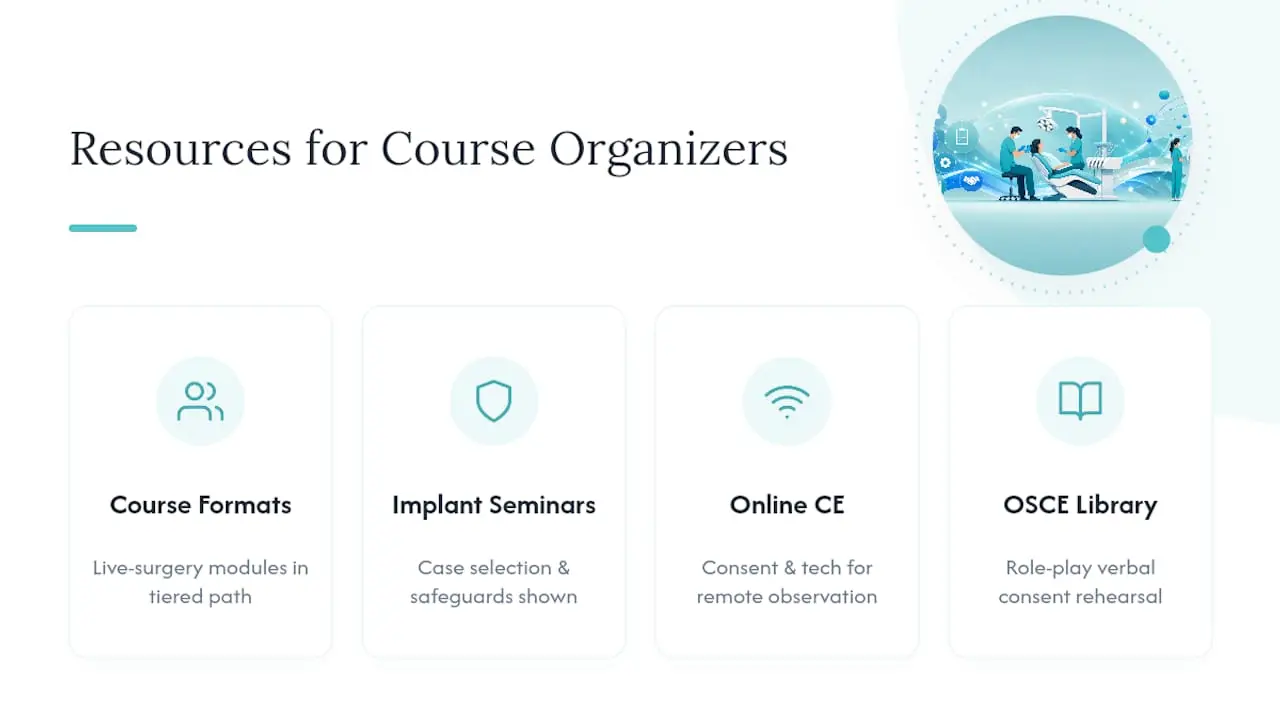
Building this workflow from scratch is exactly the gap One World Dental’s course formats are designed to close. Its hands-on implant training programs run live-surgery modules inside a tiered learning path, where mentorship-driven oversight and faculty moderation are already built into the course structure rather than bolted on afterward.
Organizers planning their own live demonstrations can look at how dental implant seminars structure hands-on training to see case-selection criteria and safeguards in practice, and how online CE formats handle the consent and technology questions that come with remote observation. Reviewing role-play frameworks like BoardMaster’s OSCE scenario library can also help staff rehearse the verbal consent conversation before a real patient is in the chair.
Why Spectacle Should Never Outrank the Patient
Live surgery teaching works when it’s built around a defined skill gap, not around how impressive the case looks to a room full of observers. The moment a course starts selecting cases for drama rather than education, the consent conversation stops being informed and starts being theater with a signature attached.
Independent oversight isn’t bureaucratic overhead. It’s the mechanism that keeps a program honest about why a given case is on stage at all. When state rules or institutional policy are unclear, the right move is a call to legal counsel or the state dental board, not a guess dressed up as a policy.
— Jake
Get Course-Ready Support From One World Dental
Building a compliant live-surgery program from a blank page eats weeks that most practices don’t have. Some continuing education providers offer live-surgery course formats with mentorship-driven oversight structured around defined educational objectives, plus operational templates that can be adapted to specific state rules instead of drafting consent language cold.
If you’re planning a live-surgery module for U.S. dentists or specialists, start by reviewing the Training Courses page to see current course dates and formats, or compare options on the dental CE courses overview before locking in your next program.
Recommended