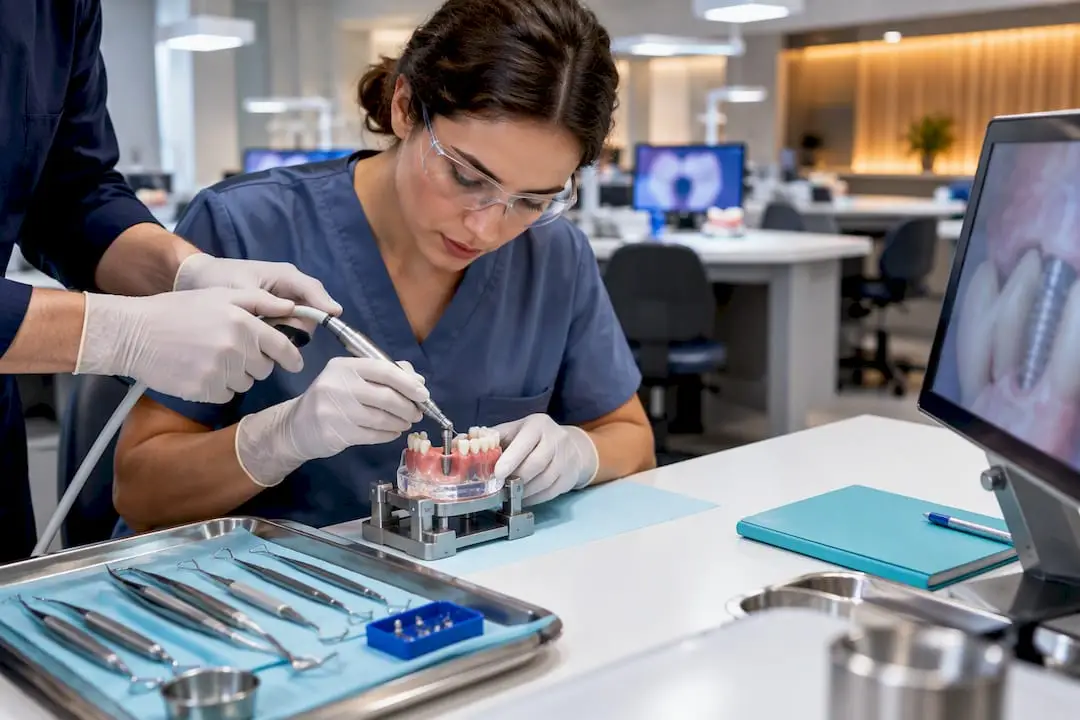
Yes, U.S. licensing boards accept live patient CE credits, provided the course is synchronous, supervised by a qualified instructor, and documented properly. Verify the provider’s board and AGD approvals before you register, and download your certificate the moment the course ends. Check with your state board, the AGD, and the ADA if you’re unsure, and look for providers that build compliance into the course structure itself.
Three formats qualify for live continuing education credit, and each carries a different level of audit scrutiny.
Live in-person courses put you in a room with an instructor and, often, a patient. This is the gold standard for hands-on dental training, because attendance is unambiguous and supervision is direct.
Live-virtual or synchronous webinars count too, but only under specific conditions. The AGD’s assigning-hours guidance notes that a webinar can earn lecture credit when a live instructor is present and answering questions in real time, and the provider has a method for confirming attendees stayed for the whole session. A pre-recorded video with a quiz at the end does not meet this bar, no matter how it’s marketed.
Hands-on participation with live patient treatment is the category that actually moves your clinical skills forward. When you’re placing an implant or adjusting a clear aligner under direct supervision, that’s participation credit, not lecture credit. The distinction matters because boards weight them differently, and some states require a minimum number of participation or clinical hours per renewal cycle.
Here’s the rule that trips people up most: if hands-on activity makes up 30% or more of a course’s total time, the provider can record those hours as participation credit rather than lecture credit, according to PACE/AGD standards. Below that threshold, it typically stays classified as lecture.
- Live in-person: highest audit safety, includes physical attendance records
- Live-virtual with mandatory Q&A: acceptable when interactivity is enforced and logged
- On-demand or pre-recorded: almost never counts as “live,” regardless of content quality
Auditors look for one thing above all else: proof the interaction was synchronous. Time-stamped logins, instructor attestations, and Q&A transcripts separate a legitimate live patient course from a video you watched at 1.5x speed.
How Do Boards Classify Participation vs. Lecture vs. Self-Instruction?
The AGD/PACE framework sorts every CE activity into one of three buckets, and which bucket your course lands in determines whether it satisfies a “clinical” or “hands-on” requirement on your license renewal.
- Lecture covers passive learning, one hour of seated instruction generally equals one CE hour, whether that’s in a hotel ballroom or a webinar with a live speaker.
- Participation applies when you’re doing something, not just watching, and it requires that 30%-or-more hands-on threshold mentioned above.
- Self-instruction covers journal articles, recorded courses, and other formats you complete alone and on your own schedule, usually capped at a small percentage of total renewal hours by most boards.
State boards don’t all draw these lines identically. Some cap self-instruction at 25% of your total hours; others allow more. If you’re licensed in more than one state, plan around the strictest rule that applies to you rather than trying to track separate requirements for each jurisdiction. Onewd’s compliance guide breaks down how these state-by-state clinical-hour percentages typically work.
Before you register for any course marketed as “hands-on” or “live patient,” check the provider’s course description for three things: an explicit breakdown of lecture minutes versus participation minutes, a statement confirming live patient treatment happened under direct instructor supervision, and the provider’s AGD PACE or ADA CERP approval number.
Pro Tip: Screenshot or save the course’s published agenda before you attend. If a board or employer questions your hours later, that agenda is often the fastest way to prove the participation percentage without waiting on the provider to respond.
What Documentation Do You Need to Prove Your Hours?
Every certificate should include the same core elements, and missing even one can cause a rejected submission or a flagged audit.
A compliant certificate needs the provider’s name and AGD provider ID (when applicable), your name as the licensee, the exact course dates, the course type (lecture, participation, or self-instruction), the number of hours earned, and a brief course synopsis. These elements are exactly what the AGD’s CE submission guidelines require for proper transcript credit, and most state boards mirror the same expectations.
Do these four things the day the course ends, not the week before renewal:
- Download the certificate immediately, don’t rely on a provider portal you might lose access to later
- Save it with a standardized filename (something like “2026_ImplantWorkshop_ProviderName_HoursX”)
- Back it up to cloud storage separate from your practice management system
- Log the entry in a CE tracker or spreadsheet with date, hours, and category
Audit reviewers commonly flag files missing synchronous attendance proof, so a CE audit compliance guide recommends keeping a buffer above your state’s live-interactivity minimum. If your state requires a certain number of clinical hours, aim for a buffer above that minimum, since a single disqualified course can otherwise drop you below the line during renewal season.
How Do You Find Accredited Live Patient CE That Counts?
Search smarter, not longer. When you’re scanning provider catalogs, filter using terms like “live,” “participation,” “hands-on,” “live patient,” “PACE,” and “ADA CERP.” Courses that bury their accreditation status or avoid stating hands-on percentages are usually not worth your time.
Before registering, ask every provider three questions:
- Will patient treatment be performed under direct instructor supervision, and how is that documented?
- What PACE or ADA CERP approval does this course carry, and can you provide the provider ID?
- How is attendance verified for live-virtual sessions, and will I receive a certificate the same day?
If your goal is mastering a new surgical technique, an in-person lab with live patients beats a webinar every time, since skill acquisition depends on repetition under supervision, not just watching a demonstration. Onewd’s guide to online dental CE walks through when a hybrid model, part live-virtual instruction paired with an in-person lab weekend, makes more financial and scheduling sense than a fully in-person course.
When Does Live Patient CE Actually Move the Needle?
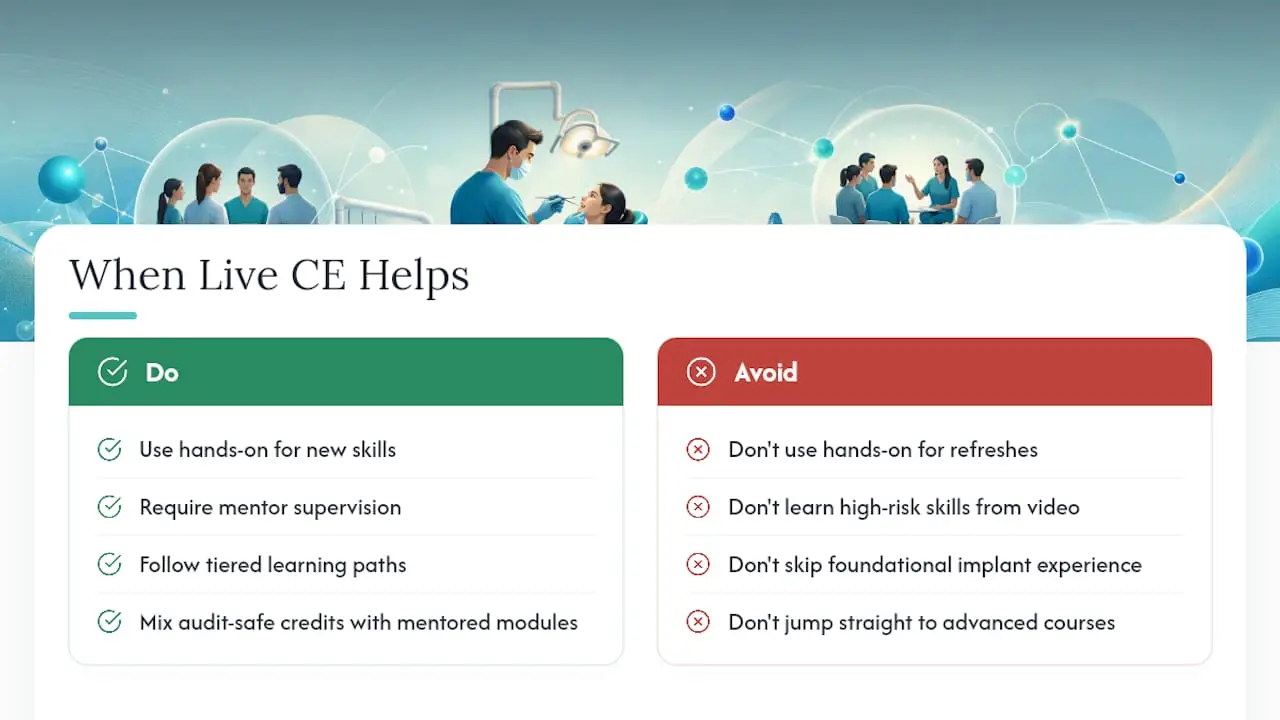
Hands-on training earns its cost when you’re adopting a genuinely new skill, not refreshing one you already have. Implant placement, full-arch workflows, and advanced surgical techniques carry real risk if you learn them from a screen alone. A mentor standing next to you while you work on a live patient catches mistakes a video never will.
Tiered learning paths matter here too. Jumping straight to an advanced full-arch course without foundational implant experience is how clinicians end up undertrained and overconfident. The smarter approach mixes audit-safe live credits for renewal compliance with targeted, mentorship-driven hands-on modules aimed at specific competency gaps. Credits keep your license current. Mentored repetition is what actually changes how you treat patients on Monday morning.
— Jake
Where One World Dental Fits Into Your CE Plan
The provider builds every course around the same principle: credits should reflect real skill gained, not just seat time logged. Their live, in-person, and hands-on programs cover implants, clear aligners, and cosmetic dentistry, each structured through tiered pathways from foundational technique to advanced surgical mastery, with mentorship built into every level.
Every certificate issued includes the provider details, course type breakdown, and hours documentation that boards and AGD audits actually look for, so you’re not scrambling to reconstruct proof six months later. If you’re weighing which format fits your renewal cycle and your skill goals, browse the training courses currently open for enrollment, or look specifically at hands-on implant training if surgical competency is your priority this year. Patient communication matters just as much as technique, and pairing clinical training with resources like patient consultation practice can round out how you handle live cases. Reach out with your state and course questions before you register, and get a straight answer about whether a specific program will count.
Where to Verify the Rules Yourself
Check the AGD’s CE submission guidelines for certificate requirements, PACE’s hour-assignment standard for the 30% participation rule, and your state dental board’s CE page for jurisdiction-specific mandates.
Recommended