What are the CE requirements for a Texas dentist?
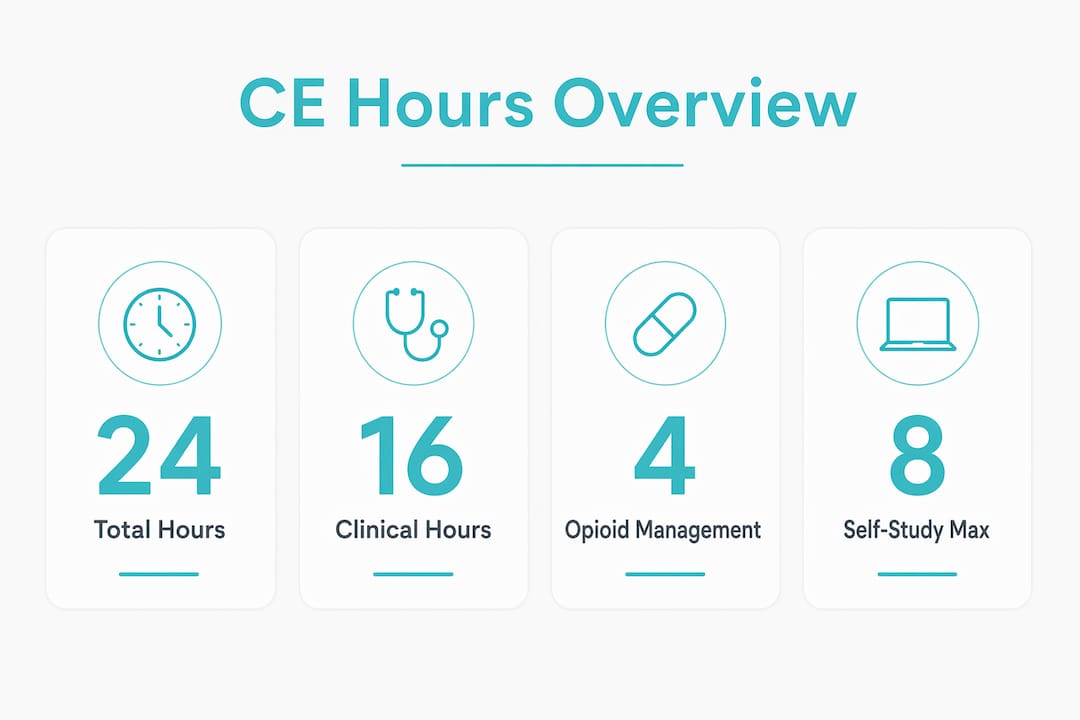
Texas dentists must complete 24 CE hours biennially, with at least 16 of those hours in clinical or technical coursework. That’s the core rule under Texas Occupations Code Section 257.005 and TSBDE Chapter 104. Beyond the hour count, several specific mandates apply.
- Minimum continuing education hours every two years required for renewal
- Major portion of hours must be clinical or technical to directly enhance patient care skills
- Some hours may be in risk-management topics such as recordkeeping, HIPAA, ethics
- A limited amount of hours may be self-study including recorded video, audio, reading courses
- A required portion of hours dedicated to opioid and controlled substance pain management for direct patient care dentists
- Human trafficking prevention training approved by the Texas Health and Human Services Commission, required every renewal cycle
- Current BLS certification from approved providers required for license renewal
- Jurisprudence assessment required periodically, separate from continuing education hours
How the 24 CE hours break down in practice
The 16-hour clinical floor is where most dentists spend the bulk of their CE budget. Courses qualify as clinical or technical when they carry “significant intellectual or practical content” designed to directly improve how you treat patients. Hands-on surgical workshops, implant technique courses, and pharmacology updates all fit cleanly here.
The 4-hour opioid and controlled substance requirement counts toward those 16 clinical hours, not on top of them. Courses must cover reasonable standards of care, identifying drug-seeking behavior, and communicating with patients about opioid prescriptions. This mandate took effect January 1, 2021, for all dentists providing direct patient care.
TSBDE Rule 104.1: “A licensed dentist whose practice includes direct patient care must complete not less than 4 hours for each biennial renewal, regarding safe and effective pain management related to the prescription of opioids and other controlled substances. These 4 hours may be used to satisfy the 16-hour technical and scientific requirement.”
A few additional rules worth knowing:
- OSHA annual update courses and CPR/BLS training hours do not count toward the 24-hour CE total
- Practice finance courses are also excluded
- ACLS and PALS courses may count toward CE for dentists without sedation permits, but cannot fulfill anesthesia permit CE requirements
- Excess classroom hours earned within the year before renewal can carry forward, up to a maximum of 24 hours
- DEA permit holders must complete 2 CE hours on controlled substance prescribing procedures and conduct at least one self-query through the Texas State Board of Pharmacy’s Prescription Monitoring Program
- Dentists holding anesthesia permits must complete additional sedation-specific continuing education hours and must pass a separate anesthesia jurisprudence exam every five years
- Human trafficking courses must be approved by the Texas Health and Human Services Commission and meet updated listing requirements starting in 2025
How to stay compliant: documentation, attestation, and renewal
License renewal in Texas follows a two-year cycle. Before submitting your application, you need four things confirmed: CE hours completed, current BLS certification from AHA or ARC, jurisprudence assessment current (if due), and the renewal fee paid.
- Complete all required CE hours before your license expiration date, not after
- Retain all CE documentation for at least two full renewal cycles in case of audit
- Attest at renewal that you have met the minimum CE requirement; you do not submit proof unless selected for audit
- Expect possible audit: approximately 5% of renewals each month are randomly selected; audited dentists cannot renew until documentation is reviewed and approved
- Late fees accrue if you cannot provide documentation before your expiration date
- Request a deferral or exemption in writing to the TSBDE Licensing Committee before your renewal period expires; acceptable reasons include documented medical or financial hardship
- Jurisprudence assessment: complete it every four years through the TSBDE portal; missing it blocks renewal even when all CE hours are done
Pro Tip: Live interactive webinars where you can ask questions in real time count as in-person CE hours, not self-study. If you are close to the 8-hour self-study cap, switching to a live webinar format keeps those hours fully creditable.
Dentists residing outside the United States may complete all required hours through self-study without prior committee approval, provided they can document their residence during the audit.
Advanced CE opportunities that go beyond the Texas minimum
Meeting the 24-hour floor keeps your license active. What you do with the remaining CE budget shapes your clinical range. Dentists who invest in advanced coursework consistently report greater confidence in complex cases and stronger patient outcomes.
- Implant surgery and full-arch reconstruction: hands-on courses with live patient modules give you repetitions that lecture-only formats cannot replicate
- Clear aligner treatment planning: multidisciplinary case-based training covers the orthodontic and restorative decisions that determine long-term results
- Cosmetic dentistry: veneer preparation, smile design, and digital workflow courses address the growing patient demand for esthetic work
- Mentorship-driven learning: tiered pathways from foundational to advanced allow you to build on each skill set rather than collecting unrelated credits
- Live surgery observation and participation: watching and assisting in real procedures accelerates clinical judgment in ways that no recorded course can
Onewd offers accredited CE courses across implants, surgery, clear aligners, and cosmetic dentistry, with live patient modules and mentorship built into the curriculum. Faculty bring active clinical practices to the teaching environment, so case discussions reflect current techniques rather than textbook scenarios. For dentists who want to maximize credit hours in a single enrollment, courses in the 11–20 credit range cover substantial clinical ground while satisfying a large portion of the biennial requirement.
Explore Onewd’s upcoming live and online courses to find accredited options that fulfill Texas CE mandates and build the clinical skills your patients need.
Key Takeaways
Texas dentists must complete 24 CE hours every two years, with at least 16 clinical hours, 4 opioid management hours, mandatory human trafficking training, current BLS certification, and a jurisprudence assessment every four years.
| Point |
Details |
| Total CE hours required |
Minimum hours every two years; a significant portion clinical or technical. |
| Opioid management mandate |
Specific required hours on pain management included in clinical hours. |
| Self-study cap |
Limited hours allowed from self-study formats. |
| Jurisprudence assessment |
Required periodically; separate from continuing education hours. |
| Audit exposure |
Some renewals are selected for audit; retain documentation accordingly. |
Recommended