Dental CE requirements are state-mandated continuing education credits that licensed dental professionals must complete within a set renewal cycle to keep their licenses active. Every US state mandates continuing education for dental license renewal, with requirements typically ranging from 12 to 36 hours per renewal cycle. Renewal cycles run one to three years depending on your state and license type. Regulatory bodies like the ADA CERP (Continuing Education Recognition Program) and individual state dental boards set the standards for what counts. Missing these requirements puts your license at risk of suspension or non-renewal, which makes understanding the rules before your deadline non-negotiable.
What are the dental CE requirements by state and topic?
The number of required CE hours varies significantly by state, and the differences matter more than most clinicians expect. California requires 50 hours every two years. Texas and Florida each have their own credit totals and mandatory subject breakdowns. The range across all states sits between 12 and 36 hours per renewal cycle, though some states fall outside that band.
Beyond the total hour count, states mandate specific topics. These are not optional electives. Mandatory CE topics commonly include:
- Infection control: California requires 2 hours per renewal cycle; most states require at least 1–2 hours.
- CPR/BLS certification: Required in the majority of states; must be current at time of renewal.
- Jurisprudence: Covers state dental practice acts and legal obligations.
- Ethics: Required in many states, often combined with jurisprudence hours.
- Opioid/pain management: An increasingly common mandatory topic added by states in recent years.
Specialty-specific CE applies when your license covers expanded functions or specialty practice. A dental hygienist with local anesthesia authorization, for example, may face additional CE requirements tied to that permit.
| State |
Total Hours Required |
Renewal Cycle |
Notable Mandatory Topics |
| California |
50 hours |
2 years |
Infection control (2 hrs), dental practice act (2 hrs) |
| Texas |
12 hours |
2 years |
Jurisprudence (1 hr), CPR required |
| Florida |
30 hours |
2 years |
Medical errors (2 hrs), domestic violence (2 hrs) |
| Washington |
21 hours |
3 years |
Infection control, CPR |
| New York |
60 hours |
3 years |
Infection control, child abuse recognition |

Always verify your state board’s current requirements directly. Tables like this reflect general patterns, not guaranteed current rules.
What documentation do you need for dental CE audits?
Most state boards use an attestation process at renewal. You self-report your CE completion, and documentation is only required if you are randomly selected for audit. When audited, you typically have 30 days to produce your records. That window sounds reasonable until you realize how many clinicians cannot locate certificates from two years ago.
Every CE certificate you retain should include:
- The course title and a brief description of content
- The date of completion
- The number of CE hours or credits awarded
- The provider’s name and approval number (ADA CERP, AGD PACE, or state board registration)
- Your name as the participant
Under 2026 ADA CERP standards, certified CE providers must maintain detailed learner participation records for six years. That does not mean you can rely on the provider to produce your records during an audit. Boards want documentation from you, not from a third party.
California requires retaining CE certificates for three renewal periods, which typically equals six years. Other states set shorter minimums, but retaining records indefinitely is the smarter practice. Hospital credentialing committees and insurance panels frequently request CE records that go back further than your state board requires.
Common audit failures include an inability to prove course provider approval status and incomplete certificates. Practitioners who keep screenshots of provider approval from board websites alongside their certificates pass audits far more reliably than those who rely on certificates alone.
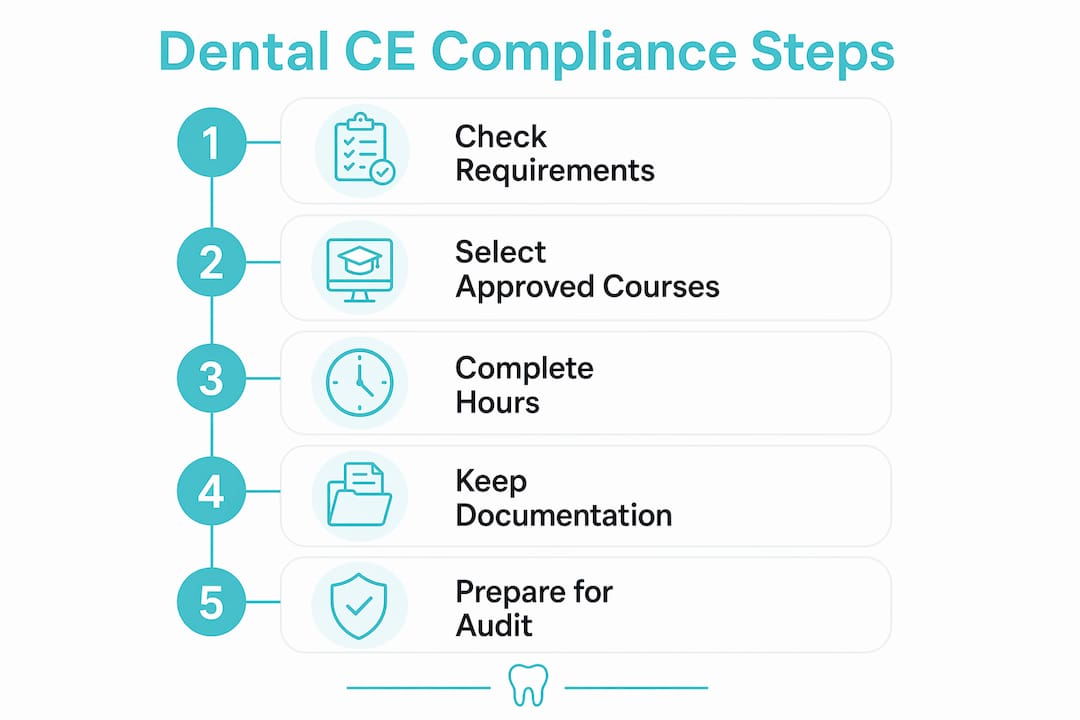
Pro Tip: Create a dedicated folder, either physical or digital, for each renewal cycle. Label it with the cycle dates and drop every certificate in immediately after course completion. Add a screenshot of the provider’s approval status from your state board’s website at the same time.
How do live courses, online courses, and home study count toward CE?
Not all CE formats carry equal weight in every state. The format of a course determines whether it counts at all, and how many hours you can apply toward your total.
Live interactive webinars are widely accepted as equivalent to in-person attendance. The key requirement is real-time interaction: you must be able to ask questions and receive responses during the session. A recorded replay of the same webinar does not meet this standard in most states.
Self-paced on-demand courses fall into the home study or self-study category. Many states cap home study CE hours at 50% of total required hours. Nevada and California both apply this cap. That means if your state requires 30 hours, no more than 15 can come from self-paced online content.
Self-paced courses typically require an assessment or quiz at the end to verify completion. Passing that assessment is what generates your certificate. Skipping the quiz means no credit, regardless of how much content you watched.
| Course format |
Typically accepted as live? |
Subject to home study cap? |
Assessment required? |
| In-person lecture or hands-on |
Yes |
No |
No |
| Live interactive webinar |
Yes (most states) |
No |
No |
| On-demand/self-paced online |
No |
Yes (often 50% cap) |
Yes |
| Home study (reading/workbook) |
No |
Yes |
Yes |
Before enrolling in any course, confirm two things: that the provider is approved by your state board or a recognized accreditor like ADA CERP, and that the format is accepted for the number of hours you need. Online dental CE courses can satisfy a significant portion of your requirements when chosen carefully.
Pro Tip: Contact your state dental board directly before enrolling in a course you are unsure about. A five-minute phone call can prevent you from completing hours that do not count.
How to select and organize CE courses to stay compliant
Planning your CE calendar is the single most effective way to avoid last-minute scrambles and audit failures. Clinicians who treat CE as an annual project rather than a renewal-week emergency consistently report less stress and better course choices.
-
Pull your state board’s current requirement list at the start of each renewal cycle. Requirements change. What was true two years ago may not be true today. Bookmark your board’s CE page and check it at the beginning of every cycle.
-
Complete mandatory topics first. Infection control, CPR/BLS, and jurisprudence have fixed hour requirements and specific provider rules. Finish these early so a scheduling conflict near your renewal date does not leave you short on a required subject.
-
Verify provider approval before you register. Non-clinical courses often do not count toward CE credits and can cause audit failures. Check that the course is approved by ADA CERP, AGD PACE, or your state board before paying.
-
Track your credits in a spreadsheet or CE management app. List each course, the date completed, the hours earned, the provider name, and the approval number. Update it every time you complete a course, not at renewal time.
-
Balance live and online formats intentionally. Use live courses for hands-on skills and mandatory interactive requirements. Use board-approved online courses for foundational topics and elective hours where the home study cap allows.
-
Keep your CPR/BLS certification current throughout the cycle. An expired BLS card at renewal is one of the most common and easily avoidable compliance failures. Set a calendar reminder six weeks before your card expires.
-
Retain documentation beyond the minimum. Retaining CE records indefinitely protects you for hospital credentialing and insurance purposes, not just board audits.
Key Takeaways
Meeting dental CE requirements demands early planning, verified providers, and audit-ready documentation kept well beyond the minimum legal retention period.
| Point |
Details |
| State requirements vary widely |
Hours range from 12 to 36+ per cycle; always verify your board’s current rules directly. |
| Mandatory topics are non-negotiable |
Infection control, CPR/BLS, jurisprudence, and ethics must be completed with approved providers. |
| Documentation wins audits |
Keep certificates, provider approval screenshots, and attendance records for every course you complete. |
| Home study hours are capped |
Most states limit self-paced online CE to 50% of total required hours; plan your format mix accordingly. |
| Retain records indefinitely |
Hospital credentialing and insurance panels request CE records that go beyond state board minimums. |
Why I think most dentists approach CE backwards
The standard advice is to knock out your CE hours in the final months before renewal. I have watched that approach create real problems: clinicians scrambling for any approved course that fits the calendar, paying premium prices for last-minute live events, and occasionally discovering that a course they completed does not count because the provider was not approved in their state.
The smarter move is to treat CE as a clinical development plan that happens to satisfy a compliance requirement. When you start a renewal cycle by identifying the two or three skills you actually want to build, then find approved courses that teach those skills, you end up with better training and zero compliance gaps. The mandatory topics take maybe four to six hours in most states. The rest of your hours are yours to direct.
Lower CE hour requirements in some states do not mean easier audits. I have seen clinicians in low-hour states fail audits because the scrutiny on course quality and clinical relevance was higher than they expected. A 12-hour requirement with strict content rules is harder to satisfy carelessly than a 30-hour requirement with broad elective flexibility.
The 2026 documentation standards are also stricter than most clinicians realize. Boards are increasingly cross-referencing provider approval status against submitted certificates. A certificate from a provider whose approval lapsed before your course date will not pass. Verify approval status at the time of enrollment, not just at the time of completion.
My honest recommendation: build your CE folder on day one of your renewal cycle, complete your mandatory topics within the first six months, and choose elective courses that make you a better clinician. Compliance becomes automatic when the planning is front-loaded.
— Jake
Onewd’s board-approved CE courses for dental professionals
Dental professionals who want CE that counts toward licensure and builds real clinical skill will find both at Onewd. Every course on the platform is designed to meet state CE standards, with clear documentation of provider approval status so your records are audit-ready from the start.
Onewd offers a full range of board-approved training courses, from online lecture series you can complete on your own schedule to hands-on surgical programs with live mentorship. Courses cover implants, clear aligners, cosmetic dentistry, and suturing, with tiered learning paths that take you from foundational skills to advanced procedures. Whether you need to fill elective hours or develop a specialty, Onewd’s faculty brings the clinical depth that makes CE worth your time.
Recommended