Online dental continuing education is defined as accredited coursework that licensed dental professionals complete remotely to satisfy state board licensure requirements and maintain clinical competency. The field shifted significantly in 2026, when the ADA CERP standards were streamlined from 14 to 5 standards and from 104 to 17 criteria, sharpening the focus on educational quality and measurable outcomes. State boards set the rules on credit hours, approved formats, and mandatory topics, and non-compliance during an audit can cost you your license renewal. Choosing the right online CE courses dental professionals need requires understanding accreditation, format rules, and state-specific requirements before you click “enroll.”
How to verify accreditation for online dental CE courses
Accreditation by ADA CERP or AGD PACE is the gold standard for dental continuing education. Both accreditations signal that a provider meets nationally recognized standards for educational quality, conflict-of-interest disclosure, and credit reporting. Most state boards accept credits only from these two recognized bodies, so a course without one of these designations is a liability, not an asset.

Verifying a provider’s current status takes less than five minutes. The ADA maintains a public directory of CERP-recognized providers, and the AGD lists all active PACE-approved organizations. After the 2026 standards update, some providers lost recognition or are in the process of re-applying. Checking the directory before you register protects your credits.
A legitimate provider’s website displays several things clearly:
- The ADA CERP or AGD PACE logo with the recognition period
- A conflict-of-interest disclosure for every course
- The provider’s name, address, and contact information
- The number of CE credits awarded and the credit type (general, clinical, or elective)
- A course synopsis that describes learning objectives
ADA CERP-recognized providers are required to display accreditation and conflict-of-interest disclosures to maintain compliance under the new standards. If any of these elements are missing from a course page, treat it as a red flag.
One common mistake is counting workplace compliance training as formal CE. Misclassification of workplace training and non-accredited courses as CE credits is a leading cause of audit failure. Your annual OSHA refresher does not count unless it is delivered by an ADA CERP or AGD PACE provider and comes with a proper certificate.
Pro Tip: Search the ADA CERP provider directory by name before registering for any course. If the provider does not appear or shows an expired recognition date, choose a different course.
Not all online dental CE activities carry equal weight with your state board. The format of a course determines whether it counts toward your live hour minimum, your self-study cap, or both.
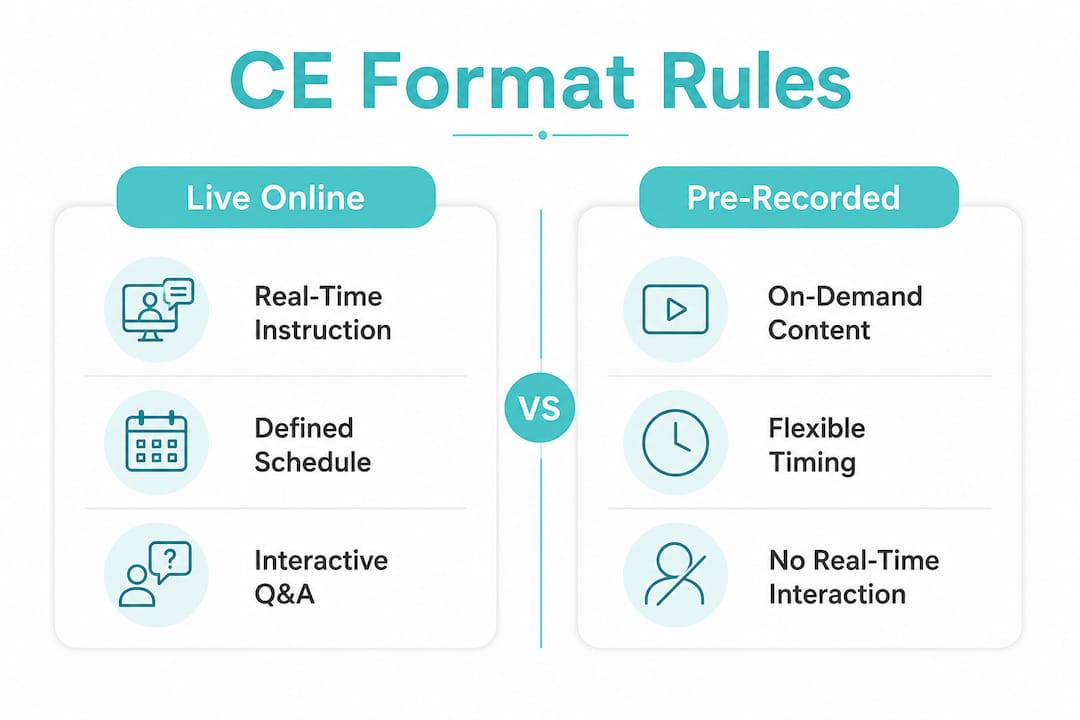
Live interactive online courses feature real-time instruction with a qualified faculty member, a defined start and end time, and the ability to ask questions and receive immediate answers. Live interactive online courses allow real-time questions and instructor responses, while pre-recorded on-demand courses do not count fully toward live hour mandates. That distinction matters enormously if your state requires a minimum percentage of live hours.

Many dental professionals do not realize that only certain interactive online formats qualify as live CE. Failing to meet live hour minimums is one of the most common causes of audit failure. A webinar you watch on replay is self-study, even if the original broadcast was live.
Follow these steps to plan your format mix correctly:
- Pull your state board’s current CE rules. Look specifically for the percentage of hours that must be live or interactive, and the maximum hours allowed from self-study or online sources.
- Categorize every course before you register. Confirm with the provider whether the format qualifies as live, interactive, or self-paced for your state.
- Prioritize live webinars for mandated topics. Infection control, opioid prescribing, and similar required subjects often carry format restrictions.
- Fill remaining hours with on-demand courses. Use on-demand CE options for elective topics once your live hour minimum is secured.
- Track format type on every certificate. Your documentation should show not just hours completed but the delivery method for each course.
Many state dental boards require at least 50% of continuing education hours to be earned through live or interactive formats to meet audit standards. That means if your renewal cycle requires 30 hours, at least 15 must come from live or interactive delivery.
Pro Tip: When registering for a live webinar, save the confirmation email showing the scheduled date and time. That timestamp proves you attended the live session, not the replay.
How do state-specific CE requirements affect your planning?
State dental boards set their own rules, and the variation across states is significant. Understanding your state’s specific requirements prevents the most common and costly compliance errors.
Maryland allows a 2.5-year window to report CE credits, giving practitioners more flexibility in timing their coursework. Oklahoma, by contrast, caps online coursework at 20 hours for dentists per renewal cycle, regardless of total hours required. These differences mean a CE plan that works perfectly in one state can leave you short in another.
| State |
Notable CE Rule |
Implication |
| Maryland |
2.5-year reporting window |
More flexibility in scheduling coursework |
| Oklahoma |
20-hour online cap for dentists |
Must supplement with in-person or live formats |
| Varies by state |
50% live hour minimum |
At least half of credits must be interactive |
| Varies by state |
Infection control format restrictions |
Some states require live or proctored delivery |
Infection control CE is one of the most misunderstood mandatory topics. States vary on acceptable formats for infection control CE, with some requiring live or proctored courses for mandated topics. Completing an on-demand infection control module when your state requires a live format means the hours will not count, even if the provider is fully accredited.
Dental professionals holding licenses in multiple states face the most complex planning challenge. The safest approach is to build your CE plan around the most restrictive state’s requirements. If State A requires 15 live hours and State B requires 10, plan for 15. Use upcoming live courses to fill live hour requirements across both licenses simultaneously when topics overlap.
Documentation expectations also vary. Some states accept digital certificates, while others require original paper copies. Confirm your state board’s preferred format before your renewal deadline, not after.
Best practices for documentation and audit readiness
Audit readiness starts with the certificate you receive the moment a course ends. A complete certificate must include the licensee’s full name, the course title, the date completed, the number of CE hours awarded, the credit type, a brief course synopsis, and the provider’s name and contact information. Certificates lacking critical information such as licensee name, course hours, and provider details often lead to CE credit rejection during audits.
Request a corrected certificate immediately if any element is missing. Providers are required to issue accurate documentation, and most will correct errors quickly when asked.
Your record-keeping system should store the following for every course:
- The original certificate (digital PDF or scanned copy)
- Proof of live attendance for interactive courses (confirmation email or attendance log)
- The provider’s accreditation status at the time of the course
- The course format classification (live, interactive, or self-study)
- The credit type and number of hours
“Digital tracking systems and organized documentation help dental professionals maintain audit readiness by storing certificates, provider info, and course details securely for years.” Keeping all records in one place, whether a dedicated CE tracking platform or a well-organized cloud folder, reduces the risk of missing documentation during an audit request.
Digital tracking systems enhance compliance and audit preparation by giving you a complete, searchable record of your CE history. Retain all records for a minimum of four to six years, as state boards can audit past renewal cycles.
Conduct a self-audit at least six months before your renewal deadline. Tally your hours by format type, confirm your mandatory topic requirements are met, and verify that every provider in your records holds current ADA CERP or AGD PACE recognition. Catching a gap six months out gives you time to register for additional courses. Catching it six days out does not.
Key Takeaways
Accredited online dental CE that meets your state’s format and documentation requirements is the only reliable path to audit-proof license renewal.
| Point |
Details |
| Verify accreditation first |
Confirm ADA CERP or AGD PACE status before registering for any course. |
| Know your format requirements |
At least 50% of CE hours must be live or interactive in many states. |
| Track state-specific rules |
Oklahoma caps online hours at 20; Maryland allows a 2.5-year reporting window. |
| Collect complete certificates |
Every certificate must include licensee name, hours, date, synopsis, and provider details. |
| Self-audit six months early |
Review your CE records before renewal to catch and fix gaps in time. |
Why the 2026 ADA CERP overhaul changes how I think about CE selection
The 2026 ADA CERP reforms are the most significant structural change to dental CE accreditation in years. The shift toward outcome-based evaluations moves the standard beyond simple satisfaction surveys and demands that providers demonstrate actual educational effectiveness. That is a meaningful shift, and I think it separates serious CE providers from those who have been coasting on name recognition.
What I find most interesting is how this reform exposes a gap that has existed for a long time. Plenty of accredited courses have been technically compliant but educationally thin. A 90-minute lecture with a multiple-choice quiz at the end is not the same as a course that changes how you treat patients on Monday morning. The new criteria push providers to close that gap.
My practical advice: use the 2026 standards update as a reason to re-evaluate your CE habits. If you have been returning to the same providers out of convenience, check whether they have updated their programs to reflect the new criteria. Providers who have invested in outcome measurement and faculty development are the ones worth your time and money.
The trend toward digital-first delivery, including live webinars, AI-assisted learning modules, and eventually virtual reality simulations for procedural skills, is accelerating. Dental professionals who build clinical skills online through well-structured, mentorship-driven programs will be better positioned than those who treat CE as a checkbox exercise. The compliance piece matters, but the clinical growth piece matters more.
— Jake
Onewd’s accredited courses for dental professionals
Onewd offers a catalog of accredited training courses covering implants, clear aligners, and cosmetic dentistry, designed specifically for licensed dental professionals who want clinical depth alongside compliance credit.
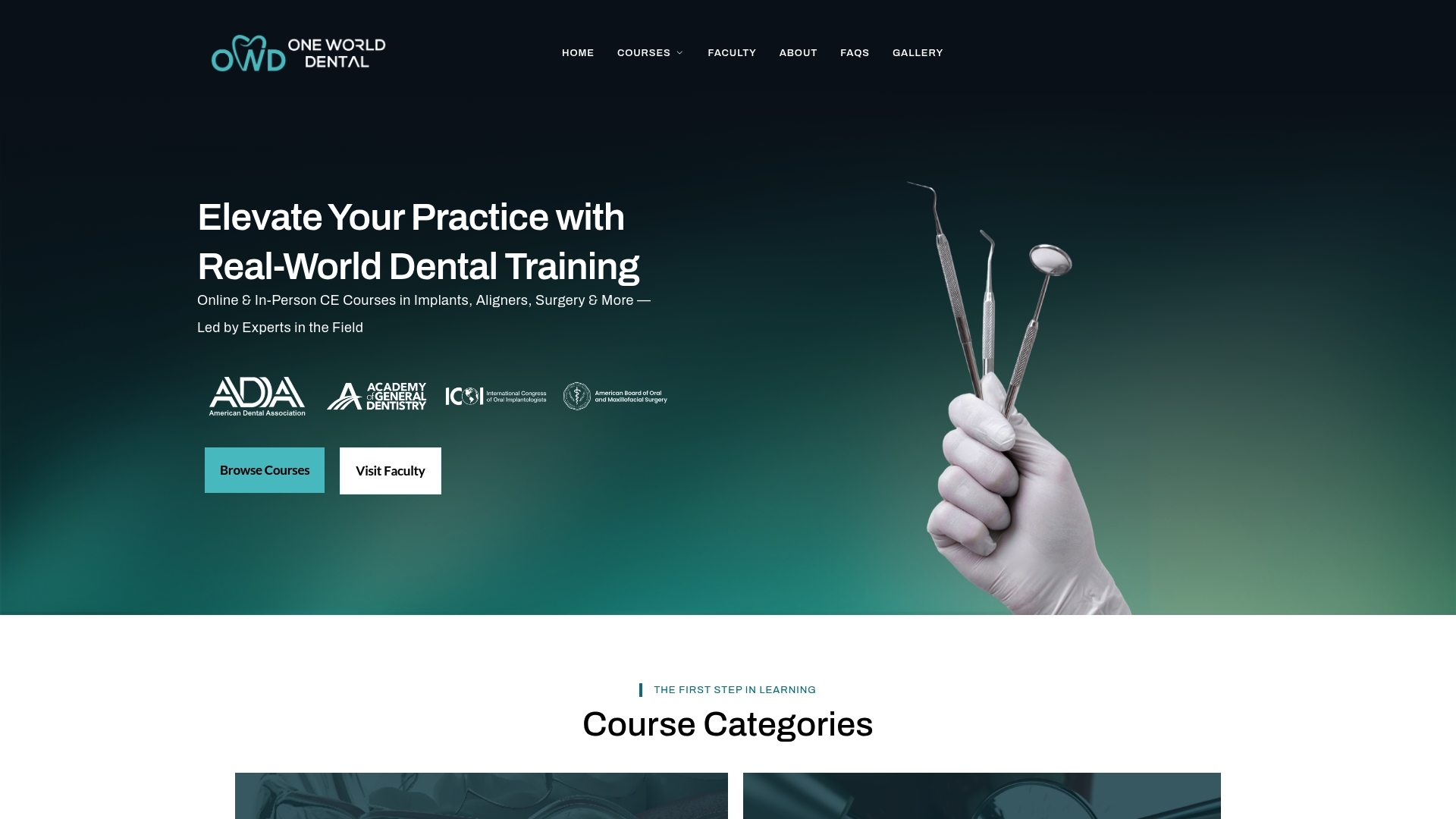
Every course on the Onewd platform displays clear accreditation information, credit type, and format classification so you can confirm compliance before enrolling. Live webinars meet interactive hour requirements, and on-demand options fill elective credit needs efficiently. The faculty roster includes practicing clinicians who bring real surgical and procedural experience into every course. Whether you need foundational credits or advanced specialty training, Onewd’s online course catalog gives you a direct path to both compliance and clinical growth.
Recommended