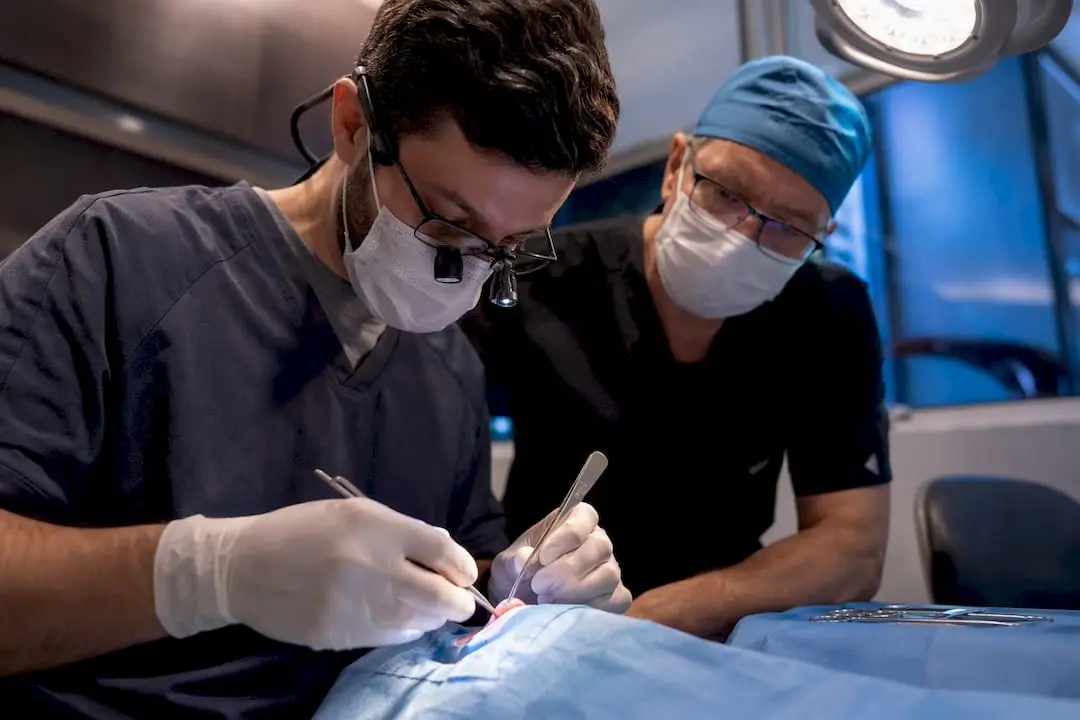
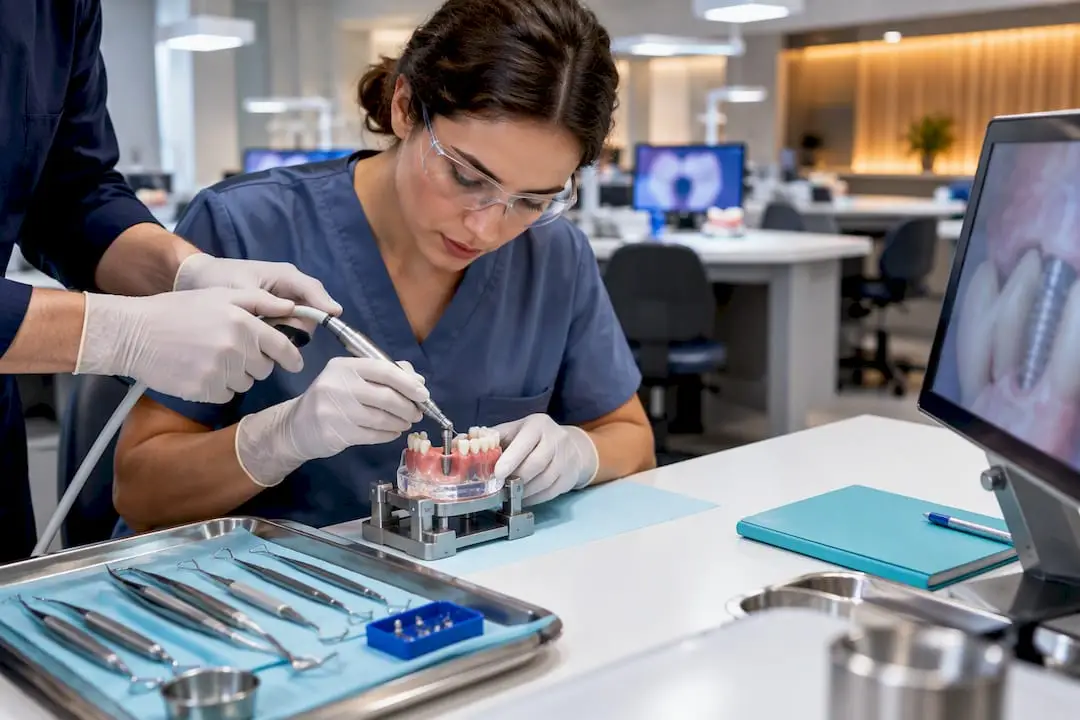
Supervised live-patient mentorship combined with progressive hands-on practice builds dental surgical confidence faster and more reliably than lecture-only or simulation-only training. Peer-reviewed research backs this: live surgical continuing education raises perceived practical relevance and skill retention compared to traditional formats. A mentorship-first pathway exists precisely because clinicians build lasting confidence in real cases, under real supervision, not in a lecture hall.
What Builds Surgical Confidence Faster Than Anything Else?
Confidence in oral surgery is not a personality trait. It is a skill outcome, built through repetition under correction, and the research on this is now specific enough to act on.
A 2025 study on live-surgery continuing education found that adding live surgical components to CE courses pushed participant satisfaction and perceived clinical relevance from roughly 3.5 out of 5 before live elements to above 4.5 afterward. That is not a marginal bump. It is the difference between a course that feels theoretical and one that feels usable the following Monday morning.
By the numbers: A 2025 survey of 503 dental students found 73.8% felt confident administering local anesthesia, but only 43.3% felt confident raising a flap and 41.6% felt confident with bone removal. Half the respondents (50.1%) blamed the gap on a lack of clinical exposure, not a lack of knowledge.
That statistic tells you exactly where the confidence problem lives. It is not in diagnosis or treatment planning. It is in the hands, at the exact moments where a scalpel, a periosteal elevator, or a handpiece meets tissue that does not behave like the textbook diagram.
Competence-development literature explains why. Clinicians move through three broad stages: novice, beginner, and competent. The novice-to-competent framework shows that the beginner stage, where a clinician understands the steps but hasn’t internalized the feel of them, is where most surgical anxiety concentrates. Mentorship is built specifically for that stage.
Mentors do three things a textbook cannot:
- Narrate what correct tissue resistance feels like in real time, not in a diagram.
- Intervene before a small error becomes a complication, rather than after.
- Hand responsibility to the trainee incrementally, so confidence and competence grow together instead of confidence outrunning skill.
This is also why blended formats, combining online didactic modules with in-person supervised practice, consistently outperform either approach alone for transferring skill into independent clinical performance.
What Should You Look for in a Hands-On or Live-Surgery Program?
Not every course billed as “hands-on” delivers meaningful surgical exposure. Some hand you a handpiece for five minutes on a pig jaw and call it live training. Here’s what actually separates a confidence-building program from a marketing exercise.
- Check the student-to-instructor ratio first. A room of 40 trainees and two faculty members means you will watch, not do. Low ratios are the single biggest predictor of how much actual case time you get.
- Ask whether you perform supervised primary-operator cases, or just assist. There is a real difference between holding a mirror and placing an implant with a mentor’s hand ready to intervene. Hands-on implant training programs worth their tuition put you in the operator’s chair, progressively.
- Verify instructors are still actively practicing the procedures they teach. A faculty member who last placed an implant a decade ago teaches theory, not current technique.
- Ask about board affiliations and how case selection works. Programs that vet patient cases for appropriate difficulty protect you from being thrown into a complex graft on day one.
- Get clarity on CE credit hours, informed consent procedures for live-patient cases, and the medico-legal safeguards in place. A program that can’t answer this clearly in writing is not one to trust with your license.
Pro Tip: Call the program director directly and ask, “How many primary-operator cases will I personally complete, and what happens if I’m not ready to progress on schedule?” Their answer tells you more than any brochure.
Which Surgical Skills Should You Practice First, and in What Order?
Skill sequencing matters as much as skill selection. Jumping into complex grafting before your suturing is automatic just compounds anxiety with technical failure.
Foundational skills come first: suturing technique, flap design and reflection, and simple exodontia. These are the skills every later procedure depends on, and they’re also the ones the 2025 student survey flagged as weakest outside of anesthesia.
Intermediate skills follow once foundational technique is reflexive: osteotomy sequencing, achieving implant primary stability, and reading bone density by feel rather than by X-ray alone.
Advanced skills come last: sinus lifts, block grafting, and complex flap management for compromised ridges.
A practical case progression looks like this:
- Observe two to three live cases at each new skill level before touching instruments yourself.
- Assist directly on the next several cases, handling suction, retraction, and closure.
- Take primary-operator responsibility on straightforward cases with a mentor scrubbed in.
- Repeat the same procedure type across multiple patients before advancing to the next skill tier.
Immediate correction is what separates this from unsupervised repetition. A mentor who catches a flawed suturing angle on case two prevents that error from becoming muscle memory by case twenty. Waiting until a self-review months later to catch the same mistake means unlearning a habit instead of never forming it.
How Do Mentors Catch Complications Before They Become Emergencies?
Experienced mentors read cues that don’t show up on a pre-op checklist. A sudden change in drill resistance, a patient reporting an unexpected “electric” sensation, a subtle shift in bleeding pattern. These are the signals that precede complications, and they’re almost impossible to learn from a textbook because they’re tactile and situational.
Sinus membrane perforation during posterior maxillary procedures is common enough that most training programs treat immediate repair technique as a core competency, not an edge case.
What mentorship adds here is repair practice under supervision, not just avoidance theory. A trainee who has actually placed a collagen membrane over a perforated sinus lining, with a mentor confirming technique in real time, handles that same complication in independent practice with composure instead of panic.
The pattern holds broadly:
- Nerve proximity often announces itself through patient sensory reports before imaging would catch it.
- Bone density changes announce themselves through handpiece resistance, not through the radiograph you already reviewed.
- Bleeding pattern shifts often precede visible hemorrhage by several seconds, long enough to adjust technique if you know what to watch for.
Clinicians who train through these moments with a mentor present tend to manage the same situations calmly when they happen solo later.
What Does a Realistic Path to Independent Competence Look Like?
Confidence doesn’t arrive on a fixed calendar, but the milestones are consistent across most mentorship-driven pathways.
- Observation. Watch multiple live cases at your target skill level, focusing on decision points rather than just technique.
- Assisted practice. Handle secondary tasks on real cases while a mentor manages the primary steps.
- Supervised primary-operator cases. Perform the procedure yourself with a mentor scrubbed in and ready to intervene.
- Independent practice with mentor availability. Perform cases solo, with a mentor reachable for questions or complications, not standing over your shoulder.
Readiness for each transition should show up as evidence, not a feeling: a mentor’s documented sign-off, repeated case success without correction, and demonstrated ability to manage a complication without freezing.
Back in your own practice, competence has a business side too. New procedures mean new scheduling blocks, updated consent language, and a realistic sense of the patient timeline you’re now able to offer in-house instead of referring out. That referral revenue staying in your practice is often the actual return on the CE investment, alongside the confidence itself.
How Do You Manage Surgical Anxiety and Bounce Back From a Bad Case?
Anxiety before a surgical case is not a sign you’re unprepared. It’s a sign you understand the stakes, and it shows up in nearly every clinician at some point, including ones with years of experience.
What separates clinicians who build confidence from those who stay anxious indefinitely is how they respond to a case that goes sideways. A perforated membrane, a failed primary stability reading, a suture line that doesn’t close cleanly. These happen to trained hands regularly. The difference is whether the clinician has a framework for what went wrong and what to adjust, or just a vague sense of having failed.
Mentorship changes the emotional math here. A mentor present during a complication reframes it immediately: this is a known, manageable event with a specific correction, not evidence you shouldn’t be doing surgery. Clinicians who experience that reframing during training carry it into solo practice. Clinicians who face the same complication alone, without that context, often walk away with the complication itself as the lesson, rather than the correction.
Practical anxiety management tends to include a few consistent habits: rehearsing the procedure steps verbally before the case, identifying in advance which point in the procedure carries the most risk, and having a specific, named contingency plan rather than a general sense of “I’ll handle it if something happens.” Clinicians who name their contingency before the handpiece touches tissue report far less mid-procedure panic than those who improvise under pressure.
How Do You Spot Your Own Confidence Gaps Before They Show Up in the Chair?
Self-assessment in surgery fails most often when it’s vague. “I feel okay about implants” tells you nothing actionable. A useful self-assessment breaks a procedure into its component decision points and rates confidence separately for each.
Take implant placement. Confidence in flap reflection might be high, confidence in reading bone density by feel might be moderate, and confidence in adjusting angulation mid-osteotomy might be low. That specificity is what lets you target the actual gap instead of retaking an entire course you only half needed.
A few concrete self-assessment habits work well in practice:
- After every case, write down the single moment you hesitated, and why.
- Rate each discrete skill in a procedure separately, not the procedure as a whole.
- Review your own case notes quarterly to see whether the same hesitation point keeps recurring.
That third habit catches what most clinicians miss: a confidence gap that looks resolved after one smooth case but reappears the moment conditions change slightly. A mentor’s outside perspective helps here too, since a trainee’s self-rating and an observer’s rating of the same case frequently diverge, especially in the beginner stage where self-awareness of skill is still developing.
Does Simulation Training Still Matter If You’re Doing Live Surgery?
Simulation has a real role, just not the role marketing often assigns it. Practicing on a model builds the motor pattern for a suture throw or an osteotomy sequence without patient risk attached, and that repetition matters before you ever touch a live case.
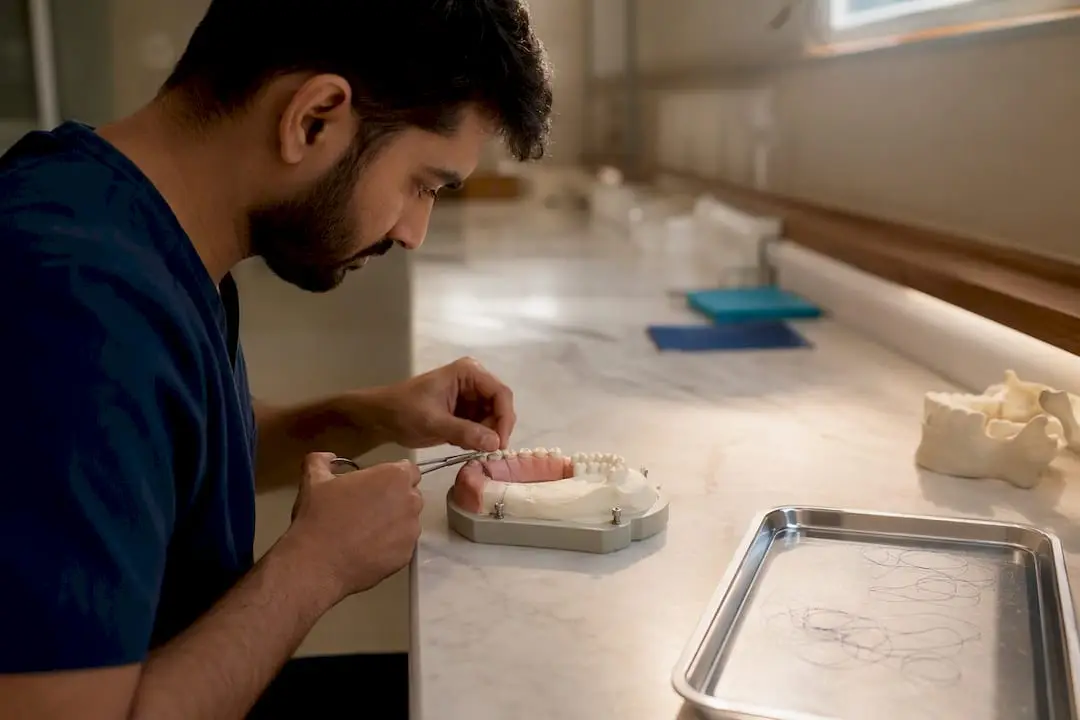
What simulation cannot do is replicate the tactile and psychological reality of operating on a person. A phantom head doesn’t bleed unpredictably, doesn’t report a sensory change, and doesn’t create the mild adrenaline response that shapes how you actually perform under real conditions. Research on self-perceived confidence in oral surgery found that confidence gaps close fastest when simulation is paired with observation and progressive live clinical exposure, not when simulation stands alone.
The practical sequence, then, is simulation first to build the motor pattern, followed by observation of live cases to see how that pattern holds up against real tissue variability, followed by supervised live practice to close the gap between the two. Skipping straight from simulation to independent practice is where most confidence collapses happen, because the clinician has the mechanics down but has never felt the difference between a phantom jaw and a real one.
How Much Does Peer Feedback Matter Compared to Mentor Feedback?
Mentor feedback carries the most weight because it comes from someone with more experience watching the exact moment you need correction. But peer feedback fills a different gap: it normalizes struggle.
Trainees learning alongside other trainees at a similar stage tend to talk more openly about specific failures, because the peer relationship carries less evaluative pressure than the mentor relationship does. A cohort where everyone admits their flap-raising confidence is shaky tends to produce clinicians who ask more questions and hide fewer mistakes than one where everyone performs confidence they don’t actually have.
That peer dynamic also creates a feedback loop mentors alone can’t replicate. A peer who just struggled with the same osteotomy step last week gives advice grounded in what actually helped them, not just theoretical correction. Programs that build cohort structure into their live-surgery training, rather than treating each trainee as an isolated case, tend to produce clinicians who report faster comfort with peer-reviewed complications and fewer solo blind spots once they’re in independent practice.
What Setbacks Should You Expect, and How Do You Push Through Them?
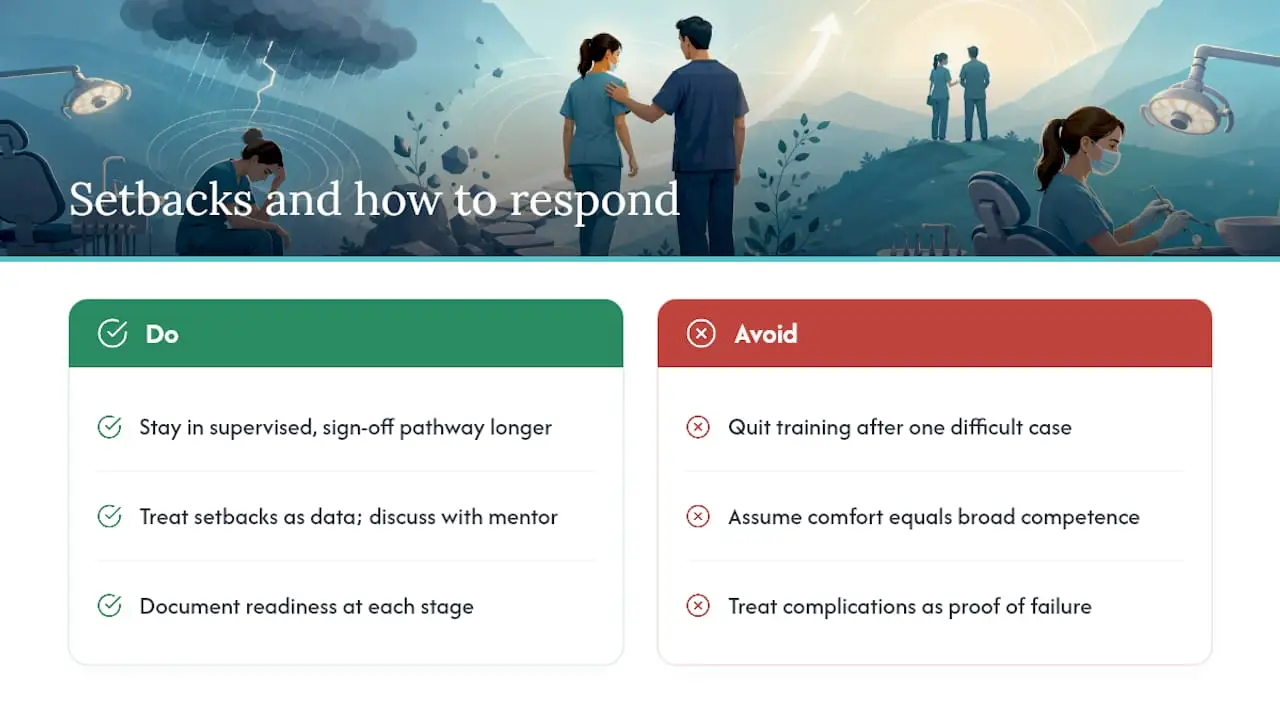
The most common pitfall isn’t a clinical mistake. It’s abandoning progressive training after one difficult case and either quitting the skill entirely or, worse, jumping straight to independent practice out of frustration with the pace of supervision.
A second common pitfall is confusing comfort with competence. A clinician who has done ten easy, straightforward implant cases under supervision can feel ready for independent practice, then encounter a complex ridge or a sinus lift and discover the confidence was case-specific, not skill-general. This is where a one-off weekend hands-on session tends to fail trainees: it builds confidence for the exact case type demonstrated, without the case variety that builds transferable judgment. A progressive, sign-off based pathway that documents readiness at each stage, rather than assuming a single successful case means broad competence, avoids this trap.
A third pitfall is treating a complication as a verdict on ability rather than as data. The clinicians who recover fastest from a perforated membrane or a failed osteotomy are the ones who go back to a mentor with the specific case details and ask what to adjust, rather than avoiding that procedure type going forward.
The fix for all three is the same: stay inside a structured, supervised pathway longer than impatience wants you to, and treat every setback as a data point a mentor can help you interpret, rather than as proof you chose the wrong specialty.
Why Mentorship Is the Better Bet, Even When It’s Slower
Committing to staged, mentored learning costs more time upfront than a weekend certificate course promises. That trade pays off. Clinicians who build skill progressively tend to accept more complex cases with less second-guessing, and patients notice the difference between a clinician who explains a procedure with real command and one reciting a script they half trust.
The honest case for mentorship isn’t that it eliminates anxiety. It’s that it gives anxiety somewhere useful to go: into preparation, into asking the right question before a case rather than during one. If you’re evaluating your own next step, find a mentor whose current caseload matches what you want to do, commit to the full progression rather than skipping stages, and let a mentor’s sign-off, not your own optimism, decide when you’re ready to go it alone.
— Jake
How One World Dental’s Mentorship Pathways Build That Confidence
Every checklist item in this guide — low student-to-instructor ratios, progressive supervised cases, mentors who still actively practice, transparent CE and consent standards — maps directly onto how such programs can be structured. Its tiered learning paths take you from foundational skills through live-patient mentorship, with sign-off at each stage instead of a single weekend certificate and a hope you retained it.
That structure matters more than the marketing language around it. You’re not choosing between “confidence” and “competence.” A mentorship-first program builds both together, because you never advance to the next case type until a mentor with current clinical experience confirms you’re ready. Programs like the hands-on implant training courses put you in the operator’s chair progressively, not as an afterthought to a lecture series.
If you’re ready to move past theoretical knowledge and into supervised, primary-operator experience, browse the full training course catalog and find the tier that matches where you are right now, not where a generic course assumes every dentist starts.
Recommended