Yes, dental continuing education is deductible for most self-employed dentists and practice owners when the CE maintains or improves skills used in your current practice, or when your license requires it. W-2 associate dentists generally cannot deduct unreimbursed CE on federal returns since 2018, which shifts the burden to employer reimbursement. Either way, save your receipts, agenda, and CE certificate, and confirm your specific situation with a CPA before filing.
Dental CE Tax Deduction Rules the IRS Actually Uses
The IRS runs every education expense through two tests, and dentists who understand them stop guessing at tax time. Under Topic 513, Work-Related Education Expenses, a course qualifies if it maintains or improves skills needed in your current work, or if your state board or employer requires it to keep your license active. A weekend hands-on implant course for a general dentist already placing implants generally qualifies under IRS rules.
The exclusion trips people up more than the qualification rule does. CE that qualifies you for a new trade or business, or that meets the minimum education needed to enter your field in the first place, is not deductible. An orthodontic residency that turns a general dentist into a licensed orthodontist falls into that excluded category, even though the coursework is directly related to dentistry. The distinction is about your current job title, not how closely the subject matter relates to teeth.
Required CE has an easier path. If your state dental board mandates a set number of CE hours for license renewal, courses that satisfy that requirement automatically support a business purpose, according to Publication 970. That said, “required” doesn’t erase the new trade exclusion. Meeting a licensing minimum for a specialty you don’t yet hold still counts as qualifying you for a new trade.
What Expenses Qualify and Where to Report Them
Once a course clears the IRS test, a wide list of related costs comes along with it. Tuition, registration fees, textbooks, required instruments or lab kits, and even exam fees tied to the course typically qualify, per Topic 513.
Travel adds another layer, and dentists often underclaim here. Deductible travel costs include:
- Airfare, train fare, or standard mileage for driving to the course
- Hotel or lodging for the nights the course requires
- 50% of meal costs during business travel
- Parking, tolls, and ground transportation like rideshares or rental cars
- Baggage fees and course-related shipping (models, equipment)
The catch is “primary purpose.” If your trip is mostly business with a day of sightseeing tacked on, the core travel costs still qualify, but you can’t deduct the extra hotel night or the excursion. If the trip is mostly personal with a course squeezed in, only the course-specific costs count.
Reporting differs by structure. Self-employed dentists and practice owners report CE costs on Schedule C as a business expense, while professional service corporations deduct them at the entity level.
W-2 Associates and the TCJA Problem
Associate dentists working as W-2 employees lost most of their CE deduction in 2018. The Tax Cuts and Jobs Act suspended miscellaneous itemized deductions subject to the 2% floor, which is exactly where unreimbursed employee CE, mileage, and travel used to live. That means a W-2 associate who pays for a $2,500 implant course out of pocket, with no employer reimbursement, generally cannot deduct it on a federal return, according to the IRS’s TCJA summary.
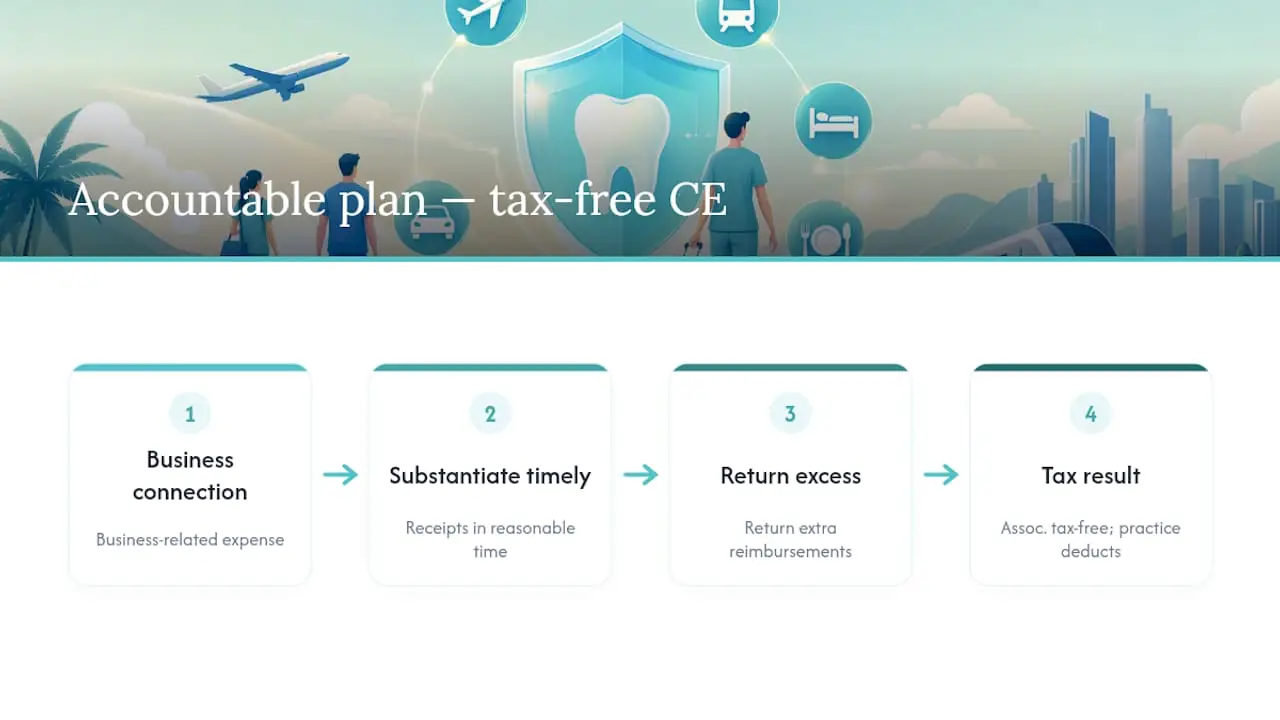
The practical fix is on the employer side. An accountable reimbursement plan lets a practice owner reimburse an associate’s CE and travel expenses tax free, as long as three conditions are met: the expense has a clear business connection, the associate substantiates it within a reasonable time, and any excess reimbursement gets returned. Structured this way, the practice deducts the cost and the associate never reports the reimbursement as income. It’s a better deal for both sides than a raw stipend, which is taxable wages.
A handful of states still allow employee business expense deductions on state returns even though the federal deduction disappeared. Coverage varies enough that it’s worth a direct question to a CPA licensed in your state rather than assuming either way.
Recordkeeping Checklist for Dental CE Deductions
Auditors don’t take your word for it, they want paper. Keep these on file for every CE expense you deduct:
- Course registration confirmation and itemized invoice
- The course agenda or syllabus showing subject matter and hours
- Your CE completion certificate
- Hotel and transportation receipts, itemized where possible
- A mileage log if you drove, tying the trip to the specific course date
For mixed trips, apportion by day. If you attended a two-day course during a five-day trip, only the CE-related lodging, meals, and a fair share of transportation are deductible, and you should note the split in your own records at the time, not months later when you’re reconstructing memory.
Pro Tip: Scan every receipt the same week you travel and file it in a folder named for the course, not the month. When your CPA asks for backup in April, “Implant Course March 2026” beats digging through a shared drive of unlabeled PDFs. Digital organization matters more than people think, and simple systems like the ones outlined in this guide to organizing receipts digitally can save hours at tax time.
Where Dentists Get CE Deductions Wrong
Three mistakes show up constantly in dental tax reviews. First, dentists treat specialty-qualifying training as ordinary CE when it actually crosses into “new trade” territory. Second, they skip the paperwork trail and try to reconstruct business purpose after the fact, which rarely survives scrutiny. Third, they deduct a full week of a mixed personal and business trip without splitting the costs.
A few quick scenarios show how this plays out:
- Self-employed dentist, implant CE weekend. Fully deductible: tuition, hotel, mileage, 50% of meals. The dentist already places implants, so the course maintains an existing skill.
- W-2 associate, national conference, no reimbursement. Not deductible federally under current rules. The associate should ask the practice to adopt an accountable plan going forward.
- Practice owner reimbursing three associates for the same course. Fully deductible to the practice as a business expense, and tax free to each associate, if structured as an accountable plan with proper substantiation.
Before you file, ask three questions: what was the primary purpose of the trip, do you have proof, and who actually paid.
Substantiating CE Expenses with Proper Course Documentation
Solid course paperwork does most of the substantiation work for you. Save the agenda, the CE hours listed, the completion certificate, the syllabus, and instructor credentials for every course you deduct. That paper trail shows an examiner exactly what the course covered and why it relates to your existing practice.
One World Dental issues course agendas and CE certificates as a standard part of enrollment, giving dentists a ready-made file for tax purposes rather than something to chase down later. This isn’t tax advice, and complex situations, especially anything touching specialty training or multi-state licensure, deserve a conversation with a CPA who knows dental practices.
Annual Caps and Phase-Outs on CE Deductions
There’s no fixed annual dollar cap on how many self-employed dentists can deduct for work-related CE. Unlike education tax credits, which phase out at specific income levels, the business deduction for CE has no income-based phase-out and no hard ceiling tied to a dollar figure. If a course genuinely maintains or improves your professional skills, the deduction scales with what you actually spent on tuition, travel, and materials.
That doesn’t mean there’s zero limit in practice. Deductions still have to be reasonable and ordinary for your business. A dentist who spends $40,000 on CE in a single year with modest practice revenue may draw more scrutiny, not because a cap exists, but because the ratio looks disproportionate. The IRS evaluates reasonableness in context, not against a published maximum.
Where caps genuinely apply is on the credit side, not the deduction side. Education tax credits like the Lifetime Learning Credit have income phase-outs described in Publication 970, but those credits are generally for degree or certificate programs, not the CE courses most practicing dentists take to stay current. Confusing the two categories is common. A CE weekend on grafting techniques is a business deduction question, not a credit-eligibility question, and the two follow completely different rules.
The 50% meals limitation is the one true built-in reduction that applies broadly. Every dollar spent on business meals during CE travel gets cut in half before it reaches your return, regardless of income level or course type.
Dental CE Courses That Typically Qualify
Hands-on surgical courses are the clearest fit for the “maintains or improves skills” test. A course like From Extraction to Implant: The Complete Surgical Workflow, priced at $795, walks a practicing dentist through techniques they’re already using in some form, which keeps it squarely inside the deductible category rather than the new-trade exclusion.
Lecture-based online series tend to qualify the same way, provided the subject matches your existing scope of practice. An introductory implant placement lecture series at $549 covering simple anterior and posterior cases fits a general dentist expanding surgical confidence within a skill set they already hold a license to perform.
Surgical technique courses, such as suturing for oral surgery and implant dentistry or a ridge preservation masterclass, sit in the same bucket. So do grafting materials courses covering biology, selection, and clinical handling. All of these refine skills within general or restorative dentistry rather than credentialing someone for a new specialty.
Where it gets murkier is orthodontic or specialty-track programs aimed at general dentists who don’t hold that specialty license. A weekend clear aligner course for treatment planning, like a multidisciplinary clear aligner case-planning program, usually still counts as skill improvement within general practice rather than a new trade, since general dentists routinely offer aligner therapy under their existing license. The line moves only when a course is explicitly a credentialing pathway into a licensed specialty you don’t currently hold.
Does CE Deduction Trigger AMT or Affect Other Credits?
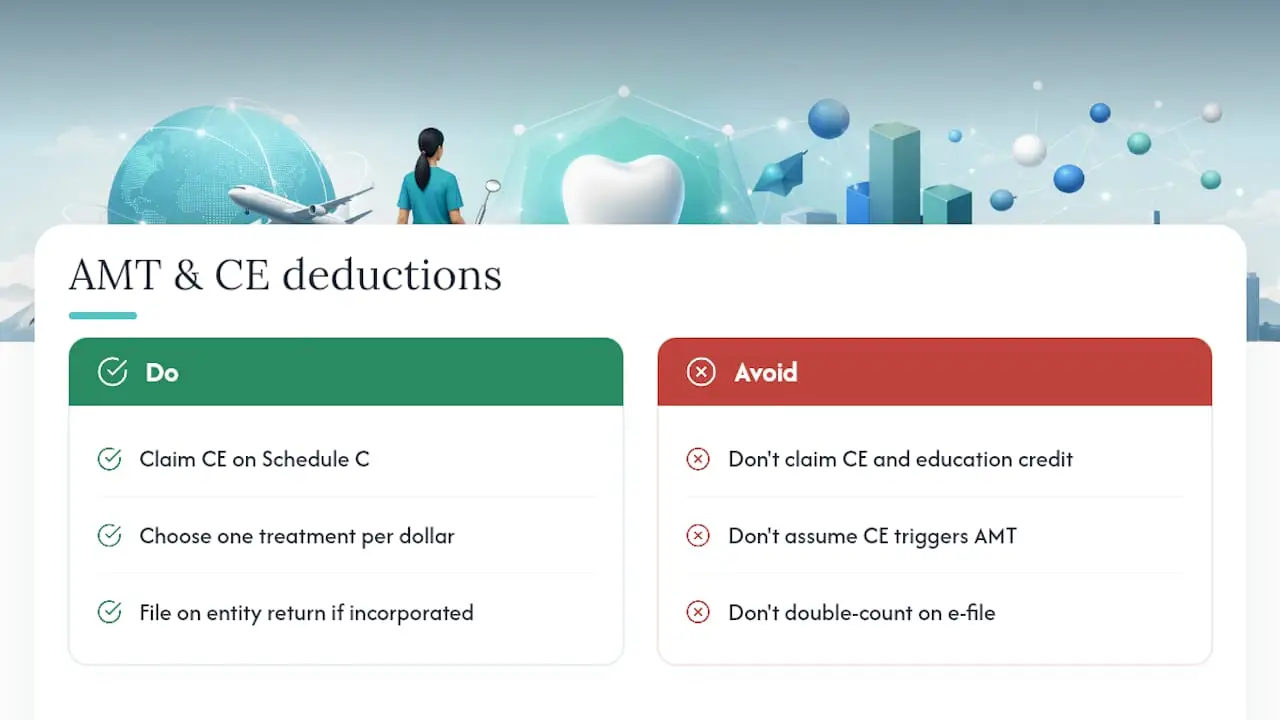
Business deductions for self-employed dentists, including CE costs claimed on Schedule C, reduce net business income before it ever reaches the individual tax calculation, so they don’t create Alternative Minimum Tax exposure the way miscellaneous itemized deductions once did. AMT primarily targets certain itemized deductions and preference items, and ordinary business expenses on Schedule C generally aren’t part of that adjustment.
This is actually good news for practice owners. Before the TCJA suspended miscellaneous itemized deductions, unreimbursed employee CE expenses were exactly the kind of itemized deduction that could get added back under AMT rules for high earners. Since that deduction category no longer exists federally for W-2 employees, the AMT interaction largely disappeared along with it.
Where CE deductions do interact with other tax benefits is on the credit side. Claiming a CE expense as a Schedule C business deduction and also claiming an education tax credit for the same expense isn’t allowed, since Publication 970 requires you to choose one treatment per dollar spent. In practice this rarely matters for practicing dentists, because education credits target degree-seeking students, not CE for licensed professionals maintaining existing skills. Most dentists never touch that overlap. The bigger planning consideration is simply making sure the deduction lands on the right form, Schedule C for a sole proprietor or the entity return for an incorporated practice, so it flows through cleanly without double counting or triggering a mismatch during e-file processing.
Your Next Steps on Dental CE Deductions
Start by classifying the course under the IRS tests: does it maintain existing skills or push you into a new trade? Then collect the syllabus, receipts, and a mileage log before tax season, not during it. If your situation involves a specialty gray area, multi-state licensing, or real audit exposure, that’s when a dental-focused CPA earns their fee.
— Jake
Get CE That Doubles as Your Tax Paperwork
Some continuing education providers offer courses with documented agendas, CE hours, and completion certificates that can support a tax deduction by providing necessary documentation for CPAs, rather than just attendance emails.
That matters more with hands-on surgical training, where course length, live components, and instructor credentials all support the business purpose behind the expense. Whether you’re building toward implant placement or refining a surgical workflow you already use, the training course catalog lists current offerings with pricing upfront. If implant and surgical CE is your focus this year, the implant and surgery course category is the fastest way to see what’s coming up and get registered before your next filing year starts.
Primary Sources for Dental CE Tax Rules
Recommended