ADA CDT codes are the standardized alphanumeric procedure codes (D####) used to report dental services and submit insurance claims. They are the federally designated standard under HIPAA Transactions & Code Sets, meaning incorrect code sets can delay reimbursement or trigger a HIPAA compliance issue. The 2026 CDT update brought new codes, revised descriptors, and deleted codes across several clinical categories. Your immediate next steps: update your practice management system (PMS) code lists, confirm payer acceptance and effective dates, and download the current ADA CDT files.
What are ADA CDT codes and how do they work?
CDT stands for Current Dental Terminology. The American Dental Association publishes the code set annually, and every code follows the same format: the letter D followed by four digits (D####). That structure is not arbitrary. The leading digits group codes into clinical categories, so anyone reading a claim knows at a glance what type of service was rendered.
The main categories and their D-code ranges:
- Diagnostic (D0100–D0999): exams, radiographs, diagnostic imaging, and tests
- Preventive (D1000–D1999): prophylaxis, fluoride, sealants, and space maintainers
- Restorative (D2000–D2999): fillings, crowns, and inlays
- Endodontics (D3000–D3999): root canal therapy and related procedures
- Periodontics (D4000–D4999): scaling, root planing, and surgical periodontal services
- Prosthodontics (D5000–D6999): removable and fixed prosthetics, implants
- Oral and Maxillofacial Surgery (D7000–D7999): extractions and surgical procedures
- Adjunctive General Services (D9000–D9999): anesthesia, behavior management, and miscellaneous
Under HIPAA, covered entities must use the current CDT version for all electronic dental claims. Using a prior-year code set is not just a billing inconvenience; it is a regulatory problem. Payers match submitted codes against the active descriptor set, so a code that was valid in 2024 but deleted in 2026 will reject outright.
Practically, CDT codes appear in four places: clinical charting, claims submission, prior authorization requests, and quality reporting. A simple example: D1110 (adult prophylaxis) is a preventive code used for a healthy patient with no active disease. D4910 (periodontal maintenance) applies after active periodontal therapy is complete. They are not interchangeable, and payers audit for exactly that distinction.
Who publishes CDT codes and decides what changes?
The American Dental Association owns and publishes the CDT code set. The body that actually governs changes is the Code Maintenance Committee (CMC), a standing committee with representatives from the ADA, dental specialty organizations, and payer representatives. That mix matters: specialty orgs advocate for clinical accuracy, and payer reps flag adjudication concerns before a code goes live.
The CMC follows an annual cycle. Change requests can be submitted by any stakeholder — a specialty society, a payer, a dental school, or an individual clinician. Requests go through a formal review process: the CMC evaluates clinical necessity, potential for misuse, and alignment with existing codes. Approved changes are published in the new CDT edition, which takes effect January 1 of the following year. The publication date and the effective date are not the same thing. The book typically releases in the fall, giving practices a window to update their systems before January 1.
One practical implication: if your specialty society is pushing for a new code or a descriptor clarification, the submission window closes well before the book publishes. Tracking CMC deadlines is worth building into your annual workflow. Assign someone in your practice to monitor ADA announcements in the third quarter each year, when CMC decisions are typically finalized.
What changed in the 2026 CDT update?
The 2026 CDT update brought changes across multiple clinical categories. The table below shows the high-level scope.
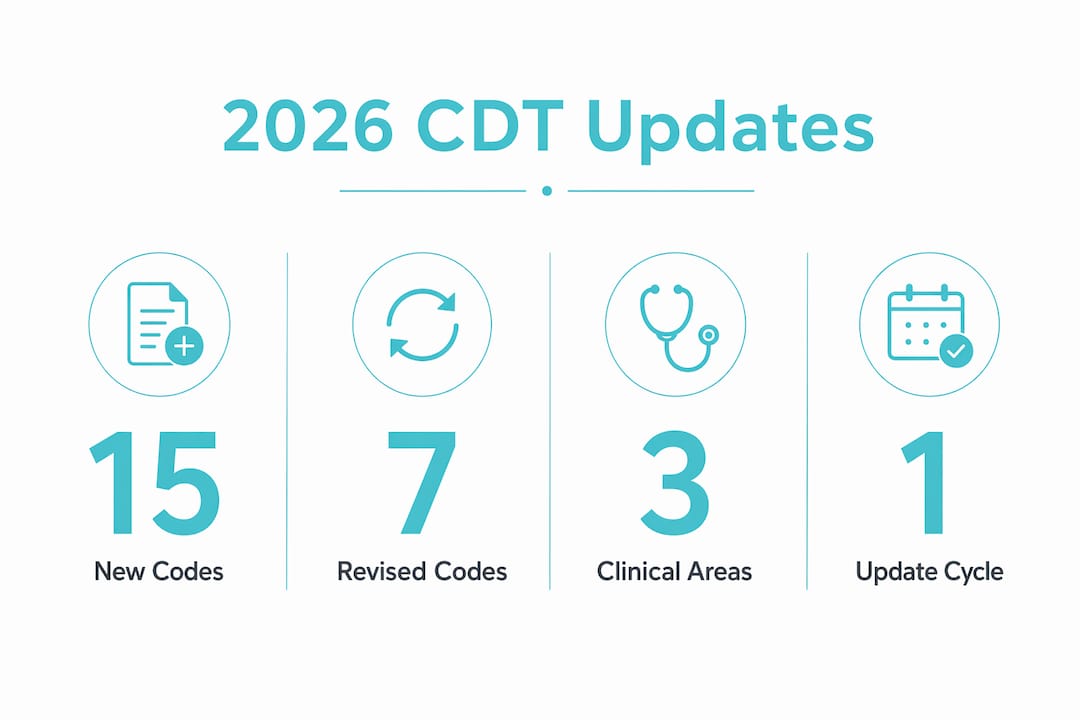
| Change Type |
2026 CDT |
| New codes |
Added across periodontics, implant services, and diagnostic categories |
| Revised codes |
Descriptor modifications in periodontics, preventive, and adjunctive services |
| Deleted codes |
Retired codes consolidated or replaced by updated equivalents |
Notable areas of impact for most practices:
- Periodontics: Descriptor revisions to existing SRP codes clarify clinical thresholds and documentation expectations. Practices that defaulted to prior-year language in narratives may see denials if the descriptor wording no longer matches.
- Implant services: New codes address procedures that were previously reported under catch-all adjunctive codes, giving billers more precise options and reducing the risk of bundling errors.
- Diagnostic and imaging: Additions in this category reflect evolving technology use, including codes for newer imaging modalities.
- Policy and descriptor changes: Some 2026 revisions are not new codes but modified descriptors. A word change in a descriptor can shift the clinical threshold for a service. Review every revised code your practice uses, not just the new ones.
Practical action steps after the 2026 update:
- Pull your top 20 most-billed codes and cross-reference each against the 2026 descriptor in the ADA CDT book.
- Update your PMS code library before January 1 and verify that fee schedules are mapped to the correct 2026 codes.
- Brief front-office staff on any deleted codes so they stop appearing on treatment plans.
- Confirm with your top two or three payers that they have adopted the 2026 CDT set and check their effective dates, since some payers lag by weeks.
Pro Tip: Descriptor tweaks are the most underestimated change in any CDT update. Annual CDT revisions can include small wording changes that materially shift how payers interpret a code. Track descriptor changes, not just code additions and deletions.
Where do you find official CDT code definitions?
The authoritative source for every CDT descriptor is the ADA. Start at ada.org/publications/cdt, where the ADA maintains the current CDT code set, reporting guides, and supplemental toolkits. The ADA also publishes a glossary of dental clinical terms and a glossary of dental administrative terms, both of which are useful when a descriptor uses terminology your team needs to interpret consistently.
For specific clinical guidance, the ADA publishes targeted reporting guides. The Guide to Reporting D4346 and the Guide to Reporting D4355 are free downloads that explain exactly when each code applies and what documentation payers expect. These guides are the closest thing to an official coding rulebook for those specific procedures.
CMC meeting minutes and rationale documents are available through ADA channels and give context for why a code was added, revised, or deleted. When a payer questions your coding rationale, citing the CMC’s stated intent is a legitimate and often persuasive appeal strategy.
For payer-specific rules, go directly to each payer’s provider portal. Delta Dental, for example, publishes annual CDT update summaries that flag which new codes they will and will not cover, and under what conditions. Checking these bulletins before January 1 prevents the first-quarter denial wave that hits practices that assume payer adoption is automatic.
Pro Tip: When submitting a prior authorization or an appeal, use the ADA’s exact descriptor wording verbatim in your narrative. Adjudicators match submitted language to the official descriptor, and paraphrasing creates gaps that reviewers flag.
D4341 vs D4342: the periodontal coding distinction that causes the most denials
This is the comparison that trips up more practices than any other in the periodontics category. Both D4341 and D4342 are scaling and root planing (SRP) codes, both require clinical evidence of active periodontal disease, and both are billed per quadrant. The difference is the tooth count per quadrant.

| Feature |
D4341 |
D4342 |
| Teeth per quadrant |
4 or more teeth |
1–3 teeth |
| Clinical indication |
Active periodontal disease |
Active periodontal disease |
| Nature of service |
Therapeutic (not preventive) |
Therapeutic (not preventive) |
| Typical reimbursement |
Reimbursement varies by complexity and time |
Reimbursement varies by complexity and time |
| Documentation required |
Perio chart, radiographs, narrative |
Perio chart, radiographs, narrative |
The decision is driven entirely by your periodontal charting, not by clinical judgment about severity. Count the qualifying teeth per quadrant from the chart. Four or more: D4341. One to three: D4342. A full-mouth SRP typically appears as four separate line items on the claim, one per quadrant, each with its own code designation based on that quadrant’s tooth count.
How do D4341 and D4342 differ from related codes? D4346 covers scaling in the presence of generalized moderate or severe gingival inflammation without bone loss, a distinct clinical picture from periodontitis. D4355 is full-mouth debridement to enable a comprehensive exam when heavy deposits obscure the clinical assessment; it is not a substitute for SRP and cannot typically be billed the same day as a comprehensive exam. D1110 is adult prophylaxis for a healthy patient. D4910 is periodontal maintenance after active therapy is complete.
A clinical documentation snippet that supports D4341 in quadrant 1:
“Quadrant 1: Teeth #2, #3, #4, #5 present. Probing depths 5–7mm with bleeding on probing at #2 (MB, DB), #3 (MB, B, DB), #4 (MB, DB), #5 (B). Clinical attachment loss noted. Radiographic bone loss confirmed. Active periodontitis present. SRP performed with local anesthesia. D4341 reported.”
That level of specificity — tooth numbers, pocket depths, bleeding sites, radiographic confirmation — is what separates a paid claim from a denied one.
Pro Tip: Defaulting to D4341 for generalized disease without counting qualifying teeth per quadrant is one of the most audited coding errors in periodontics. Let the chart drive the code, every time.
Billing and documentation best practices for CDT-based claims
A clean claim starts before the patient leaves the chair. Pre-claim checklist:
- Confirm you are using the 2026 CDT code set (not a prior-year version in your PMS)
- Verify patient benefits and any frequency limitations before the appointment
- Obtain prior authorization when required — some payers require pre-auth for SRP, and reimbursement for D4341 varies by region and payer, so confirm contract terms
- Attach current periapical or bitewing radiographs that show the affected area
- Include the full periodontal chart with pocket depths, bleeding on probing, and clinical attachment loss
- Write a concise narrative that maps tooth numbers and pocket depths to the code billed and the quadrant designation
Common denial reasons and how to address them:
- Wrong code version: Your PMS submitted a deleted or prior-year code. Fix: audit your code library every January.
- Insufficient documentation: Missing perio chart or radiographs. Fix: make chart attachment a non-negotiable step in your billing workflow.
- Upcoding flag: D4341 submitted when tooth count supports D4342. Fix: chart-driven coding, every quadrant, every time.
- Bundling errors: D4355 billed same-day as a comprehensive exam. Fix: review ADA’s D4355 guide for same-day billing rules.
- Frequency limit exceeded: Carrier applies a per-quadrant frequency limit (some carriers set this at once every 24–36 months). Fix: include treatment history and dates in prior authorization requests to preempt frequency-based denials.
For appeals, tooth-level mapping is more persuasive than general statements. Write: “Tooth #14: 6mm pocket, bleeding on probing, clinical attachment loss of 3mm. Radiograph attached shows alveolar bone loss.” Attach the corresponding radiograph and reference the ADA descriptor verbatim. That combination addresses the three things a payer reviewer checks: clinical necessity, code accuracy, and documentation completeness.
Pro Tip: When preparing a prior authorization for SRP, include the patient’s full periodontal history and prior treatment dates. Some carriers apply frequency limits per quadrant rather than per patient, and a missing treatment date is the fastest route to a frequency-based denial.
How do you stay current with CDT changes year over year?
A five-step plan that keeps your practice compliant without scrambling every January:
- Assign a coding lead. One person owns CDT updates — a billing specialist, office manager, or lead hygienist. Diffuse responsibility means nobody catches the change until a denial arrives.
- Subscribe to ADA and CMC notices. The ADA distributes update announcements through its member communications and the CDT publication page. Set a calendar reminder for Q3, when CMC decisions are typically finalized.
- Integrate updates into your PMS before January 1. Schedule a code-library audit in November or December. Cross-reference your top-billed codes against the new CDT edition and update fee schedules simultaneously.
- Update office protocols. Some code changes require clinical protocol updates (a new code for a procedure your practice now performs differently); others are purely front-office billing changes (a descriptor tweak with no clinical impact). Triage each change accordingly.
- Schedule annual staff training. Front-office staff need to know deleted codes and new ones. Clinical staff need to understand descriptor changes that affect documentation. A 30-minute annual update session prevents months of denials.
Quarterly payer checks are worth building in separately. Payers sometimes issue mid-year policy updates that affect coverage criteria, prior-auth requirements, or bundling rules. A quarterly review of your top three payers’ provider bulletins catches those changes before they hit your revenue.
Why continuing education reduces CDT coding errors
Better clinical assessment produces more defensible claims. A hygienist who can accurately classify periodontal disease stages and grades will chart with the specificity that supports D4341 or D4342 correctly. A dentist who understands the clinical threshold for D4346 versus D4341 will not default to the wrong code because the distinction was never taught explicitly. The link between CE and coding accuracy is direct, not theoretical.
What to look for in CE that actually moves the needle on billing outcomes:
- Case-based charting drills: Modules that present real periodontal charts and ask you to select and justify the correct code build the habit of chart-driven coding.
- Payer-facing documentation templates: Pre-built narrative templates that match ADA descriptor language reduce the time it takes to write a compliant claim narrative.
- Live Q&A with billing experts: Real-time answers to practice-specific questions are more useful than recorded lectures for resolving edge cases.
- Coding modules tied to clinical procedures: CE that covers implant placement, socket preservation, or periodontal surgery alongside the corresponding CDT codes (see ADA CDT billing for socket preservation) gives clinicians the full picture.
Onewd maps its continuing education directly to clinical and billing outcomes. Courses cover the procedures most likely to generate coding questions — implants, periodontal surgery, and cosmetic dentistry — with documentation guidance built into the clinical content. For practices looking to reduce denials and improve reimbursement on complex procedures, that integration between clinical training and coding accuracy is where CE pays for itself. Explore online CE pathways to find modules that fit your team’s specific gaps.
Key Takeaways
CDT codes are HIPAA-mandated, annually updated, and chart-driven — practices that treat them as static billing shortcuts face denials, audits, and lost revenue.
| Point |
Details |
| CDT codes are HIPAA-required |
Using the wrong year’s code set on electronic claims is a regulatory violation, not just a billing error. |
| D4341 vs D4342 is chart-driven |
Count qualifying teeth per quadrant from your perio chart; never default to one code for all SRP. |
| Descriptor changes matter most |
Annual CDT updates often include small wording changes that shift payer interpretation — track revisions, not just new codes. |
| Pre-claim documentation prevents denials |
Attach perio charts, radiographs, and a tooth-level narrative before submitting any periodontal claim. |
| Onewd CE ties clinical training to coding |
Onewd’s courses cover complex procedures alongside documentation practices that reduce denials and support accurate CDT use. |
Why correct CDT coding is a revenue and patient care issue
Coding accuracy is not a back-office administrative detail. When a practice consistently miscodes periodontal services, it either leaves money on the table (undercoding) or exposes itself to audit and recoupment demands (upcoding). Both outcomes affect patient care: underpaid practices cut corners on time and materials; audited practices spend months in administrative recovery instead of treating patients.
The single most useful structural change a practice can make is assigning a coding lead who owns the annual CDT update process, monitors payer bulletins quarterly, and runs a brief staff training each January. That one decision prevents the reactive scramble that follows a denial spike. Pair that with annual CDT update training — the kind that uses real charts and real claim scenarios — and most of the common errors documented in this article become preventable.
Sharpen your team’s coding accuracy with Onewd
Coding errors are almost always a training gap, not a carelessness problem. Onewd’s continuing education platform gives dental professionals the clinical depth and documentation skills to code correctly the first time. Courses cover implant services, periodontal surgery, and cosmetic dentistry with case-based modules that include documentation templates matched to ADA descriptor language.
For practices that want to close the gap between clinical skill and billing accuracy, Onewd offers both online and live formats, so your team can train without shutting down the schedule. Courses include practical charting exercises and payer-facing narrative templates that translate directly into fewer denials on complex claims. Browse the full training course catalog or start with the 2026 online CE guide to find the modules that match your team’s specific coding gaps.
Useful sources
These are the primary sources to verify CDT descriptors, CMC rationale, and payer-specific guidance before submitting claims or preparing appeals.
- ADA CDT Code Set — ada.org/publications/cdt: The official home of the current CDT edition, reporting guides, and supplemental toolkits. Start here for any descriptor question.
- ADA CDT Topic Page — ada.org/topic/cdt: Overview of CDT resources, including links to the glossary of dental clinical and administrative terms.
- ADA CDT Books and More — ada.org/publications/ada-store-products/cdt-books-and-more: Where to purchase the current CDT edition and supplemental coding resources.
- 2026 CDT Coding Updates — AAE: The American Association of Endodontists’ summary of 2026 CDT changes, useful for specialty-specific context and cross-referencing update scope.
- ADA Foundation — adafoundation.org: Background on ADA’s broader standards and education initiatives.
- Payer bulletins (Delta Dental and others): Check your payers’ provider portals directly for annual CDT adoption notices, effective dates, and coverage policy changes. Never assume a new code is covered until the payer confirms it.
When citing these sources in an appeal, reference the specific ADA descriptor and, where applicable, the CMC rationale for the code. Payer reviewers respond to official language; a citation to the ADA reporting guide carries more weight than a general billing reference.
Recommended