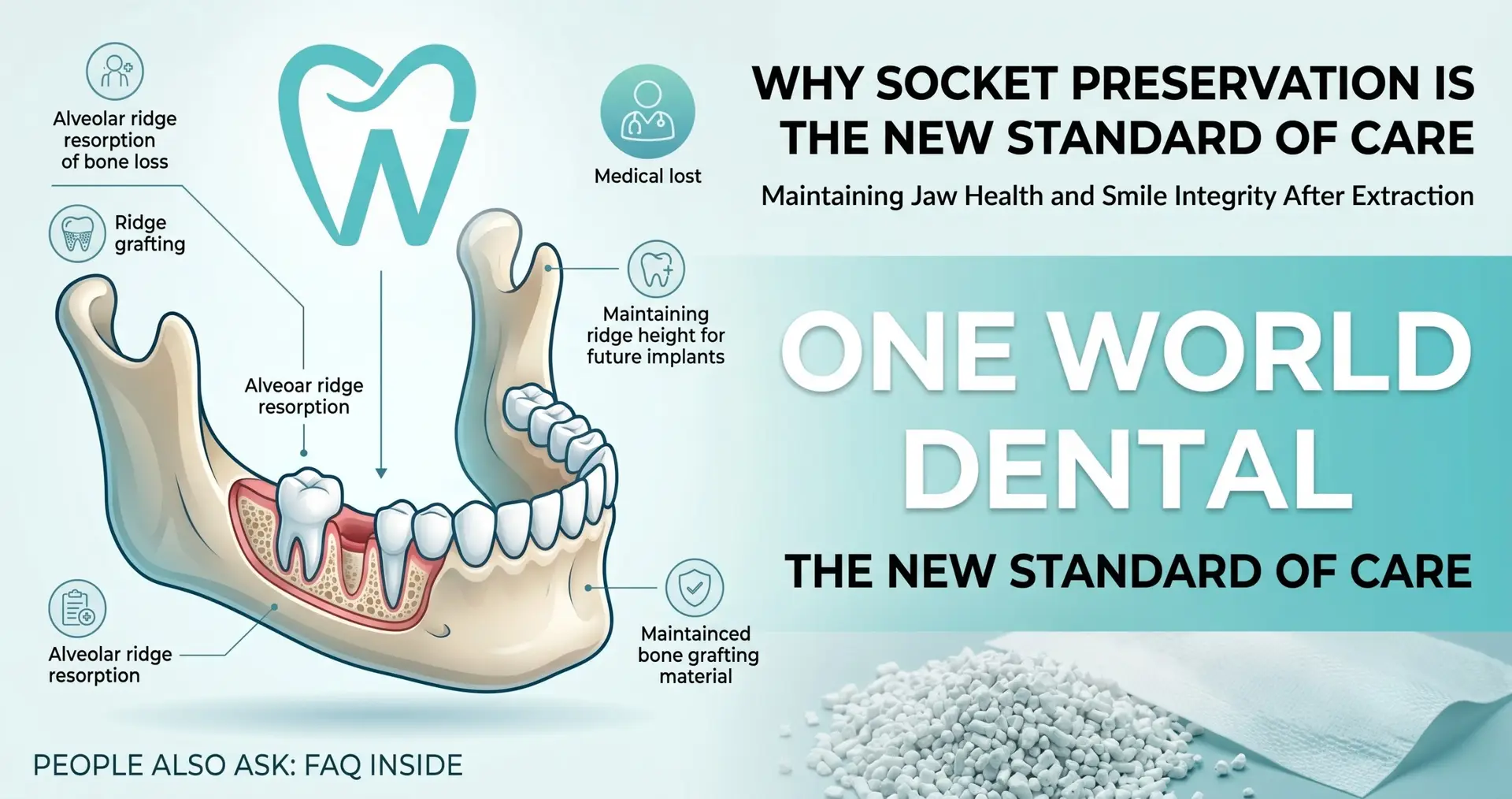
In modern implant dentistry, a successful outcome requires a perfect marriage of clinical excellence and airtight administrative workflow. While performing an atraumatic extraction and placing a bone graft is a clinical mandate to prevent up to 50% ridge width loss in the first year, securing proper reimbursement for it can be an administrative challenge.
At One World Dental, our advanced surgical and practice management modules bridge this gap. We train clinicians not only on the hand skills required for predictable ridge preservation but also on the strict coding and narrative protocols necessary to maximize legitimate insurance reimbursement and optimize practice compliance.
Below is a comprehensive guide to navigating ADA CDT codes, diagnostic requirements, and cross-billing strategies for alveolar ridge preservation.
The Clinical and Biological Prerequisite
To successfully defend a claim for socket preservation, your clinical notes must reflect a deep understanding of the biological mandate. The moment a root is extracted, the bundle bone resorbs. Meta-analyses demonstrate that natural healing alone frequently results in severe horizontal and vertical collapse of the alveolar housing.
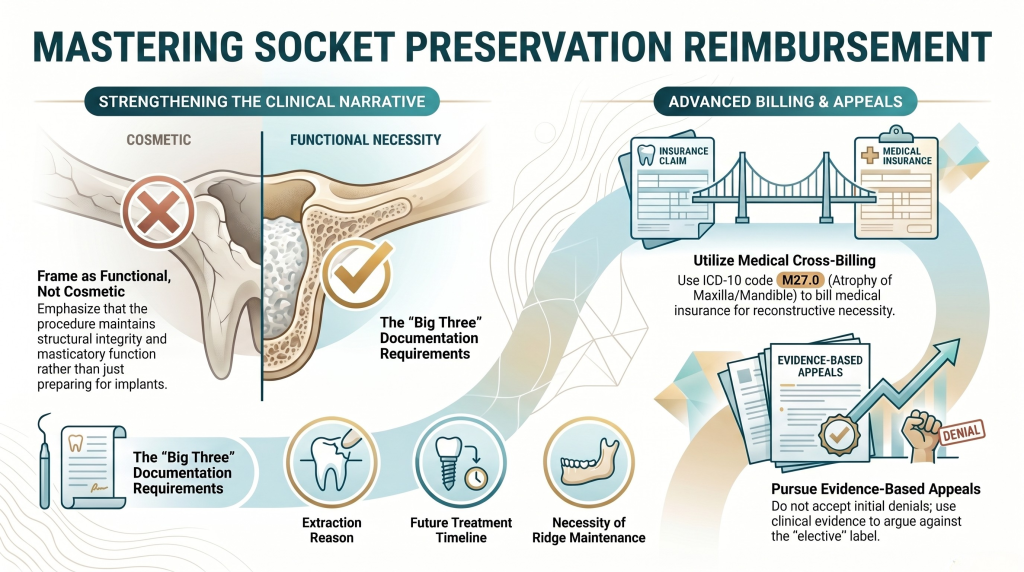
When documenting the case, the clinician must explicitly state why doing nothing puts the patient at risk. Whether managing a thin bone biotype or operating in the aesthetic zone, preserving the “envelope” of the socket must be framed as a functional necessity to maintain the structural integrity of the dental arch for future restorative success.
Primary ADA CDT Codes for Alveolar Ridge Preservation
Accurate coding is the foundation of PPO compliance. In our training programs, we emphasize the specific differentiation between these core codes:
D7953: Bone Graft for Ridge Preservation
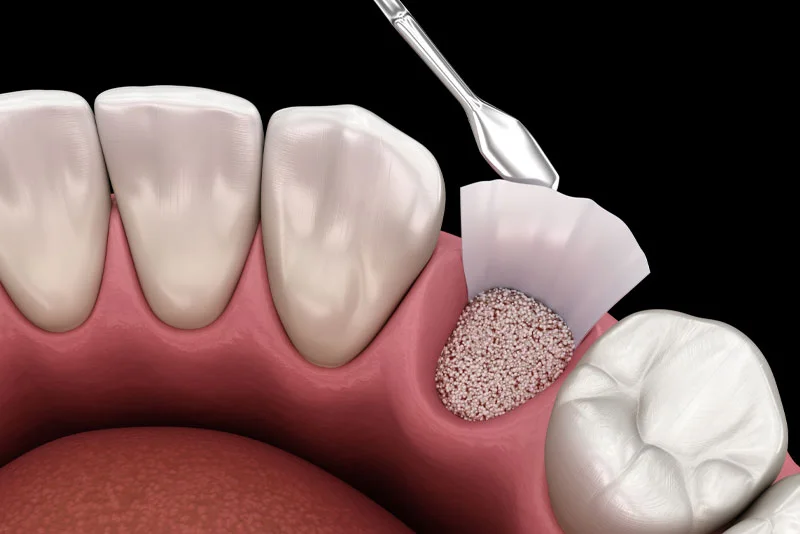
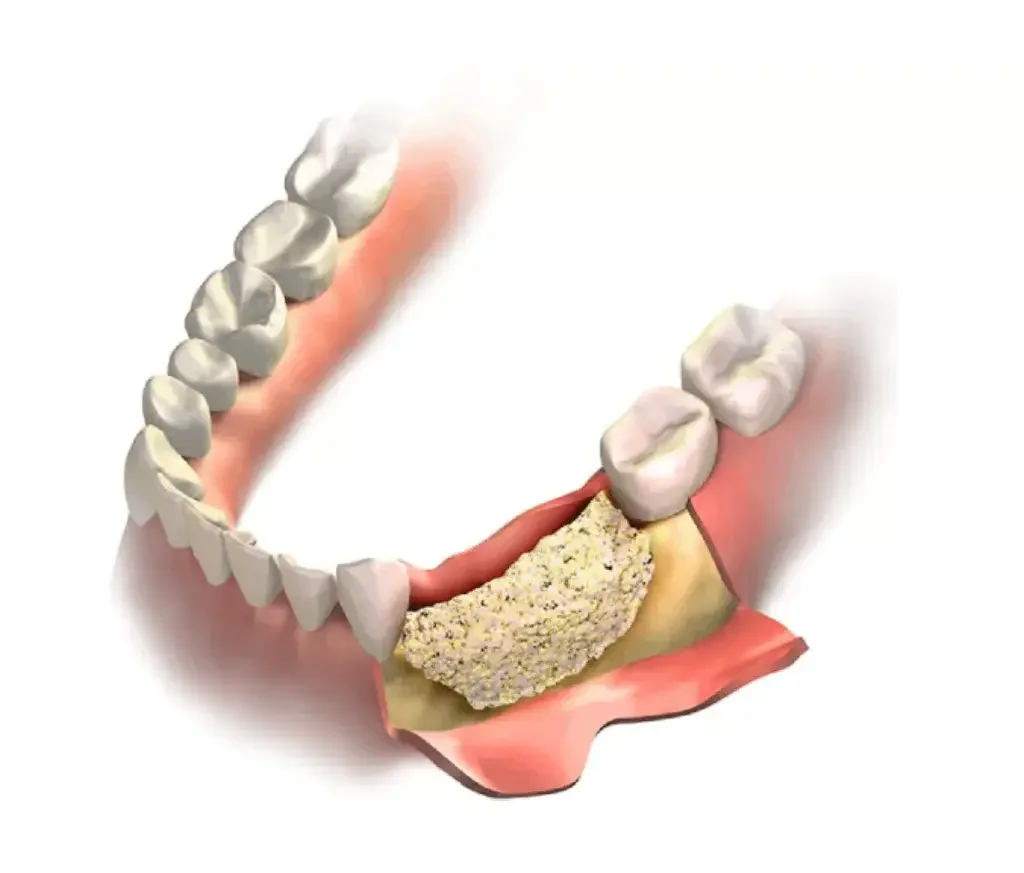
This is your primary code. It covers the placement of bone grafting material into an extraction site to preserve the ridge dimensions for future implant or reconstructive surgery.
Clinical Note: This is a “per site” code. It is entirely distinct from, and should not be bundled with, general bone grafting codes used during immediate implant placement or ridge augmentation (such as D7950).
D4266 vs. D4267: Guided Tissue Regeneration (Membranes)
When a barrier membrane is utilized to contain the particulate graft and prevent epithelial downgrowth, it must be coded based on the material used:
D4266 (Resorbable Membrane): Used for collagen membranes, amniotic membranes, or other materials that resorb naturally.
D4267 (Non-Resorbable Membrane): Used when placing dPTFE or titanium-reinforced membranes that require subsequent surgical removal.
D7140 & D7210: Extraction Coding
You cannot bill for a socket preservation site without the accompanying extraction code. Ensure your clinical documentation clearly justifies the choice between D7140 (simple, non-surgical delivery) and D7210 (surgical extraction requiring a flap, bone removal, and/or tooth sectioning).
D0350 & D0367: Diagnostic and Pre-Surgical Imaging
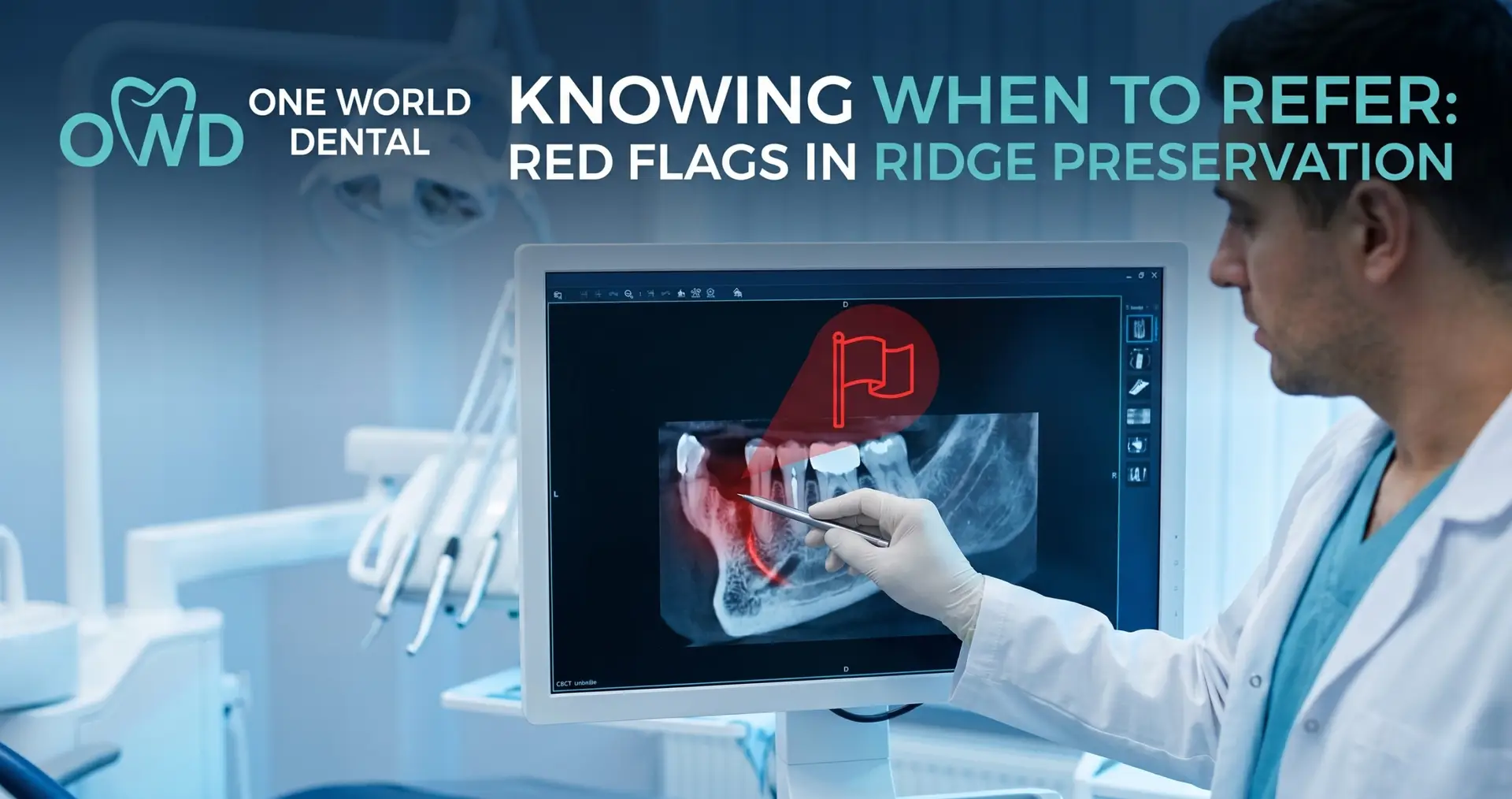
To establish objective proof of medical necessity, your administrative team must submit high-quality imaging. Use D0350 for 2D diagnostic clinical photographs or D0367 for a Cone Beam CT (CBCT). CBCT mapping allows you to precisely measure existing cortical plate thickness and provide undeniable “before” evidence to the insurance carrier.
e scans allow the team at One World Dental to measure existing bone density and height accurately, providing the “before” evidence needed for claim approval.
Navigating Insurance Reimbursement Challenges
The most common hurdle practices face is the insurance carrier labeling socket preservation as “cosmetic” or “elective” because it precedes an implant. We teach practices how to counter this with three key strategies:
Airtight Narrative Frameworks
Never leave a claim narrative blank or generalized. A bulletproof narrative for D7953 should always include:
The specific condition of the alveolar walls upon extraction (e.g., “severe loss of buccal plate”).
The planned functional restorative path (e.g., “to maintain ridge dimensions for masticatory function via implant-supported prosthesis”).
Medical Cross-Billing (ICD-10 Coding)
Many dental offices leave substantial revenue on the table by ignoring the patient’s medical insurance. When an extraction site exhibits advanced bone loss that threatens the jaw structure, the procedure can often be cross-billed to medical insurance as a reconstructive necessity.
Key Code: Use ICD-10 code M27.0 (Atrophy of the Mandible or Maxilla) to demonstrate that the graft is being performed to stop pathologic tissue degradation.
An Evidence-Based Appeals Process
If a claim is unjustly denied, your team should be equipped with a standardized appeal template. This package should include your pre-op CBCT or periapical radiographs, a copy of the surgical note explicitly highlighting the risk of pathologic resorption, and citations of peer-reviewed literature proving the efficacy of ridge preservation over natural healing. a denial by proving that the graft prevents more costly reconstructive surgeries later.
Clinical Classification and Case Selection Systems
To align your billing with your clinical workflow, we train doctors to utilize the Elian Classification of Extraction Sockets:
Type 1 Sockets: Buccal bone and soft tissue are completely intact.
Type 2 Sockets: Soft tissue is present, but the buccal bone plate is partially or fully missing.
Type 3 Sockets: Both soft tissue and buccal bone are severely compromised.
By standardizing this classification in your clinical chart notes, it becomes instantly clear to both your auditing team and the insurance processor why specific membranes (D4266/D4267) or advanced techniques like Immediate Dentoalveolar Restoration (IDR) were required to reconstruct the site.
Practice Management: Case Presentation and Patient Financing
Even with optimized insurance strategies, socket preservation will frequently involve out-of-pocket costs for the patient. A major component of our practice growth training focuses on teaching your treatment coordinators how to present this investment:
The Foundation Analogy: Train your staff to move away from technical jargon. Patients understand the concept that “you cannot build a house on a shifting foundation.” Framing the bone graft as the foundational infrastructure for their future smile drastically increases case acceptance.
Integrating Modern Financing Systems: To remove financial friction, practices should implement modern, non-recourse patient financing solutions that offer low monthly payments with no hard credit checks. Offering these integrated financial pathways ensures that patients do not decline necessary bone grafting simply due to upfront cost boundaries.
Compliance and Avoiding Audit Pitfalls: Bundling vs. Unbundling
One of the quickest ways to trigger a PPO insurance audit is “unbundling”—the non-compliant practice of fragmenting a single procedure into multiple codes to inflate the payout.
For example, you cannot bill separately for the bone graft code (D7953) and a separate code for the “graft particulate material.” The code D7953 is legally inclusive of the material used to fill the socket. At One World Dental, we teach strict adherence to ADA compliance guidelines to protect your practice, your license, and your bottom line from retrospective audits.
Transforming Clinical Excellence into Practice Success
Clinical proficiency in socket preservation only moves the needle if your administrative team knows how to predictably code and bill for it. To build a thriving, implant-focused practice, your financial workflows must match the precision of your surgical skills.
At One World Dental, our specialized practice optimization modules teach you and your team how to eliminate coding errors, minimize claim denials, and confidently present treatment plans that patients say yes to. Stop leaving hard-earned revenue on the table and start maximizing your chairside production.
Bridge the gap between clinical mastery and practice profitability, explore our upcoming courses today.
FAQ: People Also Ask
Can I bill D7953 if I am placing an immediate implant into the same socket on the same day?
No. Code D7953 explicitly defines the procedure as preserving the ridge for future implant or restorative surgery. If you are placing an implant immediately and grafting the remaining gap or “jumping distance” between the implant body and the socket wall, you should instead look to code D6105 (Bone graft at time of implant placement) or D7950 depending on the extent of the ridge augmentation required.
What should I do if a PPO insurance plan bundles D7953 directly into the extraction code (D7140/D7210)?
This is a common optimization tactic used by insurance adjusters. If a carrier states that the graft is “inclusive” of the extraction, review your provider contract. In many cases, if it is a non-covered service under that specific patient’s policy, you are legally permitted to bill the patient your standard out-of-pocket fee for the ridge preservation, provided you had them sign a clear, upfront financial disclosure form prior to the surgery.
Do I need to document the specific type of bone graft material used in my clinical chart?
Absolutely. For clinical excellence, safety tracking, and legal compliance, your surgical chart notes must record the exact biomaterial used (e.g., mineralized cortical/cancellous allograft, bovine xenograft), the manufacturer, the exact volume (e.g., 0.5cc), the lot number, and the expiration date. Failing to document these metrics can result in immediate claim denials during a retrospective insurance audit.
Can I bill code D4266 (Resorbable Membrane) if I only used a PRF (Platelet-Rich Fibrin) plug to cover the graft?
No. While PRF is an incredible autologous biologic that functions beautifully as a matrix and accelerates soft tissue healing, insurance carriers generally do not recognize a standard PRF plug as a distinct guided tissue regeneration membrane under code D4266. If you are utilizing PRF, it should be accurately documented in your clinical narrative, and if applicable, billed under specific biologic/autologous tracking codes, or factored into your total surgical fee structure.
What are the fundamental requirements when attempting to cross-bill socket preservation to a patient’s medical insurance?
Cross-billing requires transitioning from the standard dental claim form to a CMS-1500 form. You must translate your dental codes into medical CPT codes and couple them with a primary diagnostic ICD-10 code that establishes medical necessity. For instance, using ICD-10 code M27.0 (Atrophy of the maxilla or mandible) helps prove the graft is being utilized to stop a pathologic, progressive bone wasting process, rather than acting as a purely cosmetic precursor to an implant.
Can D7953 be billed multiple times if I am performing socket preservation on a multi-rooted tooth or adjacent sites?
Code D7953 is strictly billed per site (per tooth), not per root. If you are extracting a complex, three-rooted upper molar, you may only bill D7953 once for that individual socket. However, if you are performing extractions and socket preservation on multiple adjacent teeth (e.g., teeth #4 and #5), you can bill D7953 for each distinct tooth number. Your documentation must clearly break down each site as a separate line item to prevent automated multi-site bundling denials.
Educational disclaimer: Coding and reimbursement information changes frequently. Verify current codes and payer policies with the ADA, the relevant payer and your own advisors before submitting claims.