What changed in ADA CDT 2026?
The 2026 CDT code set brings 31 new codes, 14 revisions, 6 deletions, and 9 editorial changes, all effective January 1, 2026. Every dental claim for services performed in 2026 must use these updated codes to meet HIPAA requirements. That is not a suggestion. Payers match the service date to the correct code year, and mismatches trigger automatic rejections.
Here is the fast summary of what the ADA CDT 2026 updates cover:
- Numerous new procedure codes spanning diagnostics, implant services, sedation, and prosthodontics
- Several revised codes with updated descriptors affecting resin-based composites, anesthesia, and denture procedures
- Multiple deleted codes including some preventive resin restoration and sedation codes
- Various editorial changes for clarity and nomenclature consistency
- Procedure areas most affected: implant services, sedation and anesthesia, diagnostic testing, and removable prosthodontics
- Official resources: the ADA CDT 2026 book and companion app, available through the ADA
Breaking down the new, revised, and deleted codes
New codes worth knowing
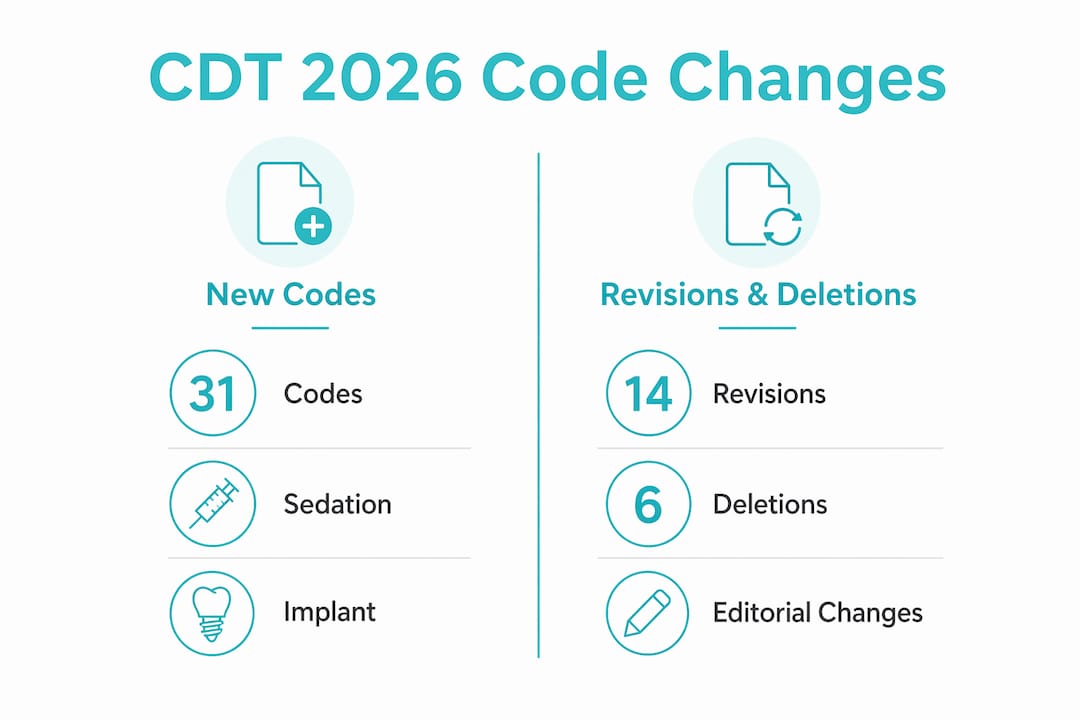
The 31 new CDT codes cover ground that many practices were already documenting without a precise code. D0426 captures point-of-care saliva testing, and D0461 covers cracked tooth testing. Both reflect clinical work that was previously underreported or bundled into broader evaluation codes.
Implant services received several targeted additions. D6049 addresses non-surgical single implant debridement for peri-implantitis, and D6280 covers maintenance for full-arch removable implant dentures per arch. D6196 handles removal of an indirect restoration on an implant-retained abutment. These codes give practices cleaner documentation paths for implant maintenance visits that previously required workarounds.
Sedation coding expanded significantly. New codes D9244 and D9245 cover enteral minimal and moderate sedation respectively, while D9246 and D9247 address non-intravenous parenteral moderate sedation in 15-minute increments. General anesthesia with advanced airway now has its own time-based codes: D9224 for the first 15-minute increment and D9225 for each subsequent one.

Photobiomodulation therapy is now distinctly reportable through D9128 and D9129, and D9936 covers cleaning and inspection of an occlusal guard per appliance.
Revisions that change documentation
The revised codes include some that directly affect how you get paid. D2391 (resin-based composite, one surface posterior) had its descriptor language restricting application to dentin-penetrating restorations removed. That change is intentional: it ties directly to deletion of another preventive resin restoration code and broadens when D2391 applies. D9230 (nitrous oxide) now has a clarified descriptor for reporting when nitrous is delivered as a single agent.
Deleted codes you must stop using
D9248 was deleted because it was not discrete enough. It covered different documented depths of sedation with different monitoring and staffing requirements. The Code Maintenance Committee replaced it with specific codes that distinguish route of administration and sedation depth. Using D9248 on a 2026 claim date will get that claim rejected.
D1352 (preventive resin restoration, permanent tooth) was removed due to overlap with the revised D2391. The four COVID-19 vaccine administration codes (D1705, D1706, D1707, D1712) were deleted because those vaccines are no longer manufactured or supplied.
How to access and use the ADA CDT 2026 resources
The ADA CDT 2026 book and app are the authoritative sources for the complete code set. The book is available through adacatalog.org or by calling the ADA at 800.947.4746. The companion app gives you on-the-go access to full code descriptors, which matters more than ever given how many 2026 changes hinge on descriptor wording rather than just code numbers.
- Order the CDT 2026 book and app before January 1 to avoid a gap in your billing workflow
- Update your practice management software’s code library as soon as the new year starts
- Remove deleted codes from templates and fee schedule entries immediately
- Distribute the ADA’s code changes summary to your billing team and front desk staff
- Audit early claims of the year to catch any old-code habits early
Pro Tip: The app’s full descriptor view is where the real value lives. Short code names on claim forms often omit the language that determines whether a payer accepts or questions a claim. Train your team to read the full descriptor, not just the code number.
Dental professionals who want to stay current on coding changes alongside their clinical skills can explore online webinar formats that fit around a busy practice schedule.
How CDT codes affect your billing and reimbursement
CDT codes standardize procedure reporting, but they do not guarantee payment. Coverage depends on each payer’s plan contracts and policies. A new code in CDT 2026 does not automatically mean your payer covers it. That distinction trips up practices every year.
Claims using outdated codes for 2026 service dates are routinely rejected. The five most common mistakes are using old or deleted codes, submitting weak clinical notes, missing required attachments, selecting the wrong code, and ignoring payer-specific rules. Each one is avoidable with a consistent pre-submission review.
The most reliable workflow is a four-part check before any claim leaves the office: verify the code year matches the service date, read the full CDT descriptor, confirm the clinical note supports the billed service, and review the payer’s specific requirements. Practices that skip step four often discover that one plan requires a photo while another requires perio charting for the same code.
Pro Tip: Separate your clinical documentation from your billing submission. The chart note should tell the clinical story completely. The claim should then reflect that story through the correct code, attachments, and payer-specific formatting. When those two documents align, denials drop.
Dental assistants and hygienists involved in billing should also understand how their role affects coding accuracy. Compensation benchmarks for these roles, including dental hygienist salary data, reflect the growing expectation that clinical staff contribute to documentation quality.
Onewd continuing education for CDT 2026 mastery
Coding accuracy and clinical confidence go together. Onewd offers training courses built for dental professionals who want both, with live, online, and on-demand formats covering implants, surgical procedures, and the documentation skills that support clean claims.
Courses range from foundational to advanced, with CE credits, mentorship, and live patient modules. For practices navigating the sedation and implant coding changes in CDT 2026, Onewd’s hands-on curriculum connects the clinical work to the documentation it requires. Visit onewd.org to see upcoming and on-demand options.
Key Takeaways
The ADA CDT 2026 update includes numerous new codes, revisions, and deletions effective January 1, 2026, with the largest operational impact in sedation, implants, and diagnostics.
| Point |
Details |
| Effective date |
All 2026 service dates require CDT 2026 codes to meet HIPAA requirements. |
| Sedation overhaul |
D9248 was deleted and replaced by multiple codes distinguishing depth, route, and time increments. |
| New implant codes |
D6049, D6280, and D6196 give practices precise reporting options for implant maintenance and debridement. |
| Billing risk |
Using deleted or prior-year codes on 2026 claims triggers automatic payer rejection. |
| Onewd training |
Onewd offers tiered CE courses connecting CDT 2026 clinical procedures to accurate documentation and billing. |
Recommended