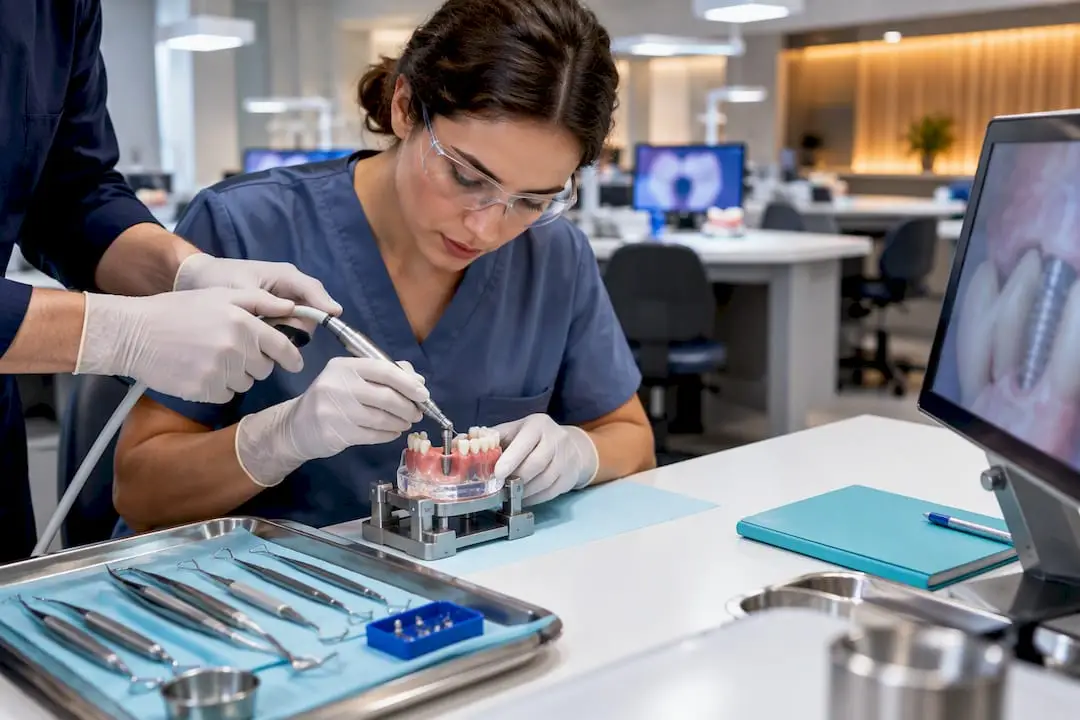
Your fastest path is a three-pronged search: check your state dental association’s mentor directory, ask a faculty member or clinical instructor for a warm introduction, and look at a study club or specialty society in your area. Mentorship can be free through organized dentistry or paid through structured programs, and paid options usually move faster because they build accountability into the match. If you want hands-on guidance in a specific skill like implants, a mentorship-driven training program can provide you that structure from day one.
Where to Search First for a Dental Mentor
Organized dentistry built its mentor directories for exactly this problem. The Academy of General Dentistry runs a searchable Find a Mentor/Mentee program that lets you filter by specialty interest and mentoring availability, and it is member-only, so joining AGD unlocks the pool. State associations run similar systems. The Washington State Dental Association mentor program publishes profiles showing each mentor’s practice setting, audience preference (student, resident, or new dentist), and program format, whether that is a single coffee meeting or a season-long relationship.
Faculty and clinical instructors are your second lever, and they are underused. A professor who supervised your prosthodontics rotation already knows how you work under pressure, which beats a cold match from a directory. Ask directly: “Would you be open to an informal mentorship, or do you know someone in [specialty] who would be?” Alumni networks work the same way, often through your school’s advancement office.
Study clubs, specialty societies, and local conference chapters round out the search. Joining organized dentistry and attending study clubs is one of the most reliable ways early-career dentists build a mentor network, because you meet mentors in a low-pressure setting before you ever ask for anything.
Before committing to a match, run a quick check on any profile or listing:
- Does the specialty or interest area match your actual goal, not just a general “dentistry” tag?
- Does the profile state mentoring availability, or is it a stale listing?
- Can you find a shared connection (school, study club, conference) to reference in your outreach?
- Is the format (one-time chat, ongoing relationship, group session) stated anywhere?
Choosing the Right Mentor: Goals, Fit, and Red Flags
Start by naming your actual goal, because “I want a mentor” is too vague to act on. A student prepping for boards needs a different mentor than a new dentist trying to build implant confidence or one aiming to open a practice in three years. Match your goal to a mentor type first:
- Clinical coach. Someone who reviews cases, watches your technique, and corrects it in real time.
- Practice management mentor. Someone further along who can talk through hiring, overhead, and patient flow.
- Academic sponsor. Someone who can write letters, open doors to residencies, or connect you to research.
Once you know the type, screen for qualities that actually predict a good relationship. Research on mentoring in dental education repeatedly points to trust, empathy, and clear communication as the traits that separate a helpful mentor from a wasted one, alongside clinical credibility and genuine availability. Add cultural sensitivity and network reach to your checklist. A mentor who cannot make time for you, no matter how impressive their resume, is not the right match right now.
Do not limit yourself to one mentor. A mentee team, one clinical coach plus one practice management mentor, covers more ground than any single person can and reduces the risk of losing your only support if that relationship fades.

Pro Tip: Set the boundary early. Ask directly how the mentor prefers to communicate and how often, so you are not guessing whether a text at 9 p.m. is welcome.
Watch for red flags: a mentor who only wants to talk about their own career, one who never follows up after the first meeting, or one who seems annoyed by questions. Those are signs to look elsewhere, not signs to try harder.
How to Reach Out and Structure the First Meeting
Your outreach message should be short, specific, and easy to say yes to. A cold email to a faculty member or directory match works best in four sentences: who you are, why you are reaching out to them specifically, what you are hoping to learn, and a low-commitment ask.
- “I’m a third-year student interested in implant dentistry, and I saw your profile on the AGD mentor directory.”
- “I noticed your background in [specialty] from [study club/school].”
- “Would you be open to a 20-minute call to talk about how you built your skills in this area?”
- “I’m happy to work around your schedule.”
For the first meeting itself, keep the agenda simple: your background, your specific goal, and one question you actually need answered. Dental student groups like ASDA recommend reflecting on your goals before the first conversation and following up consistently afterward, since the follow-up is what turns a one-time favor into an ongoing relationship.
After that first call, agree on basics before you move forward:
- How often you will meet (monthly is common for informal mentorships).
- Whether sessions involve observation, hands-on supervision, or just conversation.
- Whether case details discussed stay confidential.
- Where you will keep shared notes so nothing gets lost between sessions.
For remote mentorships, a shared document tracking goals and case reviews keeps momentum when you cannot meet in person every week.
Mentorship comes in more flavors than most students realize, and knowing which one you are getting matters as much as finding a mentor at all.
- Volunteer mentor: A working dentist donating time through a school, association, or nonprofit program with no fee attached.
- Membership-directory match: Free once you join the organization (AGD, state association), matched informally.
- Paid coach: An individual mentor charging for structured, ongoing guidance, often for practice management or career planning.
- Course-linked mentorship: Built into a paid CE program, where an instructor supervises your work through a curriculum.
- Hands-on observation or supervised cases: Usually the most expensive format, because it involves live patients and direct oversight.
Paid, course-linked mentorship earns its cost in one specific scenario: skill-based specialties like implants and surgery, where supervised cases inside a structured curriculum accelerate competence far faster than reading or observation alone. You are not paying for a relationship. You are paying for guaranteed hands-on time with real feedback.
If budget is tight, free options are genuinely strong starting points: dental school mentor programs, organized dentistry volunteer matches, and alumni networks all connect mentees at no cost. Structured programs that use multiple mentors tend to be more sustainable and accessible than relying on a single informal match, which is worth remembering if your first attempt at a match falls through.
Why Structured Mentorship Plus Hands-On Training Builds Real Competence
Reading about a procedure and performing it under supervision are not the same skill, and tiered learning paths exist to close that gap. A foundational module teaches the theory; a hands-on module puts your hands on a case with someone experienced watching for the mistakes you cannot see yourself making yet.
Structured mentorship programs that integrate academic learning with clinical practice improve clinical competence, professional confidence, and reflective practice among dental trainees, particularly when programs use multiple-mentor approaches to enhance accessibility and sustainability.
That is the core finding behind research on mentorship in dental curricula, and it lines up with how One World Dental structures its training courses: tiered paths from foundational to advanced, with mentorship and live patient modules built into the curriculum rather than bolted on.
When evaluating any course-based mentorship program, check these before you enroll:
- Are instructor credentials and clinical background clearly listed?
- How many hands-on hours are built into the curriculum, not just lecture time?
- Does the program include patient-based learning or live case observation?
- Is CE accreditation included, and does it count toward your state’s requirements?
How Mentorship Bridges the Gap From Student to Practicing Dentist
Dental school teaches you to pass boards. It does not fully prepare you for the moment you sit in front of a real patient with no attending standing behind you, deciding your treatment plan in real time. That gap between academic competence and independent clinical judgment is where most new dentists feel the sharpest anxiety, and it is exactly where mentorship does its most valuable work.
A mentor who has already made the transition can walk you through decisions you have never had to make alone: how to price a treatment plan, how to talk a nervous patient through a procedure, when to refer out rather than push forward on a case you are not confident about. These are not things a textbook covers well, because they depend on judgment built through repetition.
The transition period also tends to be when new dentists either build strong habits or develop workarounds that cause problems later. A mentor watching your first hundred cases can catch a technique flaw before it becomes muscle memory. That is a different kind of value than academic feedback, because it happens in real time, on real patients, with real consequences.
Mentorship at this stage also shapes career direction. A new dentist unsure whether to join a group practice, buy into a partnership, or go solo benefits enormously from someone who has weighed those exact tradeoffs. The right mentor does not just teach clinical skill. They shorten the trial-and-error period that otherwise eats up the first several years of practice.
How to Tell If a Mentor Is Actually a Good Fit
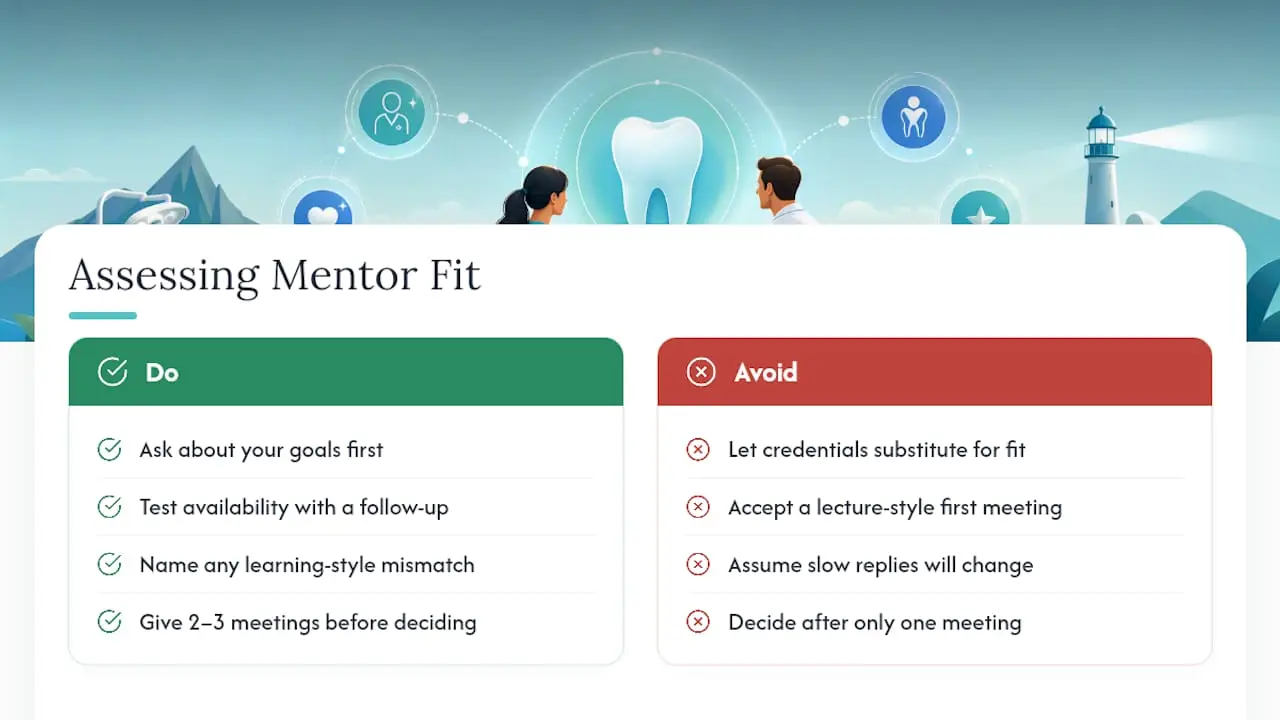
Credentials tell you almost nothing about whether a mentorship will work. Compatibility comes down to communication style, availability, and whether the mentor’s teaching approach matches how you actually learn.
Pay attention to the first conversation. Does the mentor ask about your goals, or do they spend the whole time talking about their own career? A good mentor gets curious about where you want to go before deciding how to help you get there. If the first meeting feels like a lecture rather than a dialogue, that is useful information, not a reason to force the relationship anyway.
Test for availability honestly before you commit. A mentor who is enthusiastic in the first meeting but takes three weeks to respond to a follow-up email is telling you something about the pace of the relationship going forward. That is not necessarily disqualifying, but you should adjust your expectations rather than assume it will change.
Consider learning style match specifically. Some mentors teach by demonstration, walking you through a case step by step. Others teach by asking questions and letting you work through the answer yourself. Neither approach is wrong, but if you need direct instruction and your mentor prefers the Socratic method, you will both walk away frustrated unless you name that mismatch early and ask for what you need.
Give any new mentorship two or three meetings before you decide it is not working. The first conversation is rarely representative of the whole relationship, and mentors often warm up once they see you show up prepared and follow through on what you discussed.
Common Mentorship Problems and How to Fix Them
The most common failure point in dental mentorship is not a bad match. It is a good match that quietly stops meeting. Both people get busy, no one sets a recurring time, and the relationship fades without either person deciding to end it.
The fix is structural: agree on a recurring meeting time at the start, even if it is just once a month, and put it on both calendars. Relationships with a set cadence survive busy stretches; informal “let’s grab coffee sometime” arrangements rarely do.
Another frequent issue is mismatched expectations about time commitment. A mentee expecting weekly hands-on supervision paired with a mentor who pictured one phone call a quarter will both feel let down. State your expectations plainly in the first or second meeting rather than assuming they match.
Institutional research on dental mentoring points to limited mentor time and inconsistent mentor training as structural barriers, meaning some of this friction is not personal. Mentors are often practicing full time with no formal training in how to mentor well. Give feedback gently if a mentor’s approach is not landing, and remember that a single mentor cannot cover every gap.
Ghosting happens in both directions. If life gets in the way and you miss a check-in, send a quick note rather than disappearing. Mentors remember mentees who communicate honestly far more than they remember one missed meeting.
Fitting Mentorship Into an Already-Packed Schedule
Dental school and early practice leave little slack, and mentorship that demands hours you do not have will collapse within a month. The fix is not finding more time. It is designing a mentorship rhythm that fits the time you actually have.
A monthly thirty-minute call is more sustainable than a weekly hour you will eventually cancel. Set the cadence low enough that you will actually keep it, then build up if both sides want more. Batch your questions between meetings in a running note so you are not scrambling to think of something to ask when the call starts.
If you are balancing mentorship with clinical rotations or a full patient schedule, be upfront about your constraints rather than overcommitting and then disappointing your mentor later. Most mentors appreciate directness about your availability far more than enthusiasm that fades after two sessions.
Course-based mentorship solves the scheduling problem differently, by building the mentor time into a fixed curriculum with set session dates. That structure removes the coordination burden entirely, which is part of why paid, structured programs work well for people whose calendars are already unpredictable.
What Actually Moves the Needle, and What to Do This Week
Most advice on finding a mentor treats the search itself as the hard part. It is not. The hard part is showing up consistently once you have found someone willing to help. A mentee who follows up, arrives prepared, and respects a mentor’s time will outperform a mentee with a “better” mentor who lets the relationship go quiet after week two.
Do three things this week. Search one directory (AGD if you have membership, your state association if not) and message one mentor whose profile fits your goal. Email one former professor or clinical instructor and ask directly if they mentor students or know someone who does. Register for one introductory CE session in a skill area you want to build, since course-based programs put you in a room with instructors who mentor by default.
Mentorship is not one-directional. Send your mentor a case update even when you have no question. Say thank you specifically, naming what advice actually helped. Reciprocity is what keeps a mentor invested past the first favor.
— Jake
One World Dental: Structured Mentorship Built Into Every Course
Informal mentorship is valuable, but it depends on someone else’s schedule and goodwill. Some programs offer mentorship built directly into the curriculum, so guidance is not something you have to hope for, it is part of what you are paying for.
Every course follows a tiered path from foundational concepts to advanced procedures, with instructors who supervise your work through live patient modules rather than lecture slides alone. That matters most for skill-heavy specialties like implants, where course-based mentorship means supervised cases and direct feedback in real time, not just a mentor you email occasionally. Programs like hands-on dental implant training put you in front of real cases with an instructor watching your technique, the kind of accountability an informal mentor rarely has time to provide.
If you are ready to move past the search-and-hope phase of finding a mentor, start with the online dental continuing education guide to see which course format fits your schedule and goals, then register for the session that matches where you want your skills to go next.
Trusted Directories and Research on Dental Mentorship
Start your search with sources built specifically for this purpose. The AGD Find a Mentor/Mentee directory offers member-searchable profiles, while state associations like the WSDA mentor program list availability and format details. Student-specific guidance from ASDA and curriculum resources from ADEA round out mentee-focused support, while the mentorship research from ESMED backs the case for structured programs.
Recommended