There is no dedicated CDT code for a supernumerary tooth. You report the procedure you actually performed and pair it with ICD-10-CM K00.1 (Supernumerary teeth) as the diagnosis pointer. The CDT code depends entirely on the tooth’s clinical and radiographic presentation:
- D7140 — simple extraction of an erupted supernumerary tooth (forceps and elevator only, no bone removal)
- D7210 — surgical extraction of an erupted supernumerary tooth requiring bone removal, tooth sectioning, or both
- D7220 — removal of impacted supernumerary tooth, soft tissue impaction
- D7230 — removal of impacted supernumerary tooth, partial bony impaction
- D7240 — removal of impacted supernumerary tooth, complete bony impaction
- D7999 — unspecified oral surgery, by report (narrow use; see Section 3)
Billing staff quick reference: When reporting a supplemental permanent supernumerary tooth, add 50 to the closest standard permanent tooth number (e.g., a supernumerary near tooth #4 reports as tooth #54). Always attach panoramic or periapical radiographs when claiming D7210 or any impacted-tooth code. The ADA CDT guidance confirms that code selection is driven by the procedure performed, not the diagnosis alone.
Code selection follows the clinical and radiographic facts of the case. The ADA current dental terminology defines each extraction code by what the clinician actually does, not by what the tooth is called.
D7140 — Simple extraction
This code applies when the supernumerary tooth is erupted (or the root is exposed) and removal requires only forceps and elevator technique. No flap, no bone removal, no sectioning. If you lifted a mesiodens with a straight elevator and extracted it cleanly, D7140 is correct.

D7210 — Surgical extraction of an erupted tooth
D7210 requires bone removal, tooth sectioning, or both. Flap elevation alone does not qualify a case for D7210; the operative note must document that bone was removed or the tooth was sectioned. Coding guides consistently flag this as the most common billing error: a flap was raised, but no bone was taken and no sectioning occurred, so D7140 is the correct code despite the surgical approach.
D7220, D7230, D7240 — Impacted tooth codes
These codes apply when the supernumerary tooth has not penetrated the gingiva. The distinction is the degree of bony coverage:
- D7220: Soft tissue impaction — crown is covered by soft tissue only
- D7230: Partial bony impaction — part of the crown is covered by bone
- D7240: Complete bony impaction — the entire crown is covered by bone
D7210 is for erupted teeth only. If the supernumerary is unerupted, even if the surgical technique looks identical, the correct code is D7220, D7230, or D7240 based on the radiographic picture.
Pro Tip: In your operative note, name the specific instrument used for bone removal (e.g., “round bur #6 used to remove 2 mm of buccal alveolar bone”) and state whether the tooth was sectioned and how many sections were created. That language is what separates a defensible D7210 from a downcode to D7140 during claims review.
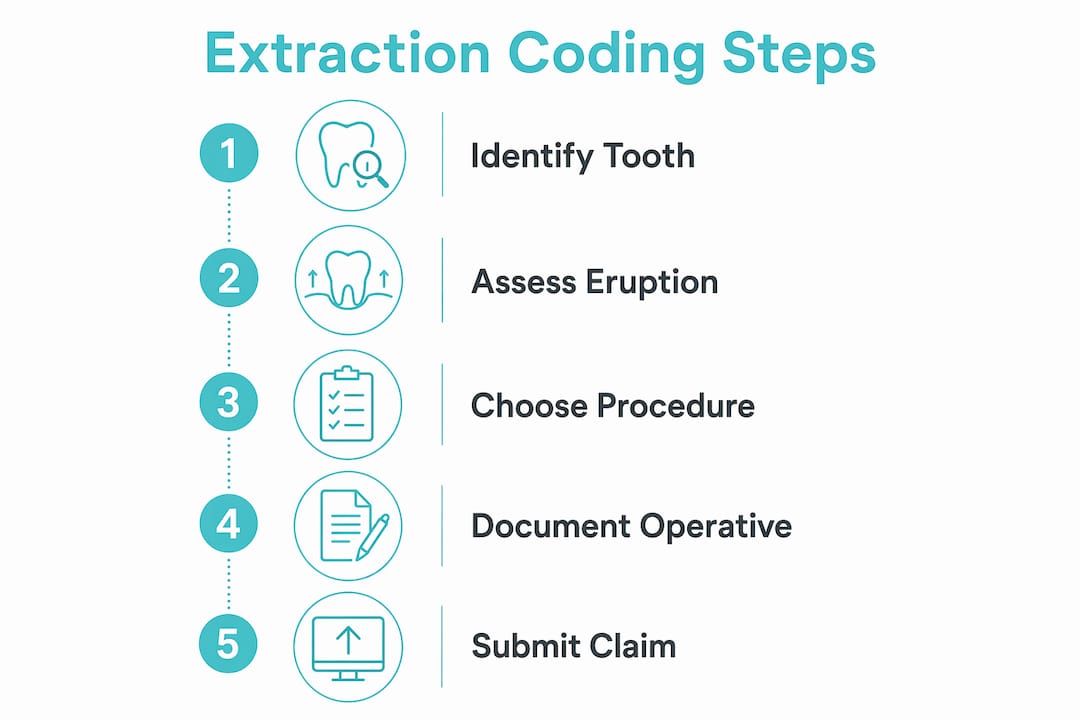
D7999 is the CDT code for an unspecified oral surgery procedure, submitted “by report.” Its use is narrow and should be a last resort, not a default.
When D7999 may be appropriate:
- The supernumerary tooth presents with unusual anatomy or a combined procedure that no single CDT code accurately captures
- A payer’s own policy or state Medicaid bulletin specifically instructs providers to use D7999 for supernumerary extractions (verify before submitting)
- The procedure genuinely falls outside the defined scope of D7140, D7210, or D7220–D7240
Why D7999 gets denied or audited:
Insurers treat D7999 as a red flag. Without a compelling narrative, reviewers assume a standard code applies and reject the claim. State-level policies that reference D7999 for supernumerary extractions still require a by-report narrative explaining why no other CDT fits.
When you do use D7999, structure the narrative in two parts: first, explain why no standard CDT code applies (describe the unusual anatomy or combined steps); second, list the major surgical steps performed that distinguish the case from a routine extraction. That two-part format shortens reviewer time and improves acceptance.
Practical note: Some state Medicaid programs and commercial payers have historically referenced D7999 for supernumerary extractions. Always check the specific plan’s policy bulletin before submitting D7999, and collect pre-authorization paperwork and a clinician narrative before the procedure date.
How to use ICD-10-CM K00.1 as your diagnosis pointer
The diagnosis code for supernumerary teeth is K00.1 in the ICD-10-CM classification, which is explained in detail in the Bilingual Dental Patient Intake Benefits for Your Practice guide to improve practice communication and documentation. It documents the underlying condition and establishes medical necessity for the extraction on the claim.
How to apply the diagnosis pointer:
- On the ADA dental claim form, enter K00.1 in the diagnosis code field and link it to the extraction procedure line using the diagnosis pointer (typically column “A,” “B,” “C,” or “D” depending on the claim form version)
- K00.1 covers the supernumerary tooth itself; if the patient also presents with an associated odontogenic cyst, infection, or pain, add those ICD-10-CM codes as secondary diagnoses and pointer them to the relevant procedure lines
- Secondary codes strengthen the medical necessity argument, particularly when a payer requires evidence of pathology or functional impact before approving surgical-level extraction
Pro Tip: In the claim narrative, write a one-sentence diagnosis statement that mirrors both the radiographic and clinical findings, for example: “Mesiodens (K00.1) confirmed on panoramic radiograph; erupted, causing crowding of maxillary central incisors; extracted surgically with bone removal (D7210).” That sentence ties the diagnosis code, the imaging, and the procedure code into a single reviewable statement.
How to identify and report the supernumerary tooth number on the claim
Supernumerary teeth do not have standard universal numbers, so coding resources and the ADA recommend a consistent convention to avoid claim rejections.
The +50 rule for permanent supplemental teeth:
Add 50 to the number of the closest standard permanent tooth. A supernumerary adjacent to tooth #4 reports as tooth #54; one near tooth #14 reports as tooth #64. This convention is widely recognized by payers and appears in ADA numbering guidance.
Documenting position and classification:
Always record the anatomical classification in the chart:
- Mesiodens: midline supernumerary between the maxillary central incisors
- Paramolar: supernumerary adjacent to a molar
- Distomolar: supernumerary distal to the third molar
Include this classification in the claim remarks field. A reviewer who sees “mesiodens, tooth #51, erupted, extracted with bone removal” has everything needed to process the claim without a call-back.
Pediatric and primary dentition:
For primary dentition, some payers use letter-based notation (A–T). A supernumerary near primary tooth E may be noted as “supernumerary adjacent to tooth E” in the remarks. Confirm the payer’s preferred notation before submitting, since inconsistent formats are a common cause of administrative rejections.
Documentation and imaging that prevent downcoding
Insufficient documentation is the leading cause of surgical extraction codes being downgraded to D7140. A detailed operative note and quality imaging are not optional for D7210 or any impacted-tooth code.
Minimum documentation for surgical-level codes:
- Preoperative diagnosis with ICD-10-CM code
- Informed consent form
- Operative note naming instruments, bone removal site and amount, and tooth sectioning details
- Postoperative instructions provided to the patient
Imaging guidance:
A panoramic radiograph is the baseline for most supernumerary extractions. Periapical views add detail for anterior cases. CBCT is warranted when the tooth’s proximity to adjacent roots, the nasal floor, or the inferior alveolar nerve makes surgical planning complex. When CBCT was used, reference it explicitly in the operative note: “CBCT confirmed complete bony impaction with 3 mm proximity to root of tooth #9; buccal approach selected.”
| Documentation Element |
Required or Recommended |
| Detailed operative note (instruments, bone removal, sectioning) |
Required for D7210/D7220–D7240 |
| Preoperative diagnosis with ICD-10-CM code |
Required |
| Panoramic or periapical radiograph |
Required |
| CBCT (complex anatomy or proximity to vital structures) |
Recommended |
| Flap design described |
Recommended |
| Suture type and count |
Recommended |
| Informed consent form |
Required |
| Postoperative instructions |
Required |
Pro Tip: Annotate the radiograph before uploading it with the claim. Draw an arrow to the impacted tooth, label the degree of bony coverage, and note the adjacent structure at risk. Reviewers process annotated images faster, and that speed works in your favor.
How payer rules and prior authorization affect coverage
Coverage for supernumerary tooth extraction is not uniform. Some commercial plans cover it as a routine extraction; others require documented medical necessity, orthodontic impact, or evidence of pathology before approving a surgical code.
What varies by plan:
- Whether supernumerary extractions are a covered benefit at all
- Whether surgical codes require prior authorization
- Whether the plan follows ADA CDT definitions or applies its own criteria for D7210 vs. D7140
- Whether state Medicaid covers the procedure and under which code
Concrete pre-submission steps:
- Call the payer or check the online portal to verify benefits for the specific CDT code you plan to submit
- Ask whether prior authorization is required for D7210 or D7240
- Pull the state Medicaid bulletin if the patient is on Medicaid — some state programs have specific rules for supernumerary extractions, including requirements to use D7999 with a by-report narrative
- Document the clinical reason that meets the plan’s stated criteria (crowding, pathology, eruption interference) in the chart before the procedure
The Washington State HCA dental bulletin is one example of a state program that addresses billing nuances for procedures like supernumerary extractions. Indiana Medicaid guidance has similarly referenced D7999 for these cases. The practical lesson: state rules differ, and a code that sails through one plan may trigger a denial in another.
Pro Tip: When a payer historically demands D7999 for supernumerary extractions, collect pre-authorization paperwork and a written clinician narrative before the procedure date. Submitting D7999 without pre-auth on a plan that requires it almost guarantees a denial.
Sample claim lines and appeal templates you can use today
These templates are starting points. Adapt the clinical details to match your actual operative findings.
Sample claim line 1 — Simple extraction (D7140)
Sample claim line 2 — Surgical erupted extraction (D7210)
Sample claim line 3 — Complete bony impaction (D7240)
Short appeal template for a D7210 downgraded to D7140:
Pro Tip: With every initial submission for D7210 or D7240, upload three attachments: the annotated radiograph, the operative note, and the signed consent form. Sending them upfront reduces the back-and-forth that delays payment by weeks.
Why surgical training directly affects your coding defensibility
The CDT code you bill is determined by what you actually did in the operatory. That means surgical decisions, such as whether to remove bone or section the tooth, are also coding decisions. A clinician who routinely removes bone when it is clinically indicated will consistently qualify for D7210; one who avoids bone removal out of habit or uncertainty may undercode and leave reimbursement on the table.
Consistent technique produces consistent documentation. When you perform the same surgical steps in the same sequence, your operative notes become more precise, your radiographic documentation improves, and your coding becomes more defensible. Auditors look for operative notes that describe specific instruments, specific amounts of bone removed, and specific sectioning patterns. Vague language like “surgical extraction performed” is the single fastest path to a downcode.
Advanced training in oral surgery also helps clinicians recognize when a case genuinely warrants D7240 versus D7230, and document that distinction clearly. The difference between a partial and complete bony impaction is not always obvious on a two-dimensional radiograph; CBCT interpretation and hands-on surgical experience sharpen that judgment.
Pro Tip: Review your last ten D7210 claims. If any operative note lacks explicit language about bone removal or sectioning, those claims are vulnerable in an audit. Updating your note template now costs nothing; losing a D7210 to a D7140 downcode costs you the reimbursement difference on every future claim.
Key Takeaways
There is no unique CDT code for a supernumerary tooth; correct billing requires matching the procedure code to the clinical steps performed and attaching ICD-10-CM K00.1 as the diagnosis pointer.
| Point |
Details |
| No dedicated supernumerary code |
Report the procedure performed: D7140, D7210, D7220, D7230, or D7240, based on clinical and radiographic findings. |
| ICD-10-CM K00.1 is required |
Attach K00.1 as the diagnosis pointer on every supernumerary extraction claim to establish medical necessity. |
| Tooth numbering convention |
Add 50 to the closest permanent tooth number (e.g., supernumerary near tooth #4 = tooth #54) and note the anatomical classification in remarks. |
| Documentation prevents downcoding |
The operative note must name the instrument, the bone removed, and any sectioning; vague notes are the primary cause of D7210 being downgraded to D7140. |
| Onewd surgical CE improves coding |
One World Dental’s extraction and surgical courses build the technique and documentation habits that support higher-level CDT codes and reduce audit risk. |
Precise coding protects your revenue and your patients
Dental coding is not a billing afterthought. The code you submit determines whether a patient’s plan covers the procedure, how much the practice collects, and whether a future audit finds your records defensible. Those three outcomes are connected.
From a clinician’s perspective, the most common mistake is not choosing the wrong code on purpose. It is performing a surgical extraction, writing a vague operative note, and then watching the claim come back as D7140. The procedure was legitimate. The documentation was not. That gap costs practices real money, and it is entirely preventable.
From a billing perspective, precise coding reduces the appeals workload. Every downcode that has to be appealed represents time spent writing letters, pulling records, and waiting for a decision that should have been made correctly the first time. A one-paragraph operative note written the day of the procedure is worth more than three hours of appeals work later.
Documentation quality also protects the clinician in audits. An auditor reviewing a D7240 claim wants to see CBCT confirmation of complete bony impaction, an operative note that names the bone removal instrument and the sectioning method, and a radiograph that matches the narrative. When all three are present, the audit ends quickly. When they are not, the practice faces recoupment requests and the administrative burden that follows.
Sharpen your surgical technique and coding confidence with Onewd
Coding accuracy starts in the operatory. When your surgical technique is consistent and your documentation habits are tight, the right CDT code follows naturally. Onewd’s extraction and socket preservation course and surgical site development masterclass are built specifically for clinicians who want to perform complex extractions with the precision that supports D7210 and D7240 claims.
Both courses cover the surgical decision points that determine your code: when to remove bone, how to document sectioning, and how to build an operative note that holds up to payer review. The curriculum follows Onewd’s tiered learning path, from foundational extraction biology through advanced surgical technique, with live patient modules and mentorship from experienced clinicians. Whether you are a general dentist adding surgical extractions to your practice or a specialist refining documentation habits, the training courses at Onewd give you a direct path from better technique to fewer denials. Browse the current course schedule and enroll in the module that fits your skill level.
Useful sources and policy references
- ADA Guide to Extractions: Tooth and Remnants — primary ADA CDT guidance on extraction code selection
- ADA Current Dental Terminology (CDT) code definitions — official CDT procedure code descriptions
- ADA CDT Coding Education — ADA coding education resources
- Washington State HCA Dental Related Services Bulletin — example state Medicaid policy referencing D7999 and billing nuances for complex extractions
- Impacted Supernumerary Teeth: Early or Delayed Intervention (PMC) — clinical review on timing and indications for supernumerary extraction
- Navigating the Coding Complexities of Supernumerary Teeth — Practice Booster — coding how-to with tooth identification and CDT mapping
- D7140 vs D7210: Simple vs Surgical Extraction Billing Guide — clinical criteria distinguishing simple and surgical extraction codes
- D7140 & D7210: A Common Coding Error — eAssist Dental Billing — common downcoding errors and documentation guidance
- How to Diagnose and Code for Supernumerary Teeth — Outsource Strategies — ICD-10-CM K00.1 application and CDT code mapping
- Charting Supernumerary Teeth — Dandy — tooth numbering conventions including the +50 rule
- ADCA Online: Coding Q&A for Supernumerary Tooth Extraction — practical Q&A example: D7240 for completely bony impacted supernumerary with remarks notation
Recommended