For most aligner-treated patients, the evidence supports dual retention as the default for high-risk cases: a bonded multistranded wire on the lower anterior teeth combined with a nightly Essix-type thermoplastic retainer. The clinical practice guideline for orthodontic retention recommends individualized planning, written patient instructions, a first check within three months of debond, and annual monitoring thereafter. Responsibility is shared: the orthodontist fits the devices and manages early checks; the general dentist takes over annual surveillance under a written handover agreement; the patient commits to nightly wear and daily cleaning. The University of Washington’s long-term postretention cohort data, summarized in the British Dental Journal evidence overview, showed that without retainers, roughly 70% of patients had a severe need for retreatment within 10 years. That figure alone justifies treating retention as a permanent clinical responsibility, not a 12-month afterthought.
At a glance — the core aligner retention protocol:
- Appliance choice: Bonded multistranded wire (lower 3-3 minimum; upper 3-3 for high-risk cases) plus a nightly Essix/VFR thermoplastic retainer
- Initial wear schedule: Full-time wear (20–22 hours/day) for months 0–3 post-debond; reduce to night-only by month 6 based on clinician assessment
- Monitoring cadence: First check at 2–3 weeks; two to three additional visits in year one; annual review from year two onward
- Responsibility assignment: Orthodontist manages fitting and year-one checks; written handover to general dentist for long-term annual monitoring; patient responsible for nightly wear and hygiene
- Evidence base: Cochrane systematic review, PMC clinical practice guideline, University of Washington longitudinal cohort data
Why do teeth relapse after aligner therapy?
Relapse after clear aligner therapy (CAT) is not a failure of technique alone. It is a predictable biological event driven by three overlapping mechanisms, and understanding them shapes every decision in your retention protocol.
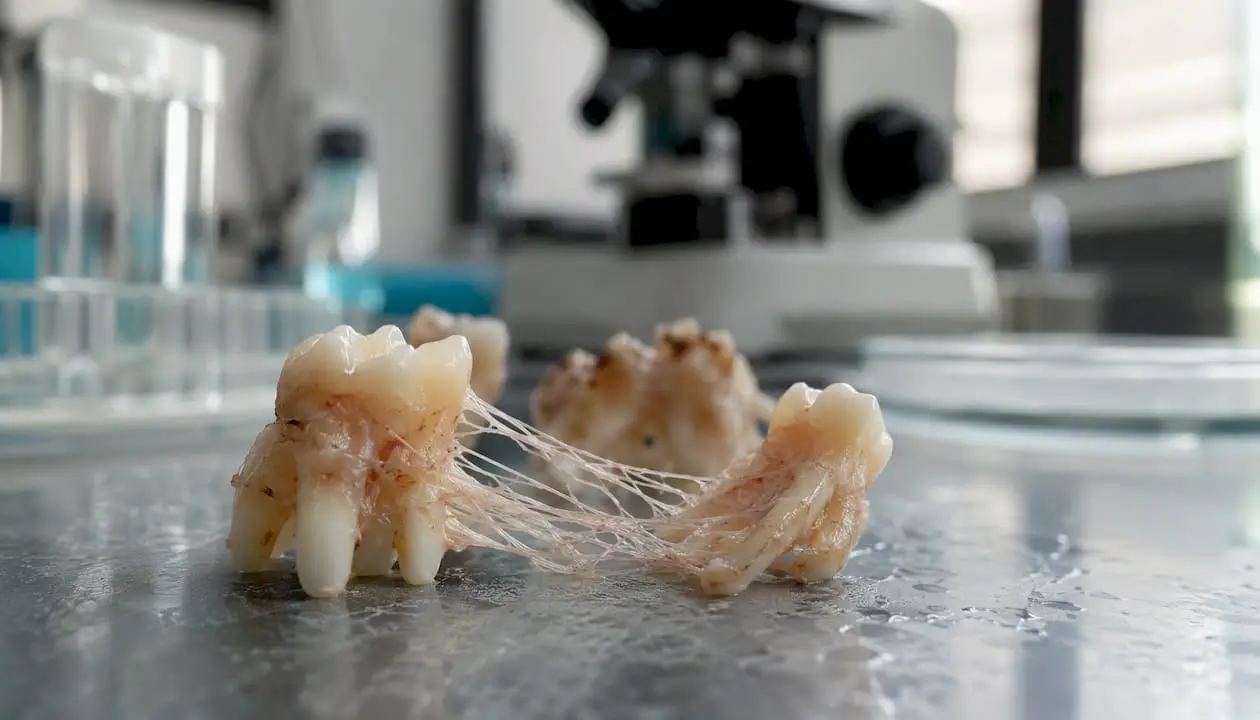
Soft tissue and periodontal fiber remodeling is the most immediate driver. The principal fibers of the periodontal ligament and the free gingival fibers, particularly the transseptal and circumferential fibers, do not remodel at the same rate as bone. After tooth movement, these fibers retain elastic memory for months, pulling teeth back toward their pretreatment positions. Rotational corrections are especially vulnerable because the gingival fibers encircle the tooth and resist derotation long after the aligner series ends.
Bone remodeling timelines add a second layer of risk. New bone deposited on the tension side of a moved tooth takes months to fully mineralize. During that window, the tooth is biomechanically less stable than it appears clinically. The first three to six months post-debond are the highest-risk period for rapid relapse, which is exactly why full-time retainer wear during that phase is non-negotiable.
Lifelong craniofacial growth and aging create a third, often underestimated pressure. Even after skeletal growth is complete, the dentition continues to drift mesially and the lower incisors tend to crowd with age. This is why retention after aligners, as after fixed appliances, is a permanent commitment for most patients, not a finite course of treatment.
Aligner-specific biomechanical limits compound all three mechanisms. A 2018 systematic review found that early Invisalign cases showed more posttreatment relapse in some series compared with conventional fixed appliances, attributing this partly to aligner limitations in torque control and root positioning. When a tooth has not been moved to its ideal three-dimensional position during treatment, the retention phase is compensating for a biomechanical deficit, not just maintaining a stable result.
Clinical implications for surveillance after CAT:
- Large rotational corrections (greater than 20 degrees) warrant bonded retention and close early monitoring
- Cases with significant bodily torque or root movement require the same heightened vigilance, given aligner torque-control limitations
- Final occlusal contact deficits at debond (posterior open bites, incomplete settling) signal that the thermoplastic retainer may be locking in an unstable occlusion
- Periodontal attachment loss or thin biotypes increase relapse risk and lower the threshold for fixed retention
Pro Tip: If you see incomplete posterior occlusal contacts at debond, do not assume they will self-correct under a full-coverage Essix retainer. Full-coverage thermoplastic devices can physically prevent settling. Consider a Hawley or scalloped trimline design for those patients, or plan a short observation window before fabricating the removable retainer.
Fixed vs removable retainers after aligner treatment
Choosing between fixed and removable retention, or combining both, is the central clinical decision in any retention protocol. The Cochrane review on orthodontic retention found similar short-term stability between fixed and removable devices, but fixed retainers tend to preserve alignment better over longer follow-up periods, at the cost of higher plaque accumulation and gingival inflammation risk.
Comparison of retainer types for aligner-treated patients
| Dimension |
Fixed (bonded wire) |
Essix/VFR thermoplastic |
Hawley |
| Best for |
High rotation relapse risk, spacing cases, lower anteriors |
Most aligner cases; aesthetic priority patients |
Cases needing occlusal settling; patients with posterior open bites |
| Durability |
Long-term if bonded correctly; failure risk highest immediately post-debond |
Typically 1–3 years before replacement; cracks and distorts |
Longer lifespan with proper care; wire adjustable |
| Compliance dependence |
None (passive) |
High; relies on nightly patient wear |
High; relies on nightly patient wear |
| Occlusal settling |
Does not interfere |
Full-coverage designs can block posterior settling |
Allows natural settling; preferred when settling is incomplete |
| Hygiene concerns |
Plaque accumulation around wire; requires floss threaders or interdental brushes |
Trap saliva and bacteria if worn full-time; clean daily |
Easier to clean; acrylic can harbor bacteria |
| Cost and replacement |
Higher initial cost; repair requires clinical visit |
Low per-unit cost; patient can replace with a backup |
Moderate cost; durable with proper use |
| Risk of unwanted movement |
Wire deformation can cause inadvertent tooth movement |
Poor fit or cracking can allow drift |
Minimal if properly adjusted |
Fixed retainer design choices. The most common wire is a multistranded stainless steel wire (typically 0.0175-inch or 0.0195-inch), bonded to each tooth individually from canine to canine. CAD/CAM nitinol wires offer a more passive, anatomically adapted alternative with lower activation risk. Fiber-reinforced composite retainers are used in some practices but carry a higher fracture risk and are harder to repair chairside. Bond failure is the most common complication and is most likely in the first weeks after placement, which is why the two-to-three-week check is critical.
Removable retainer design choices. Essix-type and vacuum-formed retainers (VFR) dominate post-CAT practice. A survey of AAO members found that 83% of orthodontists preferred Essix retainers after clear aligner therapy, with 43% also using bonded retainers. The material choice matters: thicker thermoplastic (greater than 1mm) covering the full occlusal surface can create posterior precontacts and anterior open bite over time. The evidence on Essix outcomes recommends reduced-thickness designs and scalloped or straight trimlines that stop short of full molar coverage to mitigate this risk.
Pros and cons at a glance:
Fixed retainers:
- Pros: Compliance-independent; superior long-term alignment preservation; no daily management burden for the patient
- Cons: Periodontal hygiene challenge; wire deformation risk; requires clinical repair; cannot be removed for cleaning
Essix/VFR retainers:
- Pros: Aesthetic; patient-accepted; low cost per unit; easy to replace; no hygiene compromise around teeth
- Cons: Compliance-dependent; can limit occlusal settling; shorter lifespan; full-coverage designs risk anterior open bite
Hawley retainers:
- Pros: Allows occlusal settling; durable; adjustable; easier to clean
- Cons: Visible wire; bulkier; less aesthetic; patient acceptance lower than Essix
The short-term equivalence between Essix and Hawley designs in multiple RCTs is well-established, but the longer-term picture favors fixed retention for alignment preservation, particularly in the lower anterior segment.
When and how to use dual retention after aligners
Dual retention, a bonded wire combined with a removable overlay, is the most defensible strategy for high-risk aligner cases. The ScienceDirect posttreatment care review endorses shared decision-making and tailored retention plans, noting that while additional benefit of dual over single retention is still being quantified, the redundancy it provides is clinically rational for patients at elevated relapse risk.
Rationale for dual retention:
- Protects against early bond failure: if the fixed retainer debonds in the first weeks, the removable retainer prevents immediate relapse
- Preserves posterior occlusal settling while the bonded wire secures the anterior segment
- Provides a backup device the patient can use during any emergency repair period
- Addresses the compliance gap: the bonded retainer works passively while the removable retainer adds a second layer of stability during the highest-risk period
Stepwise clinical workflow for dual retention:
- Pre-debond planning: Identify dual-retention candidates at the final aligner check (see the risk checklist in the next section). Order or prepare bonding materials and wire before the debond appointment.
- Debond and bond the fixed retainer first: Remove aligner attachments, polish, and bond the multistranded wire before taking any impressions or scans. This sequence is critical.
- Scan or take an impression with the bonded wire in place: The removable retainer must be fabricated over the wire to fit correctly. Scanning with the wire in place avoids a remake when the patient returns for the overlay.
- Fabricate the removable retainer with wire relief: The lab or in-house workflow should include a slight relief channel over the bonded wire to prevent rocking or pressure points. A 3D printing workflow can simplify this step for practices with in-house fabrication capability.
- Deliver the removable retainer and educate the patient: At the delivery visit (typically one to two weeks after debond), confirm fit, check occlusion, and review the wear schedule and cleaning protocol in writing.
- First check at 2–3 weeks: Verify bond integrity, check for wire distortion, confirm the removable retainer seats fully, and address any occlusal discrepancies.
Pro Tip: When using a full-coverage thermoplastic overlay with a bonded lower wire, check the posterior occlusal contacts with articulating paper at delivery. If the overlay is creating a posterior precontact, trim the distal extension or switch to a scalloped trimline. A small occlusal interference left uncorrected for months can produce a genuine anterior open bite.
What wear schedule does the evidence support?
The most widely used post-CAT wear regimen follows a three-phase taper, and while no single RCT has definitively proven one schedule superior to another, the clinical practice guideline recommends individualized planning with early full-time wear transitioning to nightly maintenance.
Phase 1 (months 0–3): Full-time wear, 20–22 hours/day. This covers the highest-risk biological window when periodontal fibers are still remodeling and new bone is immature. The removable retainer comes out only for eating and oral hygiene. No exceptions for high-risk cases.
Phase 2 (months 3–6): Gradual reduction. For patients with stable occlusal contacts, good oral hygiene, and no signs of mobility or relapse, daytime wear can be reduced. Many clinicians move patients to evenings and nights (12–14 hours) during this phase, with the transition confirmed at the three-month check.
Phase 3 (month 6 onward): Night-only, indefinitely. The Cochrane evidence supports part-time removable wear as effective for many patients in the long term, but “long term” means years, not months. Patients who stop wearing retainers entirely within the first two years are at the highest risk for clinically significant relapse.
Decision-point checklist before transitioning to night-only wear:
- Stable, reproducible posterior occlusal contacts bilaterally
- No increase in tooth mobility since debond
- Patient-reported compliance with full-time schedule (self-reported, confirmed by retainer wear patterns)
- No visible spacing or rotation recurrence at clinical exam
- Periodontal health stable (no new attachment loss, no bleeding on probing increase)
- Bonded retainer intact and passive (no wire distortion)
The evidence on part-time vs full-time removable wear shows similar outcomes for many patients, but the cases where part-time wear fails tend to be exactly the high-risk cases that needed full-time wear in the first place. Transition conservatively.
Cases that should stay on full-time or extended wear: severe pretreatment rotations, significant spacing cases, patients with a documented history of relapse, and any case where the bonded retainer was not placed.
How do you choose the right retainer strategy for each patient?
Risk stratification is the core skill. The retainer choice should follow from the patient’s clinical profile, not from habit or convenience. The AAO member survey confirms that most experienced CAT clinicians already individualize their retention approach, but the criteria for doing so are rarely written down in a transferable format.
Clinician risk-stratification checklist:
- Pretreatment presentation: significant spacing, severe rotations, or extraction cases all increase relapse risk
- Amount and type of tooth movement achieved: large rotational corrections (greater than 20 degrees) and bodily torque movements warrant bonded retention
- Periodontal health: attachment loss, thin biotype, or active periodontal disease lower the threshold for fixed retention
- Oral hygiene: poor hygiene is a relative contraindication to bonded retainers (plaque accumulation risk) but also predicts poor removable retainer compliance
- Patient reliability: history of missed appointments, lost appliances, or non-compliance with aligner wear predicts poor removable retainer adherence
- Age and growth potential: adolescent patients with ongoing growth require more conservative retention planning and longer full-time wear
- Presence of IPR: interproximal reduction cases may have altered contact points that affect long-term stability
- Gingival recession: recession adjacent to planned bonding sites may complicate fixed retainer placement
Red flags that mandate bonded or dual retention:
- Severe pretreatment rotations (greater than 20 degrees) in any tooth
- Spacing cases where diastema closure was the primary goal
- Documented history of orthodontic relapse
- Periodontal attachment loss greater than 2mm in the anterior segment
- Poor final occlusal contacts at debond (posterior open bite, incomplete settling)
- Patient-reported history of bruxism or parafunction (increases removable retainer failure rate)
Sample shared decision-making script for patients:
“Your treatment moved your teeth into their new positions, but the tissues around them need time to adapt. Without a retainer, teeth drift back, and that process can start within weeks. I’m recommending [device type] because [specific reason tied to their case]. Your job is to wear it every night, long-term. We’ll check in at [schedule] to make sure everything is stable. If the retainer breaks or stops fitting, contact us right away, and use your backup in the meantime.”
This language, adapted to your practice style, sets realistic expectations and assigns responsibility clearly. Written handouts reinforcing this script improve long-term adherence, as the clinical practice guideline explicitly recommends.
Follow-up schedule and managing retainer complications
A monitoring protocol without a complication management algorithm is incomplete. Retainer failures happen, and the clinical response in the first 24–48 hours after a failure determines whether the patient loses ground.
Recommended monitoring schedule:
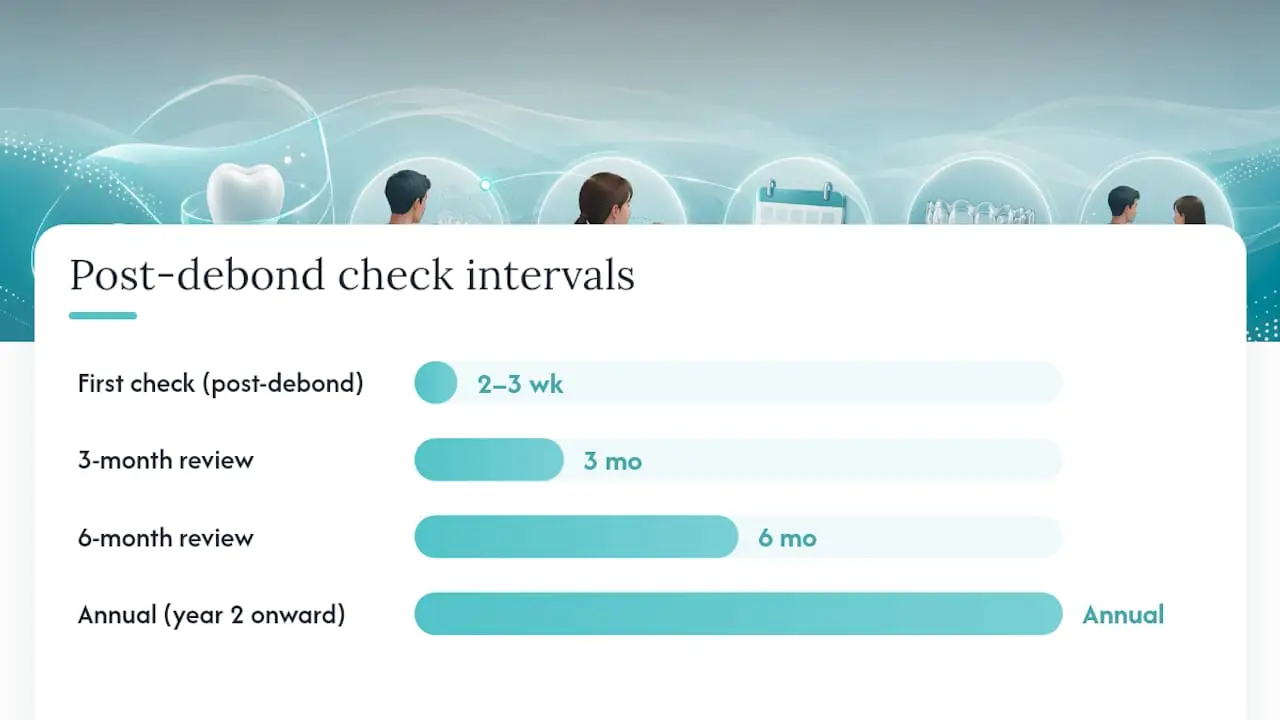
- 2–3 weeks post-debond: Bond integrity check, wire distortion assessment, removable retainer fit and occlusal contact verification
- 3 months: Full clinical review, patient compliance assessment, occlusal stability check, periodontal indices
- 6 months: Repeat clinical review; transition decision for wear schedule
- Annual (year 2 onward): Stability assessment, retainer condition, patient adherence, periodontal health; refer back to orthodontist if relapse is detected
The clinical practice guideline acknowledges that evidence on optimal check frequency is limited, but the two-to-three-week first check is consistently recommended because fixed retainer bond failure peaks in the immediate post-debond period.
Common complications and alarm signs:
- Fixed retainer debond: patient reports a loose or “clicking” wire; visible gap between wire and tooth surface
- Wire distortion causing tooth movement: visible rotation or spacing adjacent to the wire; patient reports discomfort
- Essix cracking or poor fit: retainer no longer seats fully; patient reports pressure or pain on insertion; visible cracks in the thermoplastic
- Periodontal inflammation around bonded wire: bleeding on probing, plaque accumulation, gingival hyperplasia adjacent to wire
- Occlusal change under removable retainer: patient reports bite feels different; new posterior open bite or anterior contact change
Repair and management protocol:
- Fixed retainer debond: Patient uses backup removable retainer immediately. Schedule repair within 48–72 hours. Assess for tooth movement before rebonding. Document the failure date, tooth involved, and any movement detected.
- Wire distortion with tooth movement: Do not rebond the wire in its distorted position. Assess the degree of movement. Minor movement (less than 0.5mm) may be managed with a new removable retainer impression and rebonding. Greater movement warrants orthodontic consultation and possible refinement.
- Essix cracking or poor fit: Fabricate a new retainer from the original scan or a new impression. If significant time has passed since debond, take a new scan to confirm the teeth have not moved before fabricating the replacement.
- Periodontal inflammation around wire: Reinforce oral hygiene instruction. Consider canine-only bonding as a compromise if full-arch wire is not maintainable. Refer to periodontist if attachment loss is progressing.
Handover to general dentist. The written handover agreement should specify: retainer type and material, fabrication date, wear schedule, signs of failure the dentist should watch for, and the protocol for referring back to the orthodontist. Practices that implement bilingual patient intake and communication systems report improved adherence to long-term follow-up protocols, particularly for diverse patient populations where written instructions in the patient’s primary language make a measurable difference.
What does the evidence actually say about retention after aligners?
The honest answer is that the evidence base for CAT-specific retention is thinner than most clinicians realize. Most retention RCTs and systematic reviews were conducted on fixed-appliance patients, and extrapolating those findings to aligner cases requires caution.
Evidence summary:
- The Cochrane review found similar short-term stability between fixed and removable retainers, with low-to-moderate certainty across most RCTs. Fixed retainers may preserve alignment better long-term but increase periodontal risk.
- The clinical practice guideline recommends individualized retention planning, written instructions, and early monitoring, but stops short of mandating a single protocol because the evidence does not support one.
- The AAO member survey shows that 83% of CAT-experienced orthodontists prefer Essix retainers post-treatment, with 43% also using bonded retainers, reflecting a clinical consensus that outpaces the formal RCT evidence.
- The 2018 systematic review found more relapse in some early Invisalign cases compared with fixed appliances, attributing this to aligner biomechanical limitations in torque and root control.
- University of Washington longitudinal data, cited in the British Dental Journal overview, showed approximately 70% of patients had severe retreatment need within 10 years without retainers. That cohort predates modern aligner systems, but the biological drivers of relapse have not changed.
- The ScienceDirect posttreatment review endorses shared decision-making and notes that dual retention is widely practiced, though its additional benefit over single-device retention remains incompletely quantified.
Stepwise evidence-informed protocol for US practice:
| Phase |
Action |
Timing |
| Pre-debond |
Identify risk profile; plan device type; order materials |
Final aligner check |
| Debond day |
Bond fixed retainer; scan with wire in place; begin patient education |
Day 0 |
| Delivery |
Deliver removable retainer; confirm fit and occlusion; provide written instructions |
1–2 weeks post-debond |
| Early check |
Bond integrity, wire distortion, removable fit, compliance |
2–3 weeks |
| 3-month check |
Occlusal stability, compliance, transition decision |
Month 3 |
| 6-month check |
Wear schedule transition to night-only if criteria met |
Month 6 |
| Annual review |
Stability, retainer condition, periodontal health, handover confirmation |
Year 2 onward |
| Contingency |
Relapse detected: assess degree, consider refinement or rebond; retainer failure: repair within 48–72 hours |
As needed |
Knowledge gaps clinicians should track: Long-term RCTs specifically designed for CAT retention are limited. Evolving aligner materials, in-house aligner fabrication, and attachment design changes may alter retention needs in ways the current literature does not capture. Practices should audit their own outcomes.
Priority metrics to record for practice audit:
- Retainer type and material at debond
- Fit issues noted at first check
- Patient-reported compliance at each visit
- Retainer failures (type, timing, tooth involved)
- Any post-retention retreatment within five years
What should you tell patients and document in the chart?
Patient education and documentation are where retention protocols either hold or fall apart. A clinician who delivers a perfect bonded retainer but hands the patient a verbal-only explanation is setting up a compliance failure.
Patient handout template items:
- Wear schedule: full-time for the first three months, then night-only as directed
- Cleaning instructions: rinse the removable retainer with cool water after removal; brush gently with a soft toothbrush and mild soap (not toothpaste, which is abrasive); soak weekly in a retainer cleaning tablet solution
- Signs of failure to report immediately: loose or clicking wire, retainer no longer seating fully, visible crack in the thermoplastic, new spacing or rotation
- Backup plan: keep the most recent aligner tray as a temporary backup if the retainer breaks or is lost; contact the office within 24 hours
- Long-term commitment: retainer wear is indefinite; stopping entirely is the most common cause of relapse
Cleaning and hygiene specifics. For Essix/VFR retainers, avoid hot water (distorts the thermoplastic), alcohol-based mouthwashes (degrades the material), and leaving the retainer in a closed case without cleaning (bacterial growth). For bonded retainers, floss threaders or orthodontic floss are required to clean interproximally; a water flosser is a useful adjunct but does not replace mechanical cleaning.
Pro Tip: Give every patient a written wear schedule with checkboxes for each month. Patients who track their own compliance are more likely to maintain it. A simple one-page handout with the wear schedule, cleaning steps, and your emergency contact number reduces after-hours calls and improves long-term adherence.
Documentation checklist for the clinical record:
- Device type (fixed wire, Essix, Hawley, dual)
- Material and wire gauge (for fixed retainers)
- Lab or scan record reference number
- Delivery date and fit confirmation note
- Written consent or retention agreement signed by the patient, stating long-term expectations
- Handover plan: name of general dentist, date of written handover, protocol for referral back
- Compliance notes at each check visit
- Any retainer failures, repairs, or replacements with dates
The clinical practice guideline explicitly calls for written patient instructions and documented handover agreements. These are not administrative formalities. They are the mechanism by which long-term retention actually gets maintained when the patient transitions out of active orthodontic care.
Key Takeaways
Dual retention with a bonded wire and nightly Essix retainer is the most defensible default for high-risk aligner cases, with individualized planning, early monitoring, and written documentation driving long-term success.
| Point |
Details |
| Retention is a permanent commitment |
Without retainers, approximately 70% of patients showed severe retreatment need within 10 years in University of Washington cohort data. |
| Match device to risk profile |
Bonded wire for high-rotation and spacing cases; Essix/VFR for most aligner patients; Hawley when occlusal settling is incomplete. |
| Dual retention for high-risk cases |
Bond the fixed retainer first, then scan with the wire in place to fabricate a fitting removable overlay. |
| Schedule early and annual checks |
First check at 2–3 weeks post-debond; two to three visits in year one; annual review from year two onward per the clinical practice guideline. |
| Onewd clear aligner CE |
Onewd’s clear aligner courses cover trimline design, attachment protocols, and retention workflows for US clinicians. |
The part of retention nobody talks about enough
The clinical literature on retention is thorough on device comparisons and wear schedules. What it underplays is the gap between what clinicians prescribe and what patients actually do, and how much of that gap is created at the debond appointment itself.
Most retention failures are not device failures. They are communication failures. A patient who does not genuinely understand why they need to wear a retainer indefinitely will stop wearing it within a year, usually quietly, and show up two years later asking why their teeth have shifted. The bonded wire catches some of that drift, but not all of it, and not in every arch.
The shared decision-making framework endorsed by the posttreatment care literature is the right instinct, but it requires time that a busy debond appointment often does not have. The solution is not a longer appointment. It is a better pre-debond conversation, ideally at the final aligner check, where the patient is still engaged and the retainer plan feels like a natural continuation of treatment rather than a new obligation being handed to them on the way out the door.
The other underappreciated issue is the handover to the general dentist. Most orthodontists document the handover. Far fewer confirm that the general dentist has actually received the information and knows what to look for at annual exams. A written agreement is necessary but not sufficient. A direct communication, even a brief referral note, closes that loop in a way that documentation alone does not.
Clinicians who audit their own retention outcomes, tracking retainer failures, compliance rates, and any retreatment within five years, are the ones who actually improve their protocols over time. The literature gives you a starting framework. Your own data tells you whether it is working.
Translate this protocol into clinical skills with Onewd
Reading a retention protocol and executing it confidently at the chair are two different things. Onewd’s clear aligner training courses are built specifically to close that gap for US dental professionals, with content that maps directly to the workflows covered in this guide.

The Clear Aligner Trim Line course covers exactly the trimline and edging decisions that determine whether your Essix retainer supports occlusal settling or works against it. Onewd’s hands-on and in-person training formats include live demonstrations of scan-with-bonded-retainer workflows, dual retention sequencing, and the chairside checks that catch early bond failures before they become relapse. Courses are available across difficulty levels, from introductory CAT retention basics to advanced dual-retention and complication management, with accredited CE credits upon completion. Browse current courses to find a format and schedule that fits your practice.
Useful sources
Recommended