The ADA Caries Risk Assessment Form is a standardized clinical tool developed by the American Dental Association to help dental professionals evaluate each patient’s likelihood of developing dental caries. Rather than relying on clinical intuition alone, the form structures that judgment around documented factors, producing a defensible risk category that drives preventive and treatment decisions.
The ADA CRA forms organize patient data into three risk levels: low, moderate, and high. That classification then guides recall intervals, fluoride recommendations, sealant decisions, and the intensity of patient counseling. A patient categorized as high risk gets a very different management plan than one categorized as low risk, even if their current caries status looks similar on the surface.
The form covers three broad domains:
- Clinical observations: Active caries lesions, restorations placed in the past three years, visible plaque, and radiographic evidence of decay
- Protective factors: Fluoride exposure (water, toothpaste, professional application), dental home visits, and adequate saliva flow
- Risk factors: Diet high in fermentable carbohydrates, fluoride exposure gaps, medical conditions affecting saliva, socioeconomic factors, and family history of caries
The ADA forms reflect expert consensus and clinical best practices rather than a single validated algorithm, which is worth understanding before you apply them. They are widely used across the United States and endorsed by professional dental bodies as a practical starting point for caries management.
The ADA publishes two distinct forms, and using the wrong one introduces inaccuracies from the first checkbox. The split is straightforward: one form covers patients aged 0–6, and the other covers patients aged 6 and older.
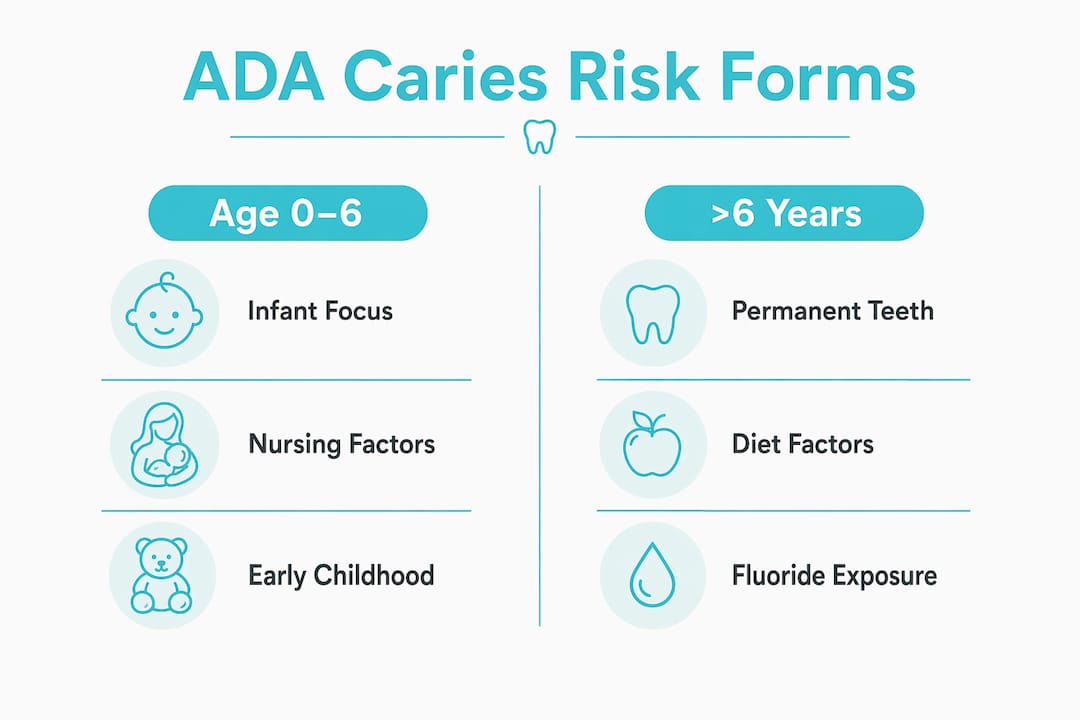
This form is built around the biological and behavioral realities of early childhood. Infants and toddlers face caries risks that simply do not apply to adults, so the form weights those factors accordingly.
Key considerations unique to this age group:
- Bottle feeding other than water at bedtime is flagged as a significant risk indicator. Prolonged exposure to fermentable carbohydrates during sleep dramatically increases caries risk in primary dentition, and the ADA 0–6 form treats this factor as a driver of higher risk categorization.
- Caregiver caries status matters here in a way it does not for older patients. Active caries in a primary caregiver increases the child’s bacterial exposure.
- Fluoride exposure is assessed differently, since community water fluoridation and age-appropriate fluoride toothpaste use are the primary protective factors for this group.
- Socioeconomic status and access to dental care are weighted because early childhood caries disproportionately affects underserved populations.
This form applies to older children, adolescents, and adults. The structure is similar but the risk factors shift to reflect the oral environment of a more mature dentition.
Distinct considerations for this group:
- Orthodontic appliances and removable partial dentures appear as risk factors, since they complicate oral hygiene and create plaque-retentive surfaces.
- Eating disorders, drug use, and medications causing xerostomia are captured here, reflecting the broader range of systemic and behavioral factors relevant to older patients.
- Interproximal restorations placed in the past three years serve as a clinical signal of recent caries activity.
- Saliva flow and quality are assessed more granularly, since salivary dysfunction is more prevalent and clinically significant in adult populations.
Both forms are available as printable PDFs from the ADA. They can be completed on paper or used digitally, though neither form currently includes automated intervention pathways or integrated clinical decision support.
Filling out the form correctly takes about five minutes once you know the workflow. The challenge is not the form itself but building the habit of completing it consistently for every patient, not just the ones who look high risk at first glance.
-
Select the correct form. Confirm the patient’s age and pull the appropriate version: 0–6 or >6. Using the adult form on a three-year-old will miss critical early childhood risk indicators.
-
Complete clinical observations first. Work through the clinical section while the patient is in the chair. Document active caries lesions, restorations placed in the past three years, visible plaque, and radiographic findings. These are objective findings, so complete them before moving to behavioral factors.
-
Record protective factors. Ask about fluoride exposure: community water source, fluoride toothpaste use, and any professional fluoride applications. Note whether the patient has an established dental home and regular recall visits. These factors can pull a borderline moderate-risk patient down to low risk.
-
Assess risk factors. Work through diet, medical history, medications, and social history. For the 0–6 form, ask caregivers directly about feeding practices and their own dental history. For the >6 form, screen for xerostomia-inducing medications and any systemic conditions affecting saliva.
-
Assign the overall risk category. The form does not calculate a score automatically. You review the checked factors across all three domains and assign low, moderate, or high risk based on the overall picture. The ADA forms weigh preventive factors less heavily than some other systems, so a patient with several protective factors may still land in the moderate or high category if clinical findings are significant.
-
Document and communicate. Record the assigned risk category in the patient’s chart. Use it to anchor your preventive recommendations during the appointment, and note the date so you can track changes at subsequent visits.
-
Integrate with your EHR. Most modern dental EHR platforms allow you to attach scanned PDFs or enter risk category data as a discrete field. If your system supports structured data entry, log the risk category there rather than in a free-text note, which makes it easier to filter patients by risk level for recall scheduling.
Pro Tip: When a patient’s clinical findings and behavioral history point in different directions, default to the higher risk category. The ADA forms are designed to err on the side of caution, and the cost of over-treating a low-risk patient is far lower than under-treating a high-risk one.

Why caries risk assessment changes how you manage patients
A cavity risk assessment is not just a documentation exercise. The risk category you assign directly shapes the clinical decisions you make for the next six to twelve months.
For low-risk patients, standard recall intervals (every six months) and routine fluoride toothpaste recommendations are usually sufficient. For moderate-risk patients, you might shorten recall to every three to four months, prescribe prescription-strength fluoride toothpaste, and apply professional fluoride varnish at each visit. High-risk patients may need all of that plus antimicrobial therapy, dietary counseling, and more aggressive restorative intervention.
The multifactorial factors assessed in ADA CRA forms, including fluoride exposure, diet, family history, socioeconomic status, medical conditions, and oral environment, give you a structured basis for those decisions rather than relying on a single clinical finding like DMFT score.
There are real limitations to acknowledge. The ADA forms lack formal clinical outcome validation studies specific to their own format. They reflect expert consensus, not a prospectively validated algorithm. In diverse patient populations, particularly those with complex social determinants of health or limited English proficiency, the forms may not capture the full picture without supplementary clinical judgment.
Benefits of using a standardized dental caries risk evaluation tool:
- Consistent documentation across providers in a group practice
- Clear communication of risk status to patients and caregivers
- Defensible basis for insurance pre-authorization of preventive services
- Trackable data over time to measure whether interventions are working
- Reduced variability in recall scheduling and fluoride prescribing
The form works best when it is treated as a clinical conversation starter, not a checkbox exercise completed after the patient leaves the chair.
Evidence base and additional resources for ADA CRA use
The ADA CRA forms are widely used, but the evidence supporting them is worth understanding clearly. They are built on expert consensus and reflect established clinical principles rather than prospective randomized trials validating the specific form structure.
Official ADA resources:
- The ADA’s official completion instructions PDF provides guidance on interpreting each section and assigning risk categories
- The ADA Center for Evidence-Based Dentistry publishes clinical practice guidelines on caries prevention that complement CRA use
- The ADA’s oral health topics library includes background on caries etiology, fluoride, and sealants
Comparative research:
| Tool |
Age Groups |
Validation Status |
Automated Pathways |
| ADA CRA (0–6 and >6) |
Pediatric and adult |
Expert consensus |
No |
| CAMBRA |
Pediatric and adult |
Prospective studies available |
Yes |
| Cariogram |
Adult-focused |
Validated in multiple studies |
Partial |
| AAPD CRA |
Pediatric |
Expert consensus |
No |
A comparative analysis of four caries risk assessment methods found that the ADA forms tend to assign higher risk categories than CAMBRA for the same patients, largely because they weight protective factors less strongly. That tendency to err toward higher risk is a deliberate design choice, not a flaw, but it is worth knowing when you are interpreting results or explaining a risk category to a patient who finds it surprising.
Supplementary clinical guidelines:
- The National Institute of Dental and Craniofacial Research (NIDCR) publishes epidemiological data on tooth decay prevalence that contextualizes individual patient risk
- MedlinePlus (medlineplus.gov) offers patient-facing resources you can use alongside the CRA form during counseling
- The Texas Health and Human Services oral health risk form for ages 6–20 offers a state-level example of how CRA tools are adapted for public health programs
Practical integration tips:
- Schedule CRA completion at new patient exams and at least annually for moderate and high-risk patients
- Use the risk category to justify fluoride varnish billing codes to insurers
- Train your entire clinical team, including hygienists and dental assistants, to gather the behavioral and social history data the form requires before the dentist enters the room
How Onewd helps you apply caries risk assessment in real practice
Understanding the ADA CRA form on paper is one thing. Applying it confidently across a diverse patient population, integrating it into your workflow, and using the results to drive genuinely better outcomes is a different skill set. That gap between knowing and doing is exactly where continuing education matters.

Onewd offers training courses built for dental professionals who want to move from theoretical knowledge to clinical mastery. The platform’s approach is mentorship-driven and tiered, which means you are not just watching a lecture on caries risk assessment. You are working through real cases, getting feedback, and building the clinical judgment that makes a tool like the ADA CRA form genuinely useful.
Relevant educational opportunities through Onewd:
- Caries risk assessment in comprehensive treatment planning: Modules covering how to integrate ADA CRA results into full-mouth rehabilitation and preventive care protocols
- Pediatric oral health fundamentals: Training on the 0–6 form, early childhood caries risk factors, and caregiver counseling techniques
- Advanced clinical decision-making: Level 3 advanced courses that address nuanced risk stratification in complex patients, including those with systemic disease or polypharmacy
- Multidisciplinary treatment planning: Courses that show how caries risk assessment intersects with orthodontic, prosthodontic, and surgical treatment decisions
- CE credits: Accredited continuing education credits awarded upon completion, supporting state licensure requirements
Pro Tip: If your practice sees a high volume of pediatric patients, prioritize training specifically on the 0–6 ADA form and early childhood caries prevention. The risk factors for that age group are distinct enough that general caries training often underserves it.
Onewd’s live patient modules and hands-on components mean that clinical skills are practiced, not just described. For a tool like the ADA CRA form, where the quality of the assessment depends heavily on how you gather history and interpret findings, that kind of practice-based learning makes a real difference.
Key Takeaways
The ADA Caries Risk Assessment Form is the standard clinical tool for categorizing patients as low, moderate, or high caries risk, and the category you assign should directly drive your preventive management decisions.
| Point |
Details |
| Two forms by age group |
Use the 0–6 form for young children and the >6 form for older children and adults; the risk factors differ significantly between them. |
| Higher risk categorization tendency |
ADA forms weight protective factors less strongly than CAMBRA, so expect higher risk assignments for some patients. |
| No automated pathways |
ADA CRA forms are PDF-based tools requiring clinical judgment; they do not include built-in intervention algorithms. |
| Risk category drives management |
Low, moderate, and high categories should directly determine recall intervals, fluoride prescribing, and preventive intensity. |
| Training closes the gap |
Continuing education through platforms like Onewd translates form knowledge into consistent, confident clinical application. |
Recommended