Contraindications for dental implants are specific medical, systemic, and local conditions that either prevent or significantly complicate successful implant therapy. The field distinguishes between absolute contraindications, which rule out implant placement entirely, and relative contraindications, which require careful risk stratification before proceeding. Clinicians who treat implant contraindications as a fixed checklist miss the point. Current evidence supports a dynamic, patient-centered approach that weighs comorbidities, medications, and local anatomy together. This guide gives you the clinical framework to make those calls with confidence.
What are the absolute contraindications for dental implants?
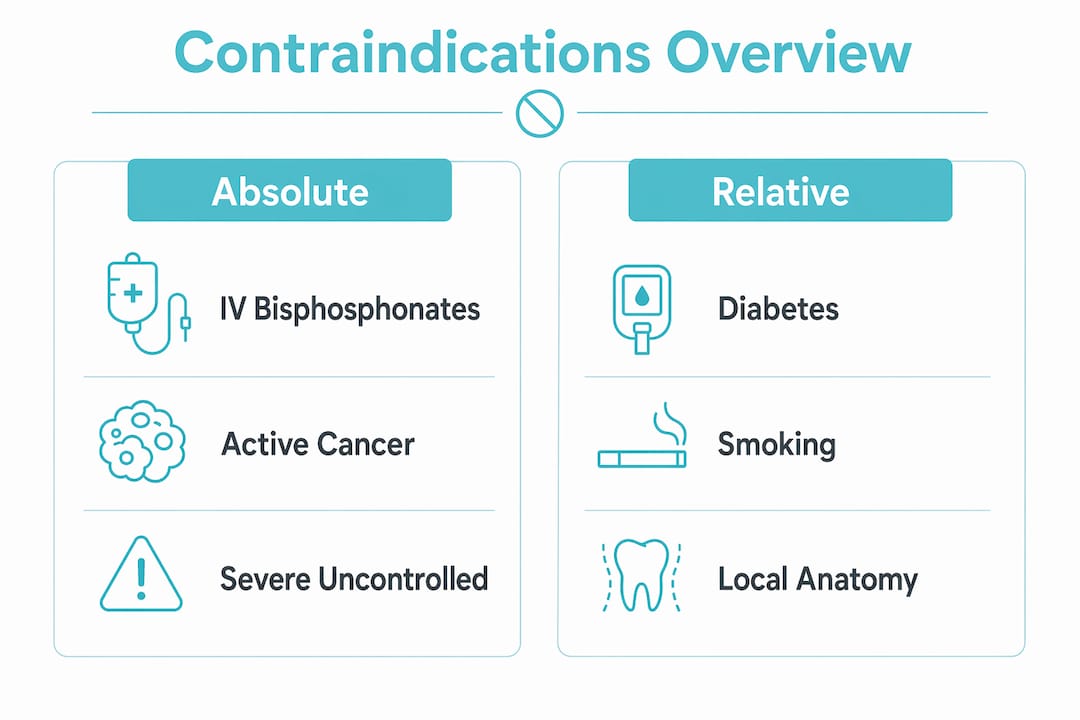
Absolute contraindications represent conditions where the risk of implant failure or life-threatening complication is high enough to prohibit placement under any standard protocol. These are not judgment calls. They are evidence-based stop signs.
The clearest absolute contraindications include:
- Recent myocardial infarction or cerebrovascular accident: Elective surgery within 6 months of a cardiac event carries unacceptable anesthetic and hemostatic risk.
- Uncontrolled bleeding disorders: Patients on anticoagulation therapy without medical clearance cannot safely undergo surgical implant placement.
- Active malignancy or radiation therapy to the head and neck: Radiation damages the vascularity of jaw bone, severely impairing healing and osseointegration.
- IV bisphosphonate therapy: IV bisphosphonate use carries a significantly elevated risk of medication-related osteonecrosis of the jaw (MRONJ). This is one of the most cited pharmacologic absolute contraindications in implant dentistry.
- Severe immunosuppression: Patients on high-dose corticosteroids or immunosuppressive agents post-transplant face dramatically elevated infection and failure risk.
- Active intravenous drug use: Systemic infection risk and poor healing capacity make implant placement untenable.
MRONJ deserves special attention. The jaw necrosis risk from IV bisphosphonates is not theoretical. Patients receiving these agents for oncologic bone disease show measurably higher implant failure and necrosis incidence. Oral bisphosphonates at low doses carry a lower but still real risk, which places them in the relative contraindication category rather than the absolute one.
Pro Tip: Always conduct a full pharmacologic review before any implant workup. Medications like denosumab and antiresorptive agents carry MRONJ risk comparable to IV bisphosphonates and are frequently overlooked in screening.
Active cancer treatment is another area where clinicians sometimes underestimate risk. Chemotherapy suppresses bone marrow function and immune response simultaneously. Placing an implant during active treatment is not a calculated risk. It is a predictable failure.
How do relative contraindications and systemic risk factors impact implant candidacy?
Relative contraindications require individualized assessment rather than automatic exclusion. The key question is not whether a condition exists, but how well it is controlled and what the realistic risk-to-benefit ratio looks like for that specific patient.
The most clinically significant relative contraindications include:
-
Uncontrolled diabetes: Well-controlled diabetes with an HbA1c at or below 7% produces implant survival rates exceeding 90–95%, comparable to non-diabetic patients. Poor glycemic control correlates directly with increased peri-implant bone loss and inflammatory complications. The condition itself does not contraindicate implants. The control level does.
-
Smoking: Cigarette smoke components impair bone metabolism and delay implant healing. Smokers face significantly higher implant failure rates than non-smokers. Cessation before and after surgery improves prognosis measurably.
-
Osteoporosis and oral bisphosphonate use: Low-dose oral bisphosphonates carry a lower MRONJ risk than IV formulations, but the risk is not zero. Drug holidays and medical consultation are standard protocol before implant surgery in these patients.
-
Autoimmune conditions: Disorders like Sjögren’s syndrome and rheumatoid arthritis affect tissue healing and immune surveillance. They require coordinated management with the patient’s rheumatologist.
-
Advanced age: Age alone does not contraindicate implants. A 2026 review found similar or better implant survival rates in older patients compared to younger cohorts. Systemic health and bone volume, not chronological age, determine candidacy.
“Clinicians are encouraged to move from fixed contraindication lists to dynamic risk factor management, optimizing systemic health preoperatively.” This shift reflects the consensus across 2026 evidence-based guidelines and represents the current standard of care in implant dentistry.
Maintenance protocols matter as much as the initial risk assessment. Patients with relative contraindications need more frequent recall appointments and closer monitoring for peri-implantitis. 2026 consensus guidelines recommend risk-stratified periodontal and implant maintenance based on systemic health status. A patient with well-controlled diabetes who smokes needs a different recall schedule than a healthy non-smoker.
What local and anatomical factors may contraindicate implant placement?
Systemic health gets most of the attention in contraindication discussions, but local factors are equally capable of preventing successful implant therapy. Clinicians must evaluate the surgical site with the same rigor applied to medical history.

| Local Factor |
Contraindication Status |
Clinical Action |
| Insufficient alveolar bone volume |
Relative |
Site development or bone grafting before implant placement |
| Active periapical infection |
Absolute (until resolved) |
Treat and confirm resolution before implantation |
| Uncontrolled periodontal disease |
Relative |
Full periodontal stabilization required pre-implant |
| Inadequate keratinized tissue |
Relative |
Soft tissue augmentation may be indicated |
| Unfavorable occlusal loading |
Relative |
Prosthetic planning and occlusal adjustment needed |
| Proximity to vital structures |
Relative |
Advanced imaging and surgical planning required |
Insufficient bone volume and unfavorable local anatomy can contraindicate implant placement unless site development is feasible. This is not a permanent barrier for most patients. It is a sequencing problem. Bone grafting, socket preservation, and guided bone regeneration can create viable implant sites in many cases where immediate placement would fail.
Active oral infections are a different matter. Placing an implant into or adjacent to an infected site introduces bacteria directly into the surgical wound. The infection must be fully resolved and confirmed with radiographic and clinical assessment before implant surgery proceeds.
Pro Tip: Cone beam computed tomography (CBCT) is the diagnostic standard for evaluating bone volume, density, and proximity to the inferior alveolar nerve or maxillary sinus before implant placement. Two-dimensional radiographs alone are insufficient for complex cases.
Occlusal factors are frequently underweighted in local contraindication assessment. Parafunctional habits like bruxism generate forces that exceed the fatigue tolerance of implant components. Patients with unmanaged bruxism need a night guard protocol and careful prosthetic design before implant placement is appropriate.
How can clinicians apply a risk-based approach to manage implant contraindications?
Risk stratification is the practical bridge between identifying contraindications and making a treatment decision. The goal is to quantify cumulative risk across systemic, pharmacologic, and local factors, then act on that number.
The Systemic Inflammatory Burden Score (SIBS) is the most evidence-supported tool for this purpose. Each unit increase in SIBS raises implant failure risk by 18%. SIBS aggregates comorbidities including diabetes, smoking, and immunosuppression into a single continuous scale. That predictive accuracy surpasses evaluating each condition in isolation.
A practical risk-based workflow includes:
- Complete medical and pharmacologic history: Flag all medications with known implant interactions, including antiresorptives, immunosuppressants, and anticoagulants.
- Glycemic optimization: For diabetic patients, target HbA1c at or below 7% before scheduling surgery. Coordinate with the patient’s endocrinologist when needed.
- Smoking cessation counseling: Recommend cessation at least 4 weeks before surgery and through the osseointegration period. Document the conversation.
- SIBS calculation: Use the score to communicate risk level to patients and to set recall frequency post-placement.
- Medication review for protective effects: Antihyperlipidemic therapy is associated with a 1.01% implant failure rate over 10 years, compared to 5.12% in controls. Statins and related agents may enhance osseointegration. This finding means medication review is not only about identifying risks. It is also about recognizing protective factors.
- Multidisciplinary collaboration: Patients with complex systemic conditions need clearance from their primary care physician or specialist before implant surgery.
- Individualized maintenance: Patients with relative contraindications benefit from aggressive, frequent recall to reduce peri-implantitis risk and catch early failures before they become irreversible.
The clinician’s role is not to exclude patients with relative contraindications. It is to optimize their systemic health, set realistic expectations, and build a monitoring protocol that catches problems early. That approach produces better outcomes than either blanket exclusion or uncritical acceptance.
Key Takeaways
Absolute and relative contraindications for dental implants require different clinical responses: absolute conditions prohibit placement, while relative conditions demand risk optimization and individualized protocols before proceeding.
| Point |
Details |
| Absolute contraindications prohibit placement |
Conditions like IV bisphosphonate use, active malignancy, and recent cardiac events require deferral or permanent exclusion. |
| Glycemic control determines diabetes risk |
Diabetic patients with HbA1c at or below 7% achieve implant survival rates comparable to non-diabetic patients. |
| Age alone is not a contraindication |
2026 evidence shows older patients achieve similar or better implant survival when systemic health and bone volume are adequate. |
| SIBS quantifies cumulative risk |
Each unit increase in the Systemic Inflammatory Burden Score raises implant failure risk by 18%, making it a reliable planning tool. |
| Medication review cuts both ways |
Antihyperlipidemics may improve osseointegration, so pharmacologic review should identify protective factors, not just risks. |
The shift I keep seeing clinicians miss
The biggest mistake I see in implant planning is treating contraindication assessment as a one-time checkbox at the initial consultation. Systemic health changes. Medications change. A patient who was not a candidate 18 months ago because of uncontrolled diabetes may be an excellent candidate today with an HbA1c of 6.8%. The reverse is also true. A patient who was cleared for implants and then started IV bisphosphonate therapy for bone metastases needs immediate reassessment.
The move toward dynamic risk management is not just an academic trend. It reflects what actually happens in practice. Rigid lists fail patients at both ends. They exclude people who could safely receive implants, and they miss newly emerging risks in patients already in treatment. The SIBS model is useful precisely because it forces you to recalculate, not just recall.
What I find most underappreciated is the pharmacologic opportunity. Most clinicians screen medications for harm. Very few screen them for benefit. The data on antihyperlipidemics is striking enough that I now include statin use as a positive factor in my pre-implant risk summary. That kind of nuance only comes from staying current with the literature, not from memorizing a contraindication list written a decade ago.
Clinicians who want to stay ahead of this curve need structured, ongoing education. The evidence base for implant contraindications is moving fast. Courses that integrate current research with live surgical experience are the fastest way to close the gap between what the literature says and what you do on Monday morning.
— Jake
Sharpen your implant risk assessment skills with Onewd
Contraindication management is one of the highest-stakes skills in implant dentistry. Getting it wrong costs patients their health and clinicians their outcomes data.
Onewd offers specialized implant training that covers patient risk assessment, contraindication screening, and evidence-based treatment planning, from foundational placement courses to advanced surgical techniques. Courses are available online and in person, with mentorship-driven formats that connect clinical decision-making to real surgical cases. Clinicians who want to build confidence in complex patient evaluation can also explore implants and surgery courses covering the full scope of pre-implant workup and perioperative management. The curriculum is built for clinicians who want to apply current evidence, not just review it.
Recommended