To earn the Master of the Academy of General Dentistry (MAGD), you must already hold the FAGD designation, maintain continuous AGD membership for at least three years by December 31 of your application year, hold an eligible dental license, and complete 1,100 AGD-approved CE hours as an AGD member — including at least 400 participation (hands-on) hours and 600 hours meeting discipline-specific minimums. Submit your application electronically by December 31 of the year before the award year, then attend an AGD Convocation Ceremony within three years of approval.
Quick eligibility checklist:
- Current FAGD status and continuous AGD membership (minimum three years by Dec. 31)
- Active, eligible dental license (no suspension/revocation in the past five years, no current probation)
- 1,100 total AGD-approved CE hours as a member (includes your first 500 Fellowship hours)
- At least 400 participation hours and 600 discipline-specific hours within that total
- Application submitted electronically by Dec. 31; Convocation attendance within three years of approval
Key Takeaways
Earning MAGD requires 1,100 AGD-approved CE hours as a member, including at least 400 participation hours and 600 discipline-specific hours, with a December 31 application deadline and mandatory Convocation attendance within three years of approval.
| Point |
Details |
| Core hour requirements |
1,100 total CE hours as an AGD member, with at least 400 participation and 600 discipline-specific hours. |
| Application deadline |
Submit electronically by December 31 of the year before the award year; all hours must be complete by that date. |
| 2029 rule changes |
Specified MAGD minimums rise from 568 to 582 hours; Sleep Medicine added as a new subject category. |
| Documentation discipline |
Keep originals of all certificates with subject codes; request corrected verifications within 30 days of any course. |
| Onewd for participation hours |
Onewd’s hands-on implant and live-surgery courses generate participation hours with AGD-compliant documentation. |
What are the exact MAGD requirements you need to meet?
Basic eligibility
Before a single CE hour matters, three baseline conditions must be satisfied. First, you must be a current AGD Fellow — the FAGD is a prerequisite, not a co-requisite. Second, your AGD membership must be continuous for at least three years as of December 31 of the year you apply. A lapse resets that clock, so keeping dues current is not optional. Third, your dental license must be in good standing: no suspension or revocation within the previous five years, and no active probation, suspension, or revocation at the time of application.
The CE hour math
The 1,100-hour total is cumulative across your entire AGD membership. Your first 500 hours earned toward Fellowship count toward that total, so you are not starting from zero after FAGD. In practice, that means you need roughly 600 additional hours after Fellowship — but the composition of those hours matters as much as the count.
Within the 1,100 hours:
- a substantial number of hours must be participation (hands-on) hours
- a considerable number of hours must satisfy the discipline-specific minimums across AGD subject categories
- These two requirements overlap — a participation course in an eligible subject category satisfies both simultaneously
What “participation” actually means
AGD defines a participation course as one where attendees actively manipulate materials or devices, treat patients, or practice clinical skills under supervision. A lecture with a brief demo at the end does not qualify. If you are unsure whether a course meets this standard, ask the provider before you register, not after.
Other CE types and caps
- Lecture: traditional didactic instruction; counts toward total hours but not participation minimums
- Self-instruction: home-study, online modules, and similar formats; accepted within AGD guidelines
- Teaching and publication: hours earned by teaching AGD-approved courses or publishing peer-reviewed work; capped at 150 hours total toward the MAGD requirement
Step-by-step eligibility confirmation
- Confirm your FAGD is active and your AGD membership has been continuous.
- Pull your current AGD transcript and tally total hours, participation hours, and hours per subject category.
- Identify gaps against the 400 participation minimum and the discipline-specific minimums.
- Verify your license is in good standing with no disqualifying history.
- Confirm all remaining CE will be completed by December 31 of the year before you plan to apply.
Pro Tip: Request your official AGD transcript at least six months before your intended application deadline. Providers sometimes submit CE records late or with incorrect subject codes, and corrections take time. Catching a coding error in June beats discovering it in December.
Which subject categories must your hours cover?
AGD organizes CE into 18 subject categories, each with its own subject code, participation minimum, and MAGD minimum. Meeting the discipline-specific minimums is what separates a dentist who has logged 1,100 hours from one who has actually earned Mastership eligibility.
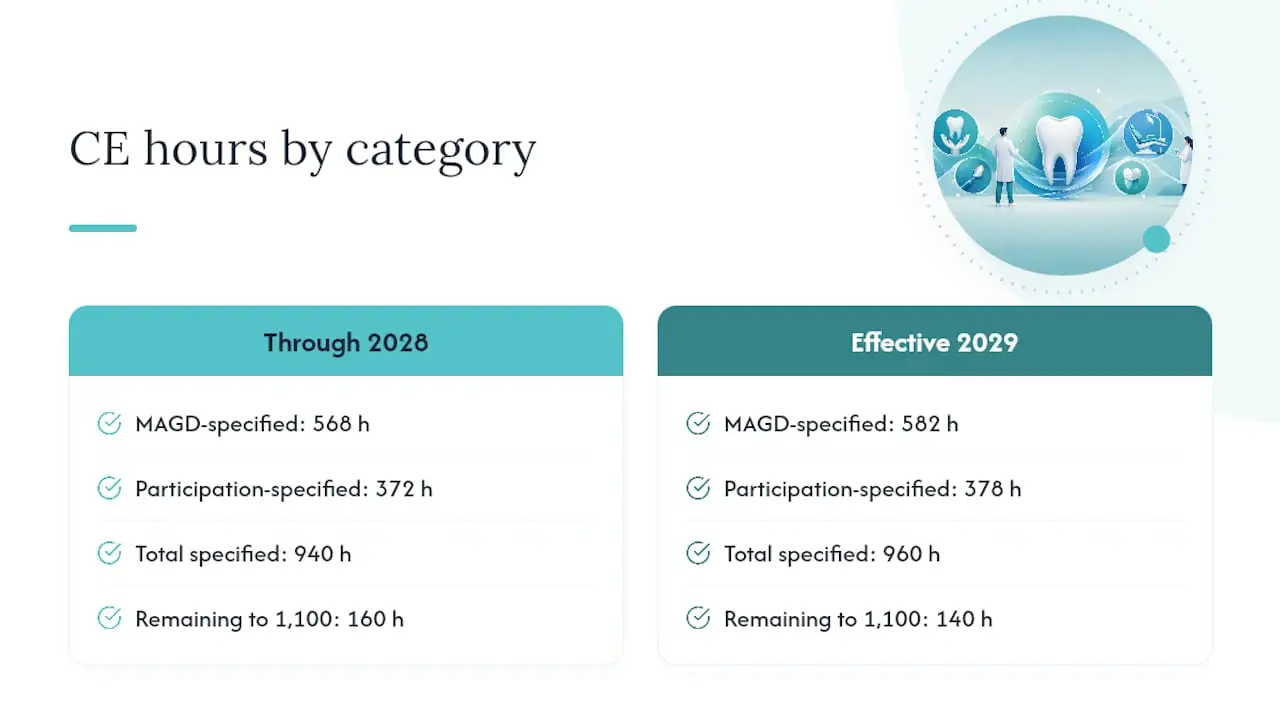
The table below reflects the current minimums (through December 31, 2028) and the revised minimums effective January 1, 2029. The 2029 figures reflect AGD’s approved guideline changes, including the addition of Sleep Medicine as a new subject category.
Note: The exact per-category hour figures are published in the official AGD subject code list. Always verify against that source before planning, since the table is updated when AGD approves guideline changes. Across all specified categories, the total MAGD minimum rises from 568 specified hours to 582 specified hours effective January 1, 2029, and participation specified hours increase from 372 to 378.
How the remaining hours work
Once you satisfy each category’s minimum, the remaining hours in your 1,100-hour total can come from any AGD-approved subject category. That flexibility is real, but it does not help you if you have a gap in a required category. Broad CE early in your MAGD journey is safer than narrow specialization.
Example allocations (generic):
- A candidate heavy in implant training might satisfy Implants, Oral Surgery, and Esthetics minimums through hands-on workshop series, then fill remaining hours with lecture-based Periodontics and Endodontics.
- A candidate focused on restorative might stack Operative and Prosthodontics participation courses, then use self-instruction for lower-minimum categories.
- A pediatric-focused dentist might front-load Pediatric Dentistry and Orthodontics participation hours, then address Implants and Esthetics minimums through shorter workshops.
Pro Tip: When you register for a course, ask the provider to confirm the AGD subject code in writing. If the code on your certificate does not match the category you intended, contact the provider immediately and request a corrected attendance verification. AGD cannot recode a course on your behalf — only the approved provider can.
What CE counts toward MAGD, and how do you document it?
Eligible CE types
All CE applied toward MAGD must be earned while you are an active AGD member. The four accepted types are:
- Participation (hands-on): Qualifies for both participation minimums and discipline minimums. Requires documentation showing the hands-on component and its percentage of course time.
- Lecture: Counts toward total hours and discipline minimums, but not participation minimums.
- Self-instruction: Accepted for total hours and discipline minimums within AGD guidelines; confirm the provider is AGD-recognized.
- Teaching and publication: Capped at 150 hours combined. Requires documentation of the course taught or publication details.
Documentation you must keep
Every hour on your AGD transcript needs a paper trail. Keep originals of all of the following:
- Attendance certificates with the provider’s name, date, subject code, and CE credit hours
- Session outlines or course agendas that describe the hands-on component (critical for participation courses)
- Instructor signatures or provider verification letters where required
- Proof of AGD provider recognition for self-instruction courses
- Copies of any corrected attendance verifications if a provider recoded a course
For transcript discrepancies, contact AGD directly at education@agd.org. AGD can flag the issue, but the approved provider must submit the correction. Do not discard originals after a course appears on your transcript — corrections sometimes require the original certificate as supporting documentation.
Common documentation pitfalls
- Missing subject codes: A certificate without a subject code cannot be applied to a specific discipline minimum. Always request a corrected certificate before the provider’s records are archived.
- Provider mislabeling: A course labeled “participation” by the provider must still meet AGD’s 30% active-time definition. If it does not, AGD may reclassify it during application review.
- Incomplete participation descriptions: Course agendas that describe only the lecture portion leave the hands-on component undocumented. Request a supplemental letter from the provider if the agenda is ambiguous.
- Late submissions by providers: Some providers submit CE records to AGD weeks after a course. Check your transcript 30 days after each course and follow up if the record is missing.
How does the MAGD application process work?
Deadlines and submission
The MAGD application must be submitted electronically by December 31 of the year prior to the award year. All requirements — every CE hour, every participation hour, every discipline minimum — must be completed by that same December 31. There is no grace period for hours earned in January of the award year.
Fee callout: AGD charges an application fee paid by credit card at the time of electronic submission. The current fee is published on the AGD Mastership Award page; confirm the exact amount at AGD Awards & Recognition before submitting, as fees are subject to change with guideline updates. An automatic confirmation email is sent upon receipt.
Review and notification
Applications received by December 31 are reviewed by the AGD Dental Education Council the following March. Applicants are notified of the outcome within weeks of that review. If approved, you receive complimentary registration for the AGD Annual Meeting at which the award is conferred.
Convocation attendance
Approval is not the same as receiving the award. You must attend an AGD Convocation Ceremony held during an AGD Scientific Session to formally attain MAGD status. AGD gives approved recipients a three-year window to attend. That flexibility is useful if a scheduling conflict arises, but do not treat it as indefinite — plan your attendance at the first available opportunity and budget for travel if needed.
Application timeline (step by step)
- Confirm all CE hours are complete and your AGD transcript is accurate by November 30.
- Resolve any transcript discrepancies with providers and AGD by December 15.
- Submit the electronic application with payment by December 31.
- Receive confirmation email and await Dental Education Council review in March.
- Receive approval notification and register for the AGD Annual Meeting.
- Attend Convocation Ceremony within three years to formally receive the MAGD designation.
What changes in 2026 and 2029 do you need to plan for?
AGD approved guideline changes in 2026, with additional revisions taking effect January 1, 2029. If you are mid-journey toward Mastership, these changes affect your planning now.
Effective dates: 2026 guideline changes are already in effect. The 1/1/2029 changes are approved and scheduled — plan for them regardless of your current timeline.
Key changes to know
- Sleep Medicine added (eff. 1/1/2029): Sleep Medicine becomes a new subject category with its own participation minimum and MAGD minimum. If your practice touches sleep-disordered breathing at all, earning hours in this category before 2029 is a low-risk way to get ahead.
- Subject-category minimum increases (eff. 1/1/2029): Total specified MAGD minimum hours rise from 568 to 582 across categories; participation specified hours increase from 372 to 378. The increases are modest but real — a candidate who finishes just at the 2028 minimums may fall short under 2029 rules if the award year straddles the change.
- Participation total adjustments: Some individual category participation minimums shift upward. Check the AGD subject code list for the per-category breakdown.
How to adapt your plan
The safest approach is to target the 2029 minimums now, even if your application date is before January 1, 2029. Earning hours in categories that will become required under the new rules costs nothing extra and eliminates the risk of a gap if your timeline slips. Broad CE across all subject categories is always safer than a narrow stack that barely clears current minimums.
One specific action: if Sleep Medicine is relevant to your practice, start identifying AGD-approved participation courses in that category now. Hands-on sleep medicine courses are less common than implant or restorative workshops, so lead time matters.
How do you build a realistic pathway to MAGD?
Sample timelines
3-year accelerated plan (starting post-FAGD with ~600 hours remaining):
- Year 1: Earn 220 hours — prioritize participation courses (target 140 participation hours); focus subject categories on any discipline minimums not yet met from Fellowship.
- Year 2: Earn 220 hours — continue participation courses (target 140 participation hours); address remaining discipline minimums; begin tracking Sleep Medicine hours if applicable.
- Year 3: Earn 160 hours — complete remaining participation hours (target 120); confirm transcript accuracy by November; submit application by December 31.
5-year steady plan (starting post-FAGD with ~600 hours remaining):
- Years 1–2: Earn 120 hours per year; focus on participation courses in high-minimum categories (Implants, Operative, Esthetics); target 80 participation hours per year.
- Years 3–4: Earn 120 hours per year; shift to filling lower-minimum categories; continue participation courses; target 60 participation hours per year.
- Year 5: Earn 120 hours; reconcile transcript by mid-year; correct any coding errors; submit application by December 31.
Audit-readiness checklist
- Pull your AGD transcript annually in January and reconcile against your personal CE log.
- Keep originals of all certificates in a dedicated folder (physical or digital), organized by year and subject code.
- Contact providers within 30 days of a course if the record does not appear on your transcript.
- Request corrected attendance verifications proactively — do not wait for application review to surface a coding error.
- Verify participation status for every hands-on course before and after completion.
Pro Tip: Front-load participation courses in the first two years of your MAGD journey. Participation courses are harder to schedule than lectures, and running short on hands-on hours in year three with a December deadline is a genuine problem. Stack your participation hours early, then fill remaining totals with lecture and self-instruction.
Common pitfalls
Waiting until the deadline year to reconcile subject-code gaps is the most common reason candidates miss their target application date. A close second: assuming that any course with a hands-on component qualifies as participation. Check the course description before you register, and ask the provider to confirm the CE type in writing.
How do One World Dental’s courses map to MAGD participation needs?
Meeting the 400 participation-hour minimum is where most MAGD candidates feel the most pressure, and it is where course selection matters most. Onewd offers both online and in-person accredited CE, with hands-on implant training and live-surgery mentorship courses that generate participation hours and come with the attendance verification documentation AGD requires.
Course types that map to participation hours
- Hands-on implant workshops: Multi-day programs covering single-tooth placement, bone grafting, and surgical protocols. These typically satisfy Implants (subject code 690) and Oral Surgery (subject code 130) minimums and qualify as participation hours when the hands-on component meets AGD’s 30% threshold.
- Live surgery and mentorship clinics: Courses where participants treat actual patients under supervision. These are among the cleanest sources of participation hours because the active patient-treatment component is unambiguous.
- In-person cosmetic and restorative training: Hands-on programs in composite placement, veneers, and full-mouth esthetics that map to Esthetics (subject code 780) and Operative (subject code 010) minimums.
Example learning paths
Path 1 — Implant focus (satisfies Implants + Oral Surgery minimums):
A four-day hands-on implant training program followed by a live-surgery mentorship session generates a concentrated block of participation hours in two high-minimum categories simultaneously.
Path 2 — Esthetics + Restorative focus:
A hands-on cosmetic dentistry workshop combined with an in-person restorative training program addresses Esthetics and Operative minimums while building participation hours. Browse Onewd’s live course catalog to find current in-person offerings.
Path 3 — Broad participation base:
Rotating through implant, esthetic, and restorative hands-on courses over two years builds participation hours across multiple subject categories, reducing the risk of a gap in any single discipline.
Getting your documentation right
At registration or course completion, request the following from Onewd:
- Attendance certificate with AGD subject code, CE credit hours, and CE type (participation vs. lecture)
- Course agenda or outline confirming the percentage of time dedicated to hands-on activity
- Provider’s AGD recognition number
Keep these with your originals. If a subject code needs correction, contact Onewd directly — as the approved provider, they can submit a corrected attendance verification to AGD.
Why MAGD is worth more than the credential itself
The MAGD is not a participation trophy for logging hours. AGD frames it as a commitment to lifelong learning, and the candidates who get the most out of the process are the ones who treat the subject-category minimums as a clinical development map, not a compliance checklist.
The 400 participation-hour requirement forces something most dentists do not do enough of: deliberate, supervised practice. Lecture-based CE is easy to consume passively. A hands-on implant workshop where you place on a model, then on a patient, under an experienced clinician’s eye — that changes how you work. The MAGD structure essentially mandates that kind of learning at scale.
There is also a practice differentiation angle that tends to get underplayed. Patients increasingly research their dentist before booking. The MAGD designation signals a level of commitment that most general dentists have not reached, and it does so through a credential that has specific, verifiable requirements behind it. That matters more than a wall of generic CE certificates.
The 2029 changes, particularly the addition of Sleep Medicine, reflect something real about where general dentistry is heading. Dentists who start earning hours in that category now are not just checking a future box — they are building a clinical skill set that patients are actively asking for.
Hands-on CE that counts toward your MAGD participation hours
The hardest part of meeting MAGD requirements is not the total hour count. It is finding enough participation courses that are well-documented, AGD-recognized, and actually worth your time clinically.
Onewd’s hands-on training programs are built around exactly that gap. From multi-day implant placement workshops to live-surgery mentorship clinics, the courses generate participation hours in high-demand subject categories — Implants, Oral Surgery, Esthetics — and come with the attendance verification and subject-code documentation your AGD transcript requires. If you need online hours to complement your in-person training, Onewd’s online CE guide covers accredited formats that count toward your total.
To get started, browse the course catalog, filter for hands-on or live formats, and confirm the AGD subject code at registration. For documentation questions, contact Onewd directly at the time of enrollment so your certificate is correct from the start.
Recommended