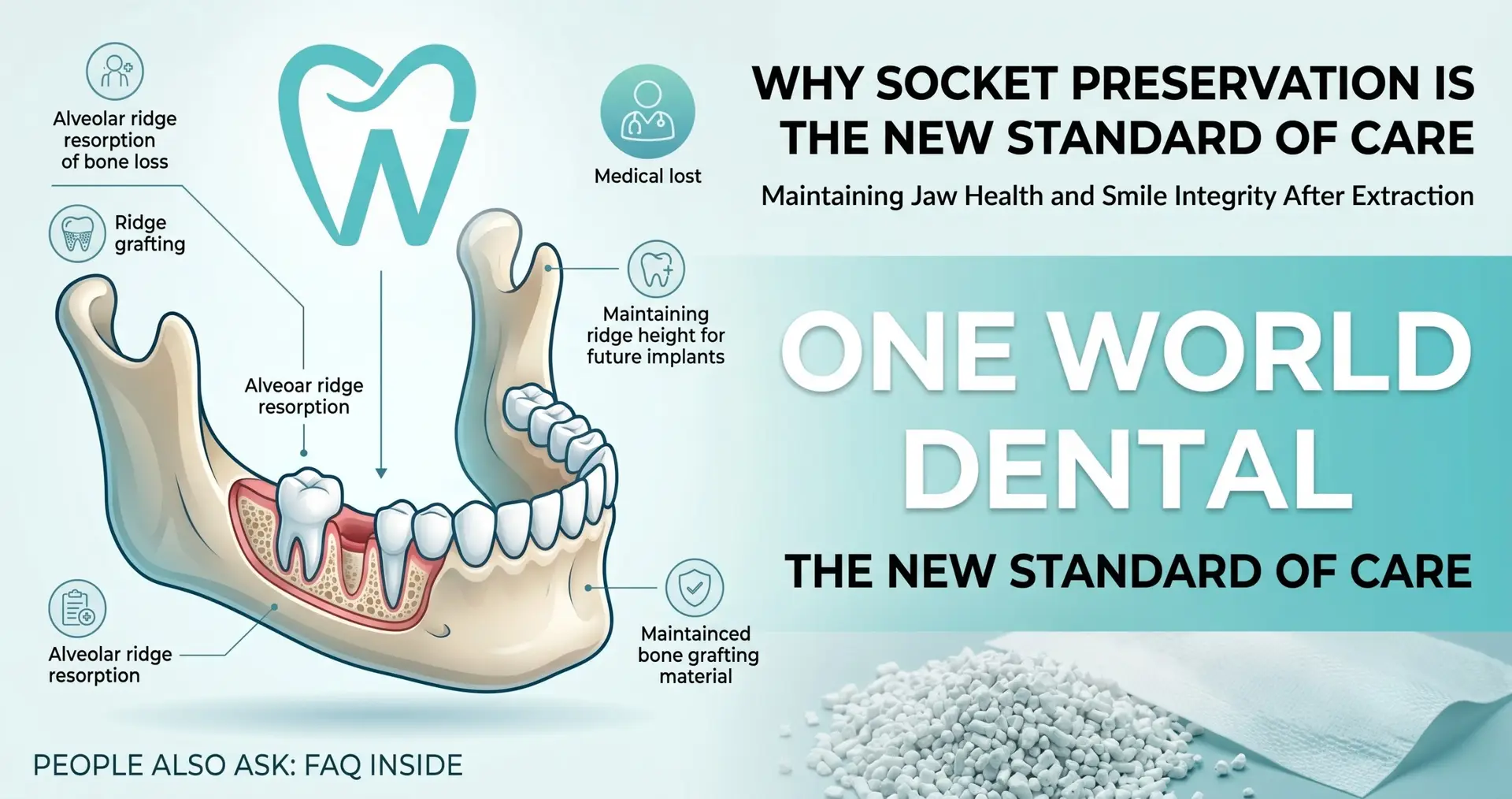
Alveolar Ridge Preservation (ARP) is the current gold standard for maintaining hard and soft tissue architecture following tooth extraction. By utilizing osteoconductive scaffolds and barrier membranes, practitioners can proactively mitigate the predictable physiologic resorption of the alveolar process. For the modern dental practice, including One World Dental, this shift from reactive “pull and pray” exodontia to proactive preservation is essential for achieving predictable, prosthetically-driven implant outcomes.
The Shift from Traditional Extraction to Socket Preservation
Why “Pull and Pray” is No Longer the Professional Gold Standard
Historically, exodontia was viewed as a terminal procedure, followed by a “wait and see” approach to healing. This “pull and pray” methodology relied on the hope that sufficient residual ridge volume would remain for future rehabilitation. However, meta-analyses consistently show that traditional healing leads to significant dimensional loss, often necessitating high-morbidity secondary grafting like Guided Bone Regeneration (GBR) or Block Grafting.
The Biological Reality: What Happens to Your Jawbone 24 Hours Post-Extraction
The alveolar process is a tooth-dependent structure; once the periodontal ligament (PDL) is severed, the bundle bone—which receives its blood supply primarily from the PDL—undergoes rapid osteoclastic resorption. The biological clock starts within 24 hours. Without an internal scaffold, the thin buccal plate, often less than $1\text{mm}$ in the maxillary aesthetic zone, is highly susceptible to collapse.
Bone Resorption: The Hidden Consequence of an Empty Socket
Quantitative data indicates that within the first six months, an untreated socket can lose up to 50% of its horizontal width and significant vertical height. This “disuse atrophy” creates a concave ridge morphology, compromising the emergence profile of future crowns and increasing the risk of “black triangles” due to the loss of interproximal papilla support.
The Clinical Mechanics: How Socket Preservation Protects Your Smile
Gentle Extraction and Debridement
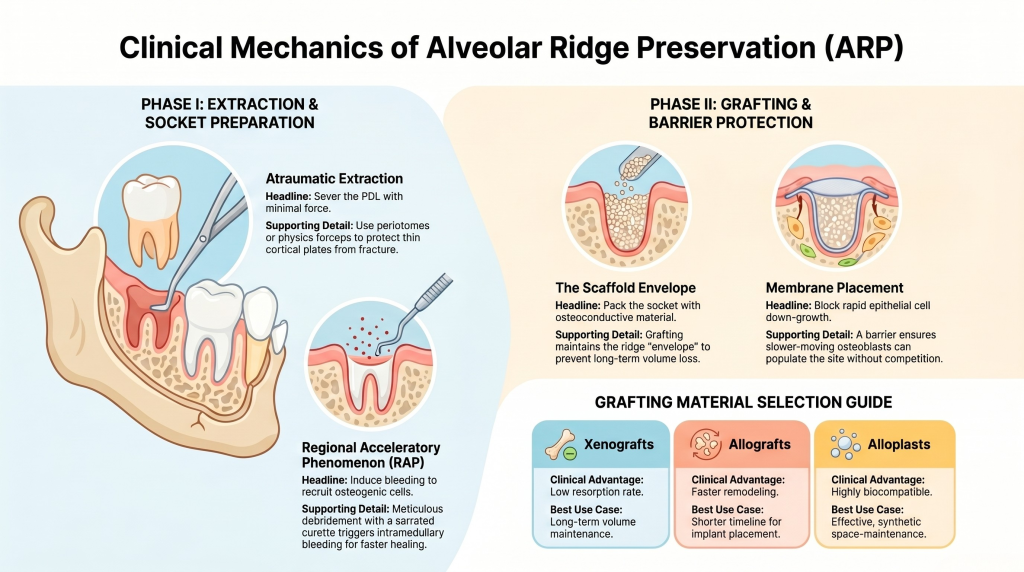
The success of ARP begins with atraumatic exodontia. Practitioners should utilize periotomes or physics forceps to sever the PDL without applying excessive force to the thin cortical plates. Following extraction, meticulous debridement with a serrated curette is required to remove granulation tissue and induce “regional acceleratory phenomenon” (RAP), which recruits osteogenic cells via intramedullary bleeding.
The Scaffold – Selecting Grafting Materials
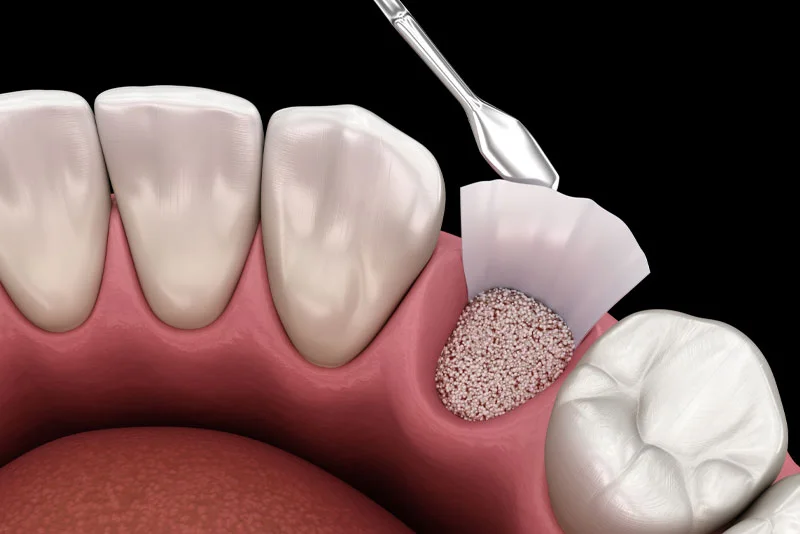
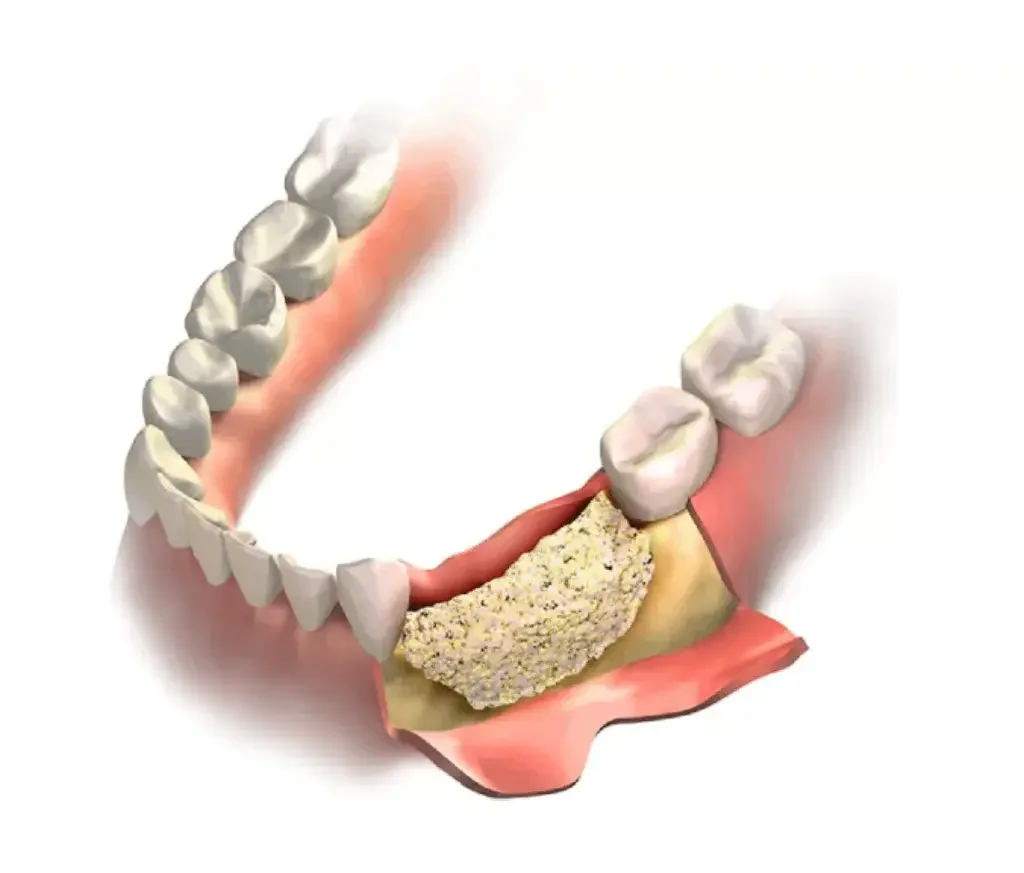
The socket is packed with an osteoconductive material to maintain the “envelope” of the ridge. The choice of material dictates the turnover rate:
Xenografts (e.g., Deproteinized Bovine Bone Mineral): Ideal for long-term volume maintenance due to a low resorption rate.
Allografts (FDBA/DFDBA): Preferred when faster remodeling into vital bone is required for a shorter implant timeline.
Alloplasts (Synthetic $\beta$-TCP): Highly biocompatible alternatives that serve as effective space-maintainers.
The Barrier Membrane – Keeping the Bone Where It Belongs
To prevent the rapid down-growth of epithelial cells—which migrate significantly faster than osteoblasts—a barrier membrane is placed.
Resorbable Collagen Membranes: Naturally degrade over 4–8 weeks.
Non-Resorbable dPTFE Membranes: Excellent for open-socket techniques where primary closure cannot be achieved without distorting the mucogingival junction.
Accelerated Healing and Suturing
Techniques like L-PRF (Leukocyte-Platelet Rich Fibrin) can be incorporated to deliver high concentrations of growth factors. Suturing should be tension-free, often utilizing a “cross-mattress” or “internal mattress” stitch to stabilize the membrane and graft material.
The 5 Primary Benefits of Choosing Preservation Today
Maintenance of Facial Support: By preserving the alveolar ridge, we prevent the resorption-related collapse of overlying soft tissues, maintaining lip support and youthful facial contours.
Implant Site Optimization: ARP ensures a sufficient volume of native and vital bone, which is the primary determinant for primary stability (ISQ values) during implant placement.
Prevention of Adjacent Tooth Migration: Maintaining the ridge prevents “mesial drift” or tilting of adjacent teeth, which can lead to periodontal pocketing and occlusal disharmony.
Reduced Post-Operative Morbidity: Grafting the site reduces the incidence of Alveolar Osteitis (Dry Socket) by protecting the forming blood clot.
Enhanced Emergence Profiles: Stable bone supports a stable gingival margin, allowing for highly aesthetic, natural-looking prosthetic outcomes.
The Economic Argument: Why Prevention is Cheaper Than Reconstruction
From a practice management and patient-value perspective, ARP is an exercise in preventive economics. While it represents an immediate line-item cost, it eliminates the need for far more expensive and invasive reconstructive procedures later.
Socket Preservation vs. Major Ridge Augmentation
If the ridge collapses, the patient is no longer a candidate for standard implant placement. They will require Ridge Augmentation or Sinus Lifts. These procedures require advanced surgical skills, high-cost materials (like titanium-reinforced membranes), and multiple surgical stages. For the patient, the cost of an ARP is often 25–30% of what they would pay for a later reconstruction.
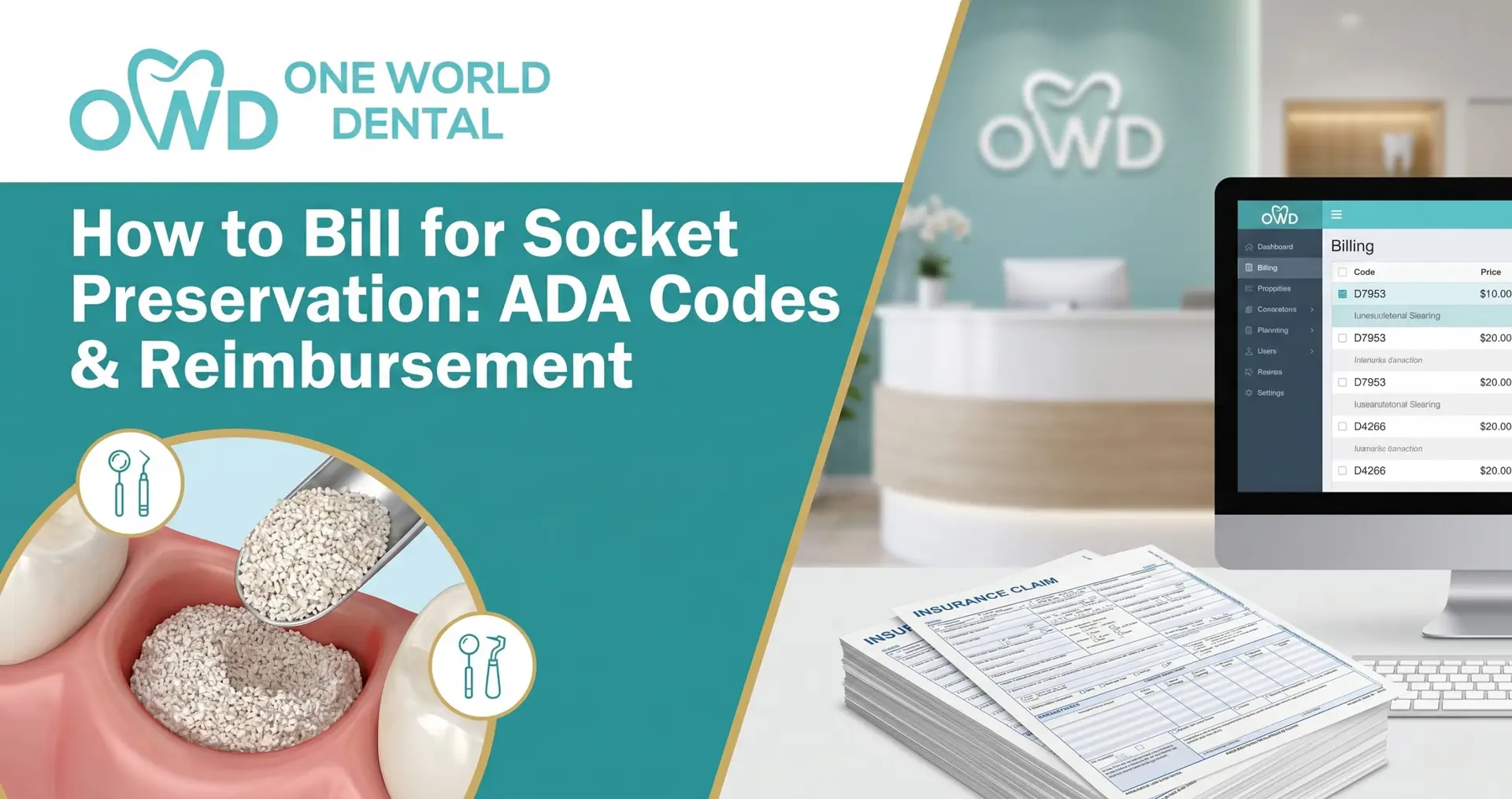
Clinicians must ensure accurate coding to facilitate patient reimbursement.
D7953 (Bone Replacement Graft for Ridge Preservation): Specifically for grafting at the time of extraction.
D4266/D4267 (GTR – Resorbable/Non-resorbable): For the barrier membrane.Clinical narratives at One World Dental emphasize “maintenance of ridge integrity for functional prosthetic rehabilitation,” which helps insurance adjusters understand the procedure isn’t merely elective but foundational.
Is It Always Necessary? When You Can (and Can’t) Skip It
While ARP is widely applicable, clinical judgment is required for case selection.
Mandatory Scenarios (The Aesthetic Zone)
In the maxillary anterior (“Aesthetic Zone”), the buccal plate is often less than $0.5\text{mm}$ thick. Without ARP, the ridge will collapse, resulting in a visible defect that cannot be masked by a crown. This is a “non-negotiable” scenario for preservation.
Elective Scenarios
If a tooth is a terminal molar with no plan for replacement, or if the patient is transitioning into a full arch prosthesis where the surgical plan involves significant alveolar reduction (e.g., All-on-X), ARP may be superfluous. However, if there is any possibility of future implant placement, the standard remains “preserve by default.”
Patient Journey: Recovery, Timeline, and Expectations
The First 72 Hours: Post-Operative Management
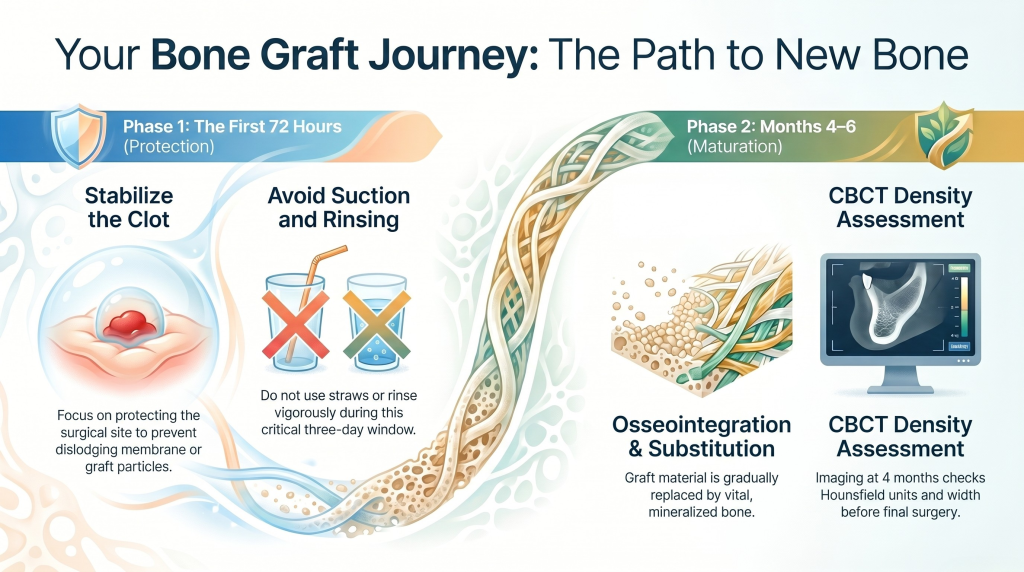
Initial healing focuses on clot stabilization. Patients should be advised to avoid vigorous rinsing or suction (straws), which could dislodge the membrane or graft particles.
The 4-Month Rule: Osseointegration and Maturation
Histologic maturation typically requires 4–6 months. During this window, the graft material is being substituted by vital, mineralized bone. CBCT imaging at the 4-month mark is used to assess the Hounsfield units (bone density) and dimensional width before scheduling the osteotomy.
Common Myths vs. Medical Facts
Myth: “Primary closure (pulling the gums tight) is required for success.”
Fact: Pulling tissue too tight can flatten the vestibule and pull the “pretty” pink gums away. Using a dPTFE membrane allows for secondary intention healing, which preserves the keratinized tissue.
Myth: “Bone grafting is just an upsell.”
Fact: Peer-reviewed literature (Schropp et al., Fickl et al.) definitively shows that untreated sockets lose significant volume. Failing to offer ARP is increasingly seen as a failure to meet the contemporary standard of care.
People Also Ask (FAQ)
Does socket preservation increase post-operative pain?
Clinically, no. In fact, by protecting the socket and preventing the exposure of nerve endings in the bone (dry socket), many patients report a more comfortable recovery compared to simple extractions.
What is the risk of graft rejection?
The materials used—whether allograft or xenograft—are processed to be acellular and non-immunogenic. True “rejection” is nearly non-existent; however, infection (usually due to smoking or poor hygiene) can lead to graft loss.
Is the bone graft actual bone?
It is a mineral matrix. Over time, your body’s cells (osteoclasts and osteoblasts) move into this matrix, dissolve it, and replace it with your own living, mineralized bone.
How soon can we place the implant after the graft?
For most cases, a maturation period of 4–5 months is ideal. This allows the site to transition from a “scaffold” to a stable foundation capable of supporting an implant under occlusal load.
Can I use a bridge instead of an implant if I get the graft?
Yes. Even for bridge work, socket preservation prevents the “sunken” look under the bridge (pontic), making the replacement tooth look like it is growing out of the gum naturally.
Is this covered by dental insurance?
Many plans now recognize the CDT code D7953. While coverage varies, our team at One World Dental provides the necessary clinical narratives to maximize your benefits.
What if I wait and do the graft later?
“Delayed grafting” is much more invasive and expensive. It is far easier to keep the bone you have than to try and build it back once it has disappeared.
Conclusion: Partnering with One World Dental for Superior Outcomes
As clinical research continues to validate the long-term success of alveolar ridge preservation, it has moved from an advanced specialty procedure to an essential component of general practice. At One World Dental, we utilize the latest in biocompatible scaffolds and surgical techniques to ensure every extraction is the first step toward a successful restoration, rather than the last step of a failing tooth.
Elevate your standard of care. For referrals, advanced surgical consultations, or to schedule your next procedure, Our team is dedicated to preserving your oral health and facial aesthetics through evidence-based dentistry.
Educational disclaimer: Content is provided for professional education and is not a substitute for a clinician's independent judgment, applicable standards, manufacturer instructions, or relevant laws and regulations.