Completing dental implant education that reliably includes live patient cases and mentorship is harder than it should be for practicing dentists and dental students. Most course providers skip supervised clinical sessions or do not make pricing, CE credit, and clinical exposure clear before registration. This comparison highlights pricing, clinical mentorship, location, and accreditation so dental practitioners can select a program that fits their learning needs and practical requirements.
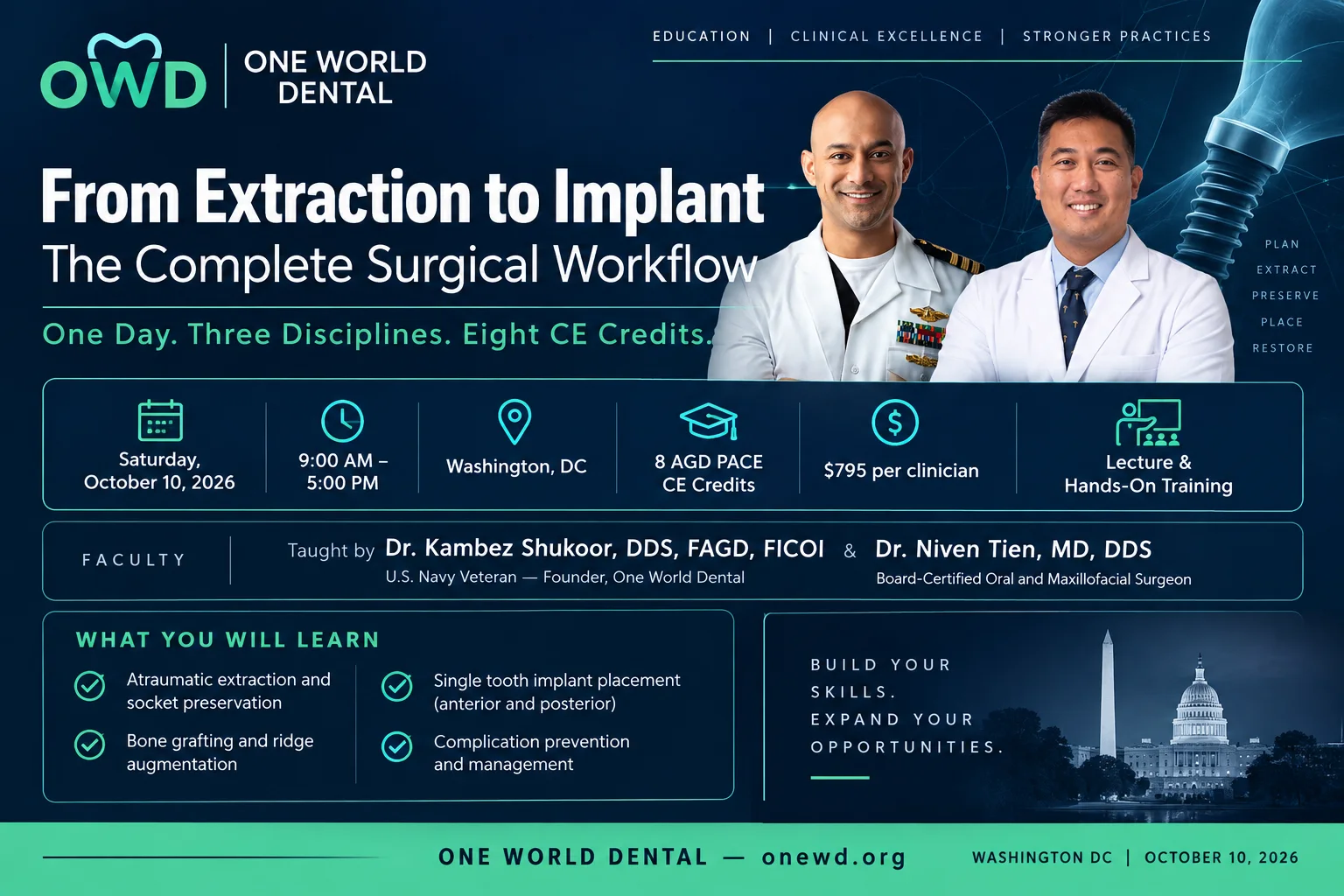
One World Dental
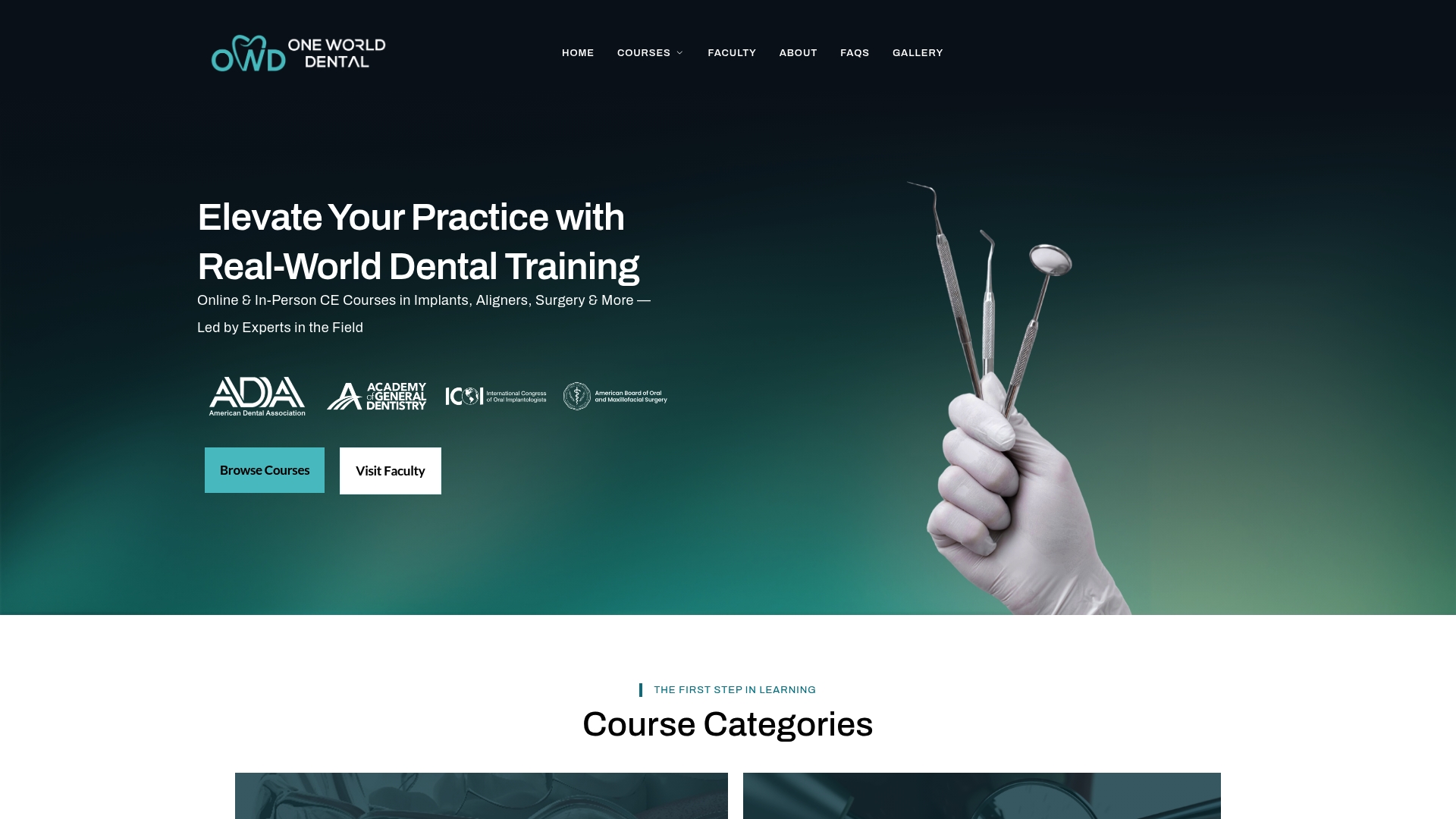
At a Glance
Real case, hands on training includes live patient modules and supervised clinical sessions. The vendor advertises mentorship driven instruction delivered by practicing clinicians. Founded by Dr. Kambez Shukoor, the program focuses on implant surgery, aligners, and cosmetic procedures.
Core Features
The curriculum mixes online learning with in person courses in implants, aligners, surgery, and esthetics, arranged into tiered learning pathways from beginner to expert. Courses pair didactic content with live patient modules and mentorship driven coaching by experienced clinicians. Instruction emphasizes evidence based practice, clinical safety, and progressive skill development.
Key Differentiator
Structured tiered learning that pairs online modules with live patient cases and clinician mentorship sets the program apart. That combination puts supervised clinical exposure at predictable points in the pathway, which helps clinicians practice new procedures under guidance.
Pros
Hands on clinical emphasis gives practicing dentists repeated supervised case experience, which supports skill transfer into private practice. Flexible delivery modes let you complete preparatory coursework online and then attend in person sessions for live patient modules. The tiered pathways clarify what to study next as you move from foundational techniques to more advanced surgical skills. Faculty include practicing clinicians and instructors with clinical and military backgrounds, so instruction reflects current clinical workflows and real clinic constraints.
Cons
- Course accreditation is in progress, which may affect availability of formal CE credit until final approval.
Who It’s For
Licensed general dentists, specialists, and dental students who want supervised clinical exposure alongside classroom instruction will find the format useful. Practitioners planning to add implants, ridge preservation, or aligner workflows to their service mix benefit from the mentorship driven structure. Students preparing for hands on clinical practice can use the tiered pathway to sequence learning and supervised cases.
Unique Value Proposition
Tiered learning that schedules live patient cases at defined stages shortens the time between classroom study and supervised clinical practice. That structure reduces guesswork about when to attempt independent cases because each level builds on prior supervised experience. For solo practitioners this means you can follow a clear sequence of online study, mentor feedback, and in person surgical modules to reach clinical competence more predictably.
Real World Use Case
A general dentist enrolls in the Implants & Surgery pathway, completes online modules on surgical extraction and ridge preservation, and then attends an in person clinical module with supervised patient cases. After mentor feedback, the clinician adopts the techniques in routine practice to offer surgical extractions and immediate site preservation. The staged pathway supports gradual case complexity and direct mentor oversight.
Website: https://onewd.org
Misch Implant Institute
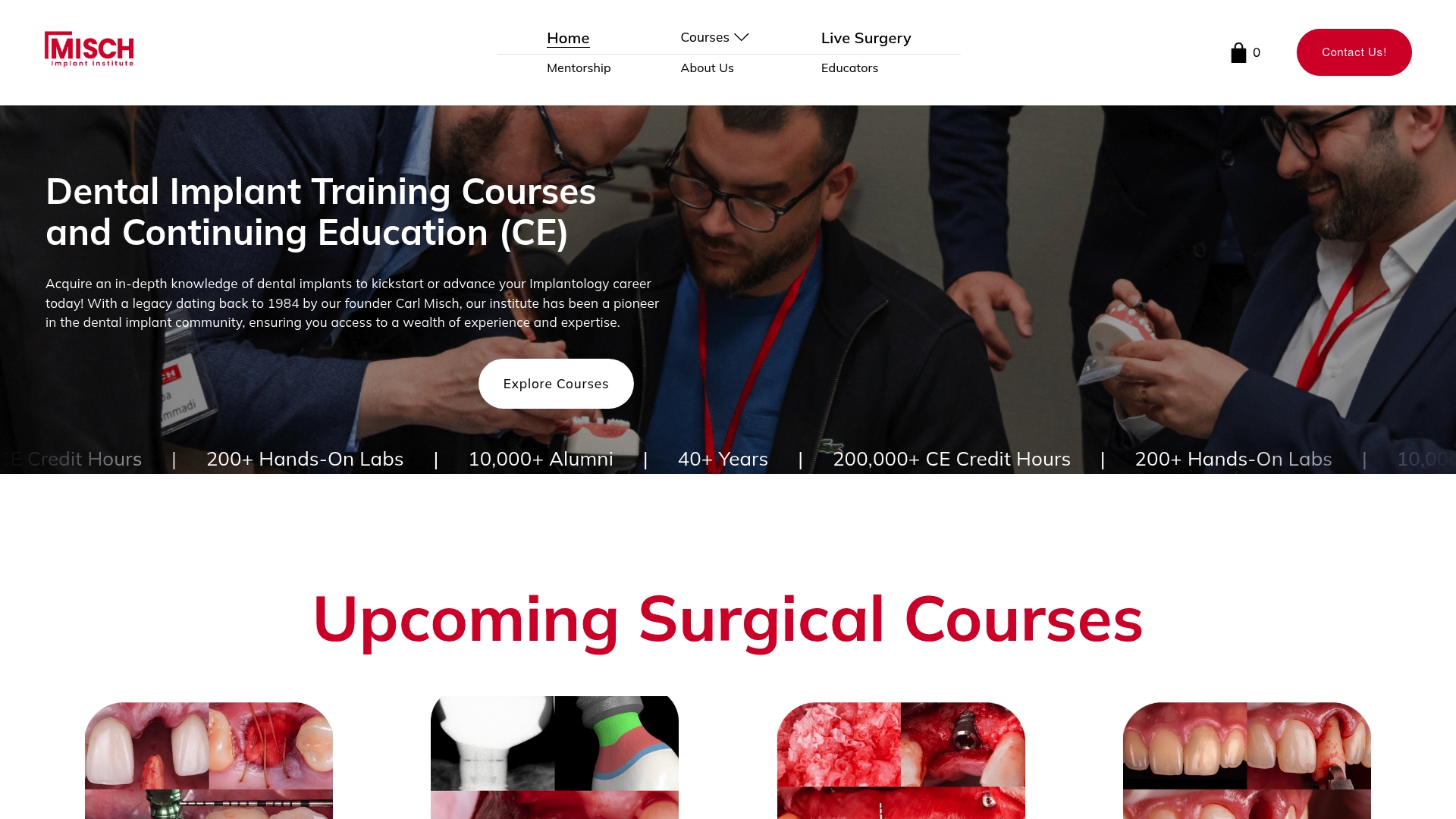
At a Glance
Misch Implant Institute reports more than 10,000 alumni and over 200,000 CE credit hours delivered. The institute traces its curriculum to Dr. Carl Misch and more than 40 years of program development. ADA CERP accreditation appears across course listings, and the catalog includes live surgery sessions and fellowship pathways.
Core Features
The platform organizes training into modular course tracks that cover implant fundamentals, prosthetics, guided bone regeneration, sinus techniques, and complication management. Courses combine classroom lectures with hands-on clinical sessions and live surgical observation. Participants can earn CE credits and pursue fellowship qualification through staged course completion.
Key Differentiator
Misch pairs one-on-one mentorship with supervised live surgeries, backed by a decades-long clinical and research lineage. That combination targets dentists who need real surgical exposure rather than purely didactic learning, and it underpins the institute’s multi-session continuum structure.
Pros
The institute has a long operational history and a deep alumni network, which supports peer referrals and mentorship placement. Its ADA CERP accreditation validates the continuing education format and credit reporting. The course mix spans beginner through advanced surgical topics, so clinicians can follow a sequential path. Live surgery experiences and mentor oversight give practical confidence that classroom-only programs do not provide.
Cons
- Premium pricing for many courses. The cost may rule out some clinicians and smaller practices.
- Several hands-on sessions run only in selected cities. Travel and time away from the office add to total cost.
- Advanced modules expect a working knowledge of implant basics. Beginners must start with foundational courses first.
When It May Not Fit
If you need fully remote, low-cost continuing education this institute may not match your needs. If local course dates never align with your schedule, the limited city availability will be a barrier. If you lack basic implant experience, the advanced workshops will be difficult to follow without prior coursework.
Who It’s For
Dentists and specialists who want extensive hands-on surgical practice and mentor-led case reviews. Clinicians planning to add implant placement and prosthetic workflows to their practice will benefit from the staged curriculum and live operating-room exposure.
Real World Use Case
A general dentist enrolls in the five-session continuum to learn implant placement, guided bone grafting, and prosthetic sequencing. They attend live surgeries with a mentor, complete staged hands-on labs, and then place implants in their clinic under remote mentor review.
Pricing
Course pricing runs from about $2,995 for individual modules to roughly $17,500 for the full five-session implant continuum bundle. Additional travel and lodging expenses are common for on-site sessions.
Website: https://misch.com
Implant Pathway
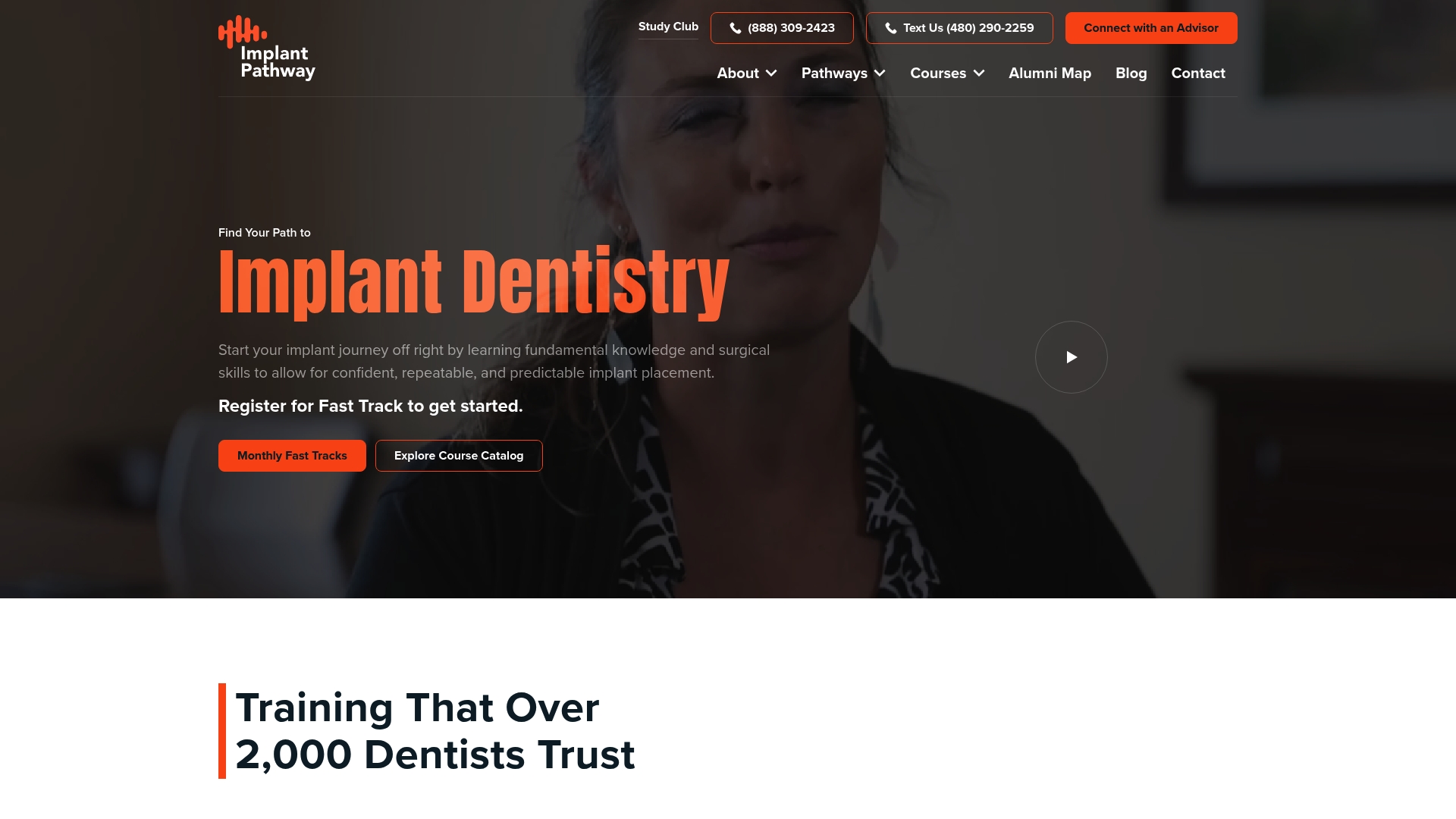
At a Glance
The program uses a 2:1 attendee to mentor ratio and includes live patient implant surgeries as part of its in-person sessions. Courses combine online modules with hands-on placement in models and real patients. Fast Track and Standard Track both include CE credit and post-course support.
Core Features
The platform mixes online learning modules with live surgical sessions and hands-on skills practice. Online content totals roughly 37 to 93 CEUs and covers treatment planning, surgical protocols, and restorative workflows. The curriculum includes CBCT planning, PRF laboratory work for regenerative cases, a high mentor presence during live cases, and continued support after course completion.
Key Differentiator
A high attendee to mentor ratio paired with live patient implant surgery sets this offering apart from many course providers. That structure gives more chairside supervision during placement and immediate feedback on surgical technique. Accredited CE credit and post-course mentoring extend clinical support after the live sessions.
Pros
Implant Pathway reports more than 2,000 dentists trust their training, which speaks to the program reach. The hands-on format pairs real patient surgery with a heavy mentor presence, so you spend clinic time rather than just watching. Accredited CE recognized by ADA and CERP lets you claim formal credit, and built-in study clubs and ongoing contact support procedural follow up.
Cons
- Premium price of $19,500 for the Fast Track may exceed many practice budgets, even with monthly payment plans available.
- Weekend and multiweek course formats require concentrated time away from the office, which can disrupt practice schedules.
- In-person offerings are mainly in the United States, which limits access for international clinicians.
When It May Not Fit
If you need a low-cost, purely online path to implants, this program will feel too expensive and too clinic focused. Practitioners who cannot take extended time away from the office will struggle with the intensive schedule. International dentists may find travel and visa logistics add complexity and cost.
Who It’s For
General dentists and dental specialists who want rapid, supervised experience placing and restoring implants will find this program useful. It fits clinicians who prefer hands-on learning with a strong mentor presence and formal CE credit. New graduates with financing needs or military clinicians seeking discounts are also included in the target audience.
Real World Use Case
A general dentist enrolls in the Fast Track to gain surgical confidence. They complete online CE modules, attend live patient surgeries with a 2:1 mentor to attendee ratio, and return to practice placing single implants and simple restorations without referring those cases. Ongoing mentorship helps refine treatment planning for more complex cases.
Pricing
Fast Track lists a tuition of $19,500 with monthly payment options of $3,250. The program also advertises flexible financing and discounts for new graduates and military members. Pricing applies per enrollee and reflects the live patient training model.
Website: https://implantpathway.com
California Implant Institute
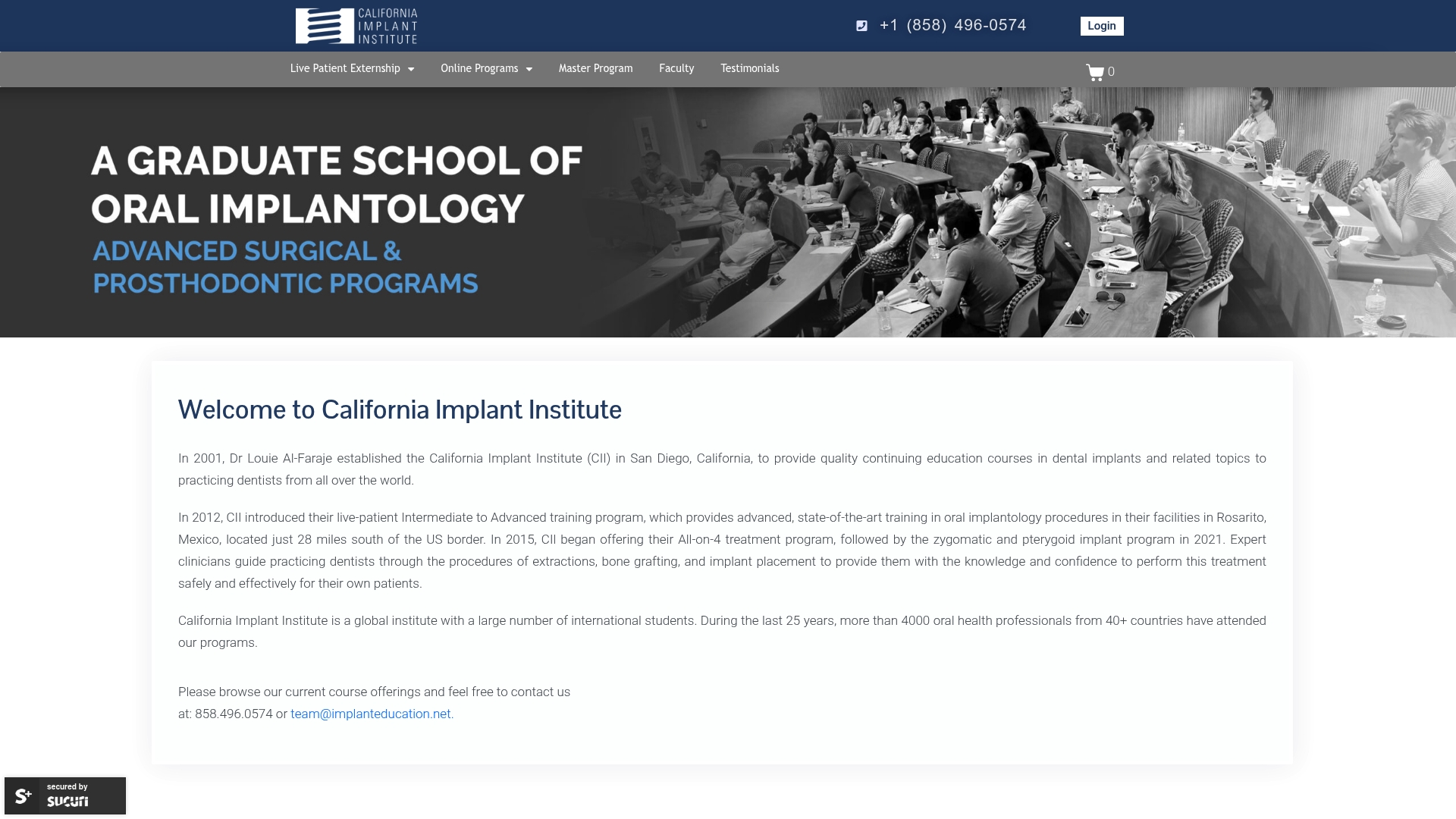
At a Glance
California Implant Institute reports training over 4,000 professionals from more than 40 countries. The school mixes live patient externships, online modules, and cadaver labs to teach advanced implant techniques. That global reach signals an established program focused on implantology rather than general dentistry.
Core Features
CII runs live patient externships that span basic to advanced implant cases and pairs them with online implantology programs for prework and review. The curriculum includes cadaver hands on training and procedural demonstrations using live video feeds and animations. According to the company, the institute is a nationally approved PACE provider for FAGD/MAGD credit, accredited from August 2022 to July 2028.
Key Differentiator
The single defining feature is the combined use of live patient externships and extensive online coursework guided by internationally recognized clinicians. That mix lets clinicians watch real procedures, then reinforce techniques through online study and cadaver practice. The structure targets dentists who need supervised clinical exposure and immediate procedural feedback.
Pros
CII’s strengths start with its clinical emphasis and a clear focus on implant procedures rather than broad general dentistry. The blend of live cases, cadaver labs, and online content supports skill transfer from observation to practice. The institute’s reported international draw and PACE accreditation make it attractive for dentists pursuing formal continuing education credit. Finally, the use of live video feeds and animations helps clarify surgical steps that are hard to capture in text alone.
Cons
- Focused scope may exclude restorative, endodontic, or pediatric topics that general dentists sometimes need.
- Course dates and seats concentrate in San Diego and Rosarito, Mexico, which limits access for clinicians outside those regions.
- Pricing is not publicly listed, so total cost of externships and cadaver labs may be unclear until registration.
When It May Not Fit
If you need broad continuing education across multiple dental disciplines, this provider will feel narrow. If travel constraints or a tight budget limit in person attendance, their location based schedule and undisclosed pricing present practical barriers. If your priority is fully remote learning without patient contact, this model will not match that need.
Who It’s For
Practicing dentists and oral health professionals seeking concentrated training in implant surgery will gain the most. Ideal candidates already placing implants or ready to add surgical implant services will benefit from live supervised cases. Those seeking FAGD or MAGD credit alongside clinical practice will find the accreditation relevant.
Real World Use Case
A general dentist enrolls in an externship to learn All on 4 implant placement and uses the online modules for preoperative planning review. The dentist then attends cadaver sessions to rehearse the surgical steps and returns to clinic with direct procedural experience and CME credit.
Website: https://implanteducation.net
Global Dental Implant Academy
At a Glance
Global Dental Implant Academy runs live patient surgical training courses in Mexico and other locations with international faculty. The program pairs classroom webinars and online modules with hands on workshops and study clubs. GDIA emphasizes practical surgical experience and research links with the implant maker DENTIS.
Core Features
GDIA combines online webinars and course modules with hands on workshops and live patient surgical training to teach both surgical and restorative implant skills. The curriculum includes international symposiums and research opportunities plus personalized mentorship and regional chapters in Mexico and Egypt. Multiple formats let you follow didactic content online and then practice techniques in supervised clinical settings.
Key Differentiator
GDIA focuses on concentrated live patient surgical exposure backed by an industry partnership with DENTIS, which shapes some research and product talks. That focus makes it a narrow offering for clinicians who want intensive surgical practice and manufacturer‑linked instruction rather than a broad suite of distance only learning. The emphasis on live surgeries and international faculty distinguishes its hands on angle.
Pros
GDIA delivers a mix of online instruction and supervised live patient cases that lets you move from theory to practical skills in a short timeframe. Regional chapters and international symposiums extend access for clinicians outside major training hubs and help you connect with faculty and peers. The mentorship component provides follow up support after courses, and the relationship with DENTIS brings vendor‑level product exposure and research opportunities.
Cons
- Pricing details are not listed publicly. Expect course and membership fees to require direct inquiry.
- The offering highlights clinical training rather than technical software tools. There is little emphasis on digital workflow or platform integrations.
- Course length, certification specifics, and continuing education credits are not clearly stated.
Who It’s For
This fits dental practitioners and surgeons who need hands on implant placement experience and want supervised live patient cases. It suits clinicians planning to add surgical implant services to their practice and those who value manufacturer involvement in training. If you prefer purely virtual learning or need explicit certification details up front, this may feel incomplete.
Real World Use Case
A general dentist travels to a GDIA live course in Mexico, completes the online prework, and practices several implant placements under faculty supervision. After the course the dentist continues mentorship calls and joins a regional study club to review cases and refine prosthetic workflows. The combination speeds practical adoption of implant services in the office.
Pricing
Pricing is not specified on the site. Courses and membership fees are available by inquiry or registration and may vary by location, course type, and live patient components. Contact GDIA directly for current tuition, workshop fees, and any included follow up mentorship.
Website: https://gdia.com
Midwest Implant Institute
At a Glance
The institute reports it was established in 1980 by Dr. Duke Heller and Dr. Jack Hahn and claims to be the first U.S. dental implant institute. It centers training in Ohio with live patient surgeries and mentorship. The curriculum covers implant placement, prosthetics, grafting, and team-level education for assistants and front office staff.
Core Features
The Midwest Implant Institute delivers hands-on surgical training paired with classroom instruction, and it runs courses that include live surgeries with patient participation. It offers mentorship programs, externships, and fellowships that follow learners from introductory skills to advanced prosthetic workflows. Team training for assistants and office staff appears integrated into several course tracks.
Key Differentiator
That claim identifies a long track record of in-person, live-surgery training combined with mentorship across entry and advanced programs. The institute highlights continuity from single courses to externships and fellowships, which supports clinicians who want staged skill development. That focus on sequential, supervised clinical exposure separates it from shorter, lecture-focused offerings.
Pros
The institute gives clinicians extensive practical experience through live surgical cases and supervised treatment. It supports learners after courses with mentorship and follow-up training that helps clinicians implement learned techniques. The curriculum spans surgical placement, prosthetic restoration, bone grafting, complications management, and practice-level training for teams. The program history and university collaborations add credibility for dentists who prioritize longstanding clinical education.
Cons
- Pricing is not clearly listed and appears positioned as premium, which could make budgeting difficult for some practices.
- Most training is in person in Ohio, so clinicians outside the region must factor travel and time away from the clinic.
- Public information about remote or online alternatives is limited, so distance learners may find options sparse.
When It May Not Fit
Practitioners who need fully remote coursework will likely find the institute a poor match because it focuses on in-person training. Solo practitioners with limited time may struggle with multi-day live-surgery courses and externships. Budget-sensitive clinicians should compare course fees carefully before committing, since some advanced courses are priced at a premium.
Who It’s For
Dentists and dental team members who want hands-on implant surgery experience and ongoing clinical mentorship will benefit most. Practices seeking to integrate assistants and front office staff into implant workflows will find the team courses useful. Academic programs or clinics building curricular attachments may use externship or fellowship pathways.
Real World Use Case
A general dentist from Ohio attends the All-Inclusive Live Surgery Course to gain direct surgical experience. They then enroll in an externship and a fellowship to develop consistent implant placement and prosthetic workflows. Over time the dentist adds implant restorations to their service mix and trains staff to manage case intake and postoperative care.
Pricing
Course pricing is set per offering rather than a single list price. Examples include a surgical course listed at $4,995, with other courses ranging from $250 to $1,995. Prospective attendees should request current fees for the specific course and any externship or fellowship packages.
Website: https://midwestimplantinstitute.com
Comparison of alternatives
Choosing the ideal dental implant education program involves considerations between structured learning frameworks, accreditation opportunities, and cost-effectiveness.
Accreditation and Certification Opportunities
The Misch Implant Institute distinguishes itself with ADA CERP accreditation, ensuring its courses provide recognized continuing education credits. This opens opportunities for licensed dentists needing formal credit validation for professional development purposes. Meanwhile, other programs also offer CE credits recognized by various bodies, such as the PACE accreditation included in the California Implant Institute courses. Accreditation is essential for practitioners aiming to maintain license requirements while gaining clinical expertise.
International Accessibility and Mentorship Intensity
Programs such as Implant Pathway and the Global Dental Implant Academy attract learners with their mentorship ratios and international faculty presence. GDIA’s partnership with the implant manufacturer DENTIS uniquely connects training with industry-level product research, appealing to dentists interested in cutting-edge materials and methods. International locations for training and symposium attendance likewise benefit those seeking diverse surgical exposure.
Best fit
- Dentists seeking structured tiers of education blending online learning with supervised patient case exposure should consider One World Dental.
- Practitioners prioritizing ADA CERP CE accreditation alongside advanced modular curriculum pathways and live surgeries might select Misch Implant Institute.
- Those focused on specialized implant techniques delivered through cadaver labs and live case externships may find the California Implant Institute suitable.
- Clinicians pursuing intense mentorship ratios and financing flexibility can opt for Implant Pathway.
Our pick
One World Dental supports licensed dentists aiming to progress through structured tiers with mentorship and patient care practice. While its accreditation process is ongoing, its predictable progression from online coursework into supervised live cases makes it highly attractive for clinicians seeking skill advancement. However, those requiring fully accredited programs for immediate CE credit should explore other options, such as the Misch Implant Institute.
Structured dental implant courses provide diverse learning pathways. Below is a comparison of some programs focused on clinical practice.
| Program |
Key Feature |
Differentiator |
Best For |
Limitation |
| One World Dental |
Tiered learning pathways with mentorship |
Live patient cases and clinical coaching at key stages |
Licensed dentists enhancing implant and esthetic skills |
Course accreditation in progress |
| Misch Implant Institute |
Modular tracks with ADA CERP accreditation |
Established history and fellowship options |
Dentists pursuing intensive live surgical training |
Premium price and limited location availability |
| Implant Pathway |
Hands-on live patient surgeries |
High mentor-to-attendee ratio |
Clinicians seeking rapid implant skills development |
High tuition costs |
| California Implant Institute |
Live patient externships and cadaver labs |
PACE accreditation and globally recognized |
Dentists focusing exclusively on implant surgery |
Specific course locations |
| Midwest Implant Institute |
Extensive live surgeries and externships |
Historical pedigree in dental implants training |
Regionally accessible dentists or teams |
Primarily Ohio-based training |
How to Choose the Best Dental Implant Course for Practical Clinical Growth
Finding the right dental implant course means balancing hands-on surgical exposure with expert mentorship. Many dentists and specialists want a clear, step-by-step learning plan that pairs real patient cases with evidence-based instruction. They need a course that helps them build skills progressively while gaining confidence to add implants and cosmetic procedures to their practice.
Onewd offers tiered learning paths designed exactly for licensed dentists, specialists, and students who value clinical experience combined with online coursework. Our mentorship-driven format includes live patient modules and ongoing support to help you apply new techniques safely and effectively. Visit the Uncategorized Archives – One World Dental for course details. Choose Onewd at https://onewd.org and strengthen your clinical expertise with a clear, practical approach that fits your schedule.
Recommended