Dental artificial intelligence (AI) is defined as computer systems that analyze clinical data, automate image interpretation, and support treatment decisions in dental practice. The technology has moved well past the research phase. The FDA has granted 510(k) clearance to specific dental AI platforms, marking their formal entry into regulated U.S. clinical practice. That regulatory milestone matters because it shifts AI from an experimental curiosity into a tool you can deploy with documented accountability. AI-powered diagnostic systems now report 82%–95% sensitivity and specificity in detecting caries and pathologies, performance that matches or exceeds specialist-level accuracy in controlled studies.
How does dental AI improve diagnosis and treatment planning?
Machine learning models in dentistry work by training on thousands of labeled radiographs, CBCT scans, and clinical photographs until they can recognize patterns that correlate with disease. The result is a second opinion that never fatigues and never misses a finding it was trained to detect.
Radiographic and imaging analysis
AI-assisted radiographic analysis is the most mature application in clinical practice today. Algorithms flag interproximal caries, periapical lesions, bone loss, and calculus on bitewing and periapical films in real time. For third molar decisions, AI models have reached over 89% accuracy in predicting eruption status. That level of accuracy gives you objective data to support extraction or retention recommendations during patient consultations.
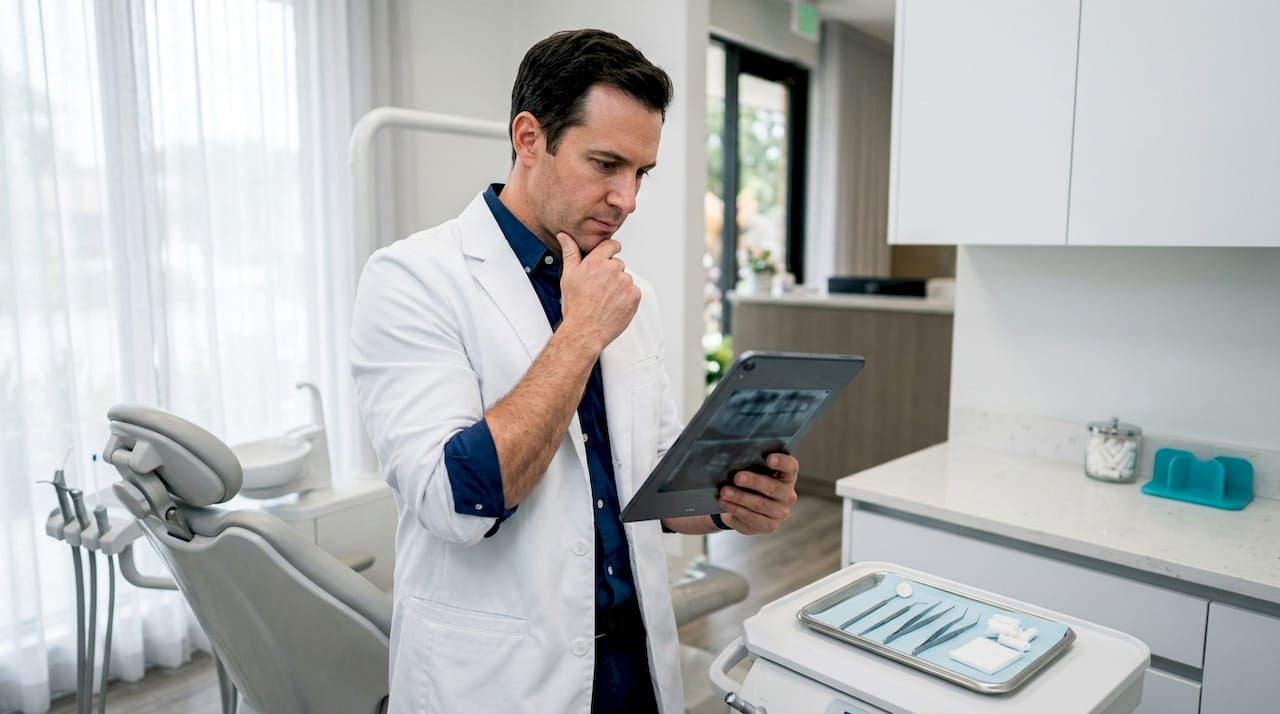
CBCT analysis adds another dimension. AI can segment anatomical structures, identify the inferior alveolar nerve canal, and flag proximity risks before implant placement. In orthodontics, automated cephalometric landmark detection reduces the time spent on manual tracing and cuts inter-examiner variability. For AI-assisted treatment planning in complex clear aligner cases, the technology can model tooth movement predictions based on existing occlusal data.
Key clinical applications at a glance
- Caries detection: AI flags early interproximal lesions that are easy to miss on standard radiographs, supporting earlier intervention.
- Periodontal assessment: Automated bone level measurement on periapical films provides consistent, reproducible data across recall appointments.
- Oral pathology screening: Machine learning models trained on intraoral photographs can identify mucosal lesions with high sensitivity, prompting timely biopsy referrals.
- Implant planning: AI-driven CBCT segmentation maps bone density and nerve proximity, reducing surgical guesswork.
- Orthodontic analysis: Automated landmark detection on lateral cephalograms accelerates treatment planning and reduces manual error.
Pro Tip: Before relying on any AI diagnostic output, verify the finding clinically. AI flags a probability, not a diagnosis. Your clinical judgment is the final authority.
What are practical ways to integrate AI into dental practice workflows?
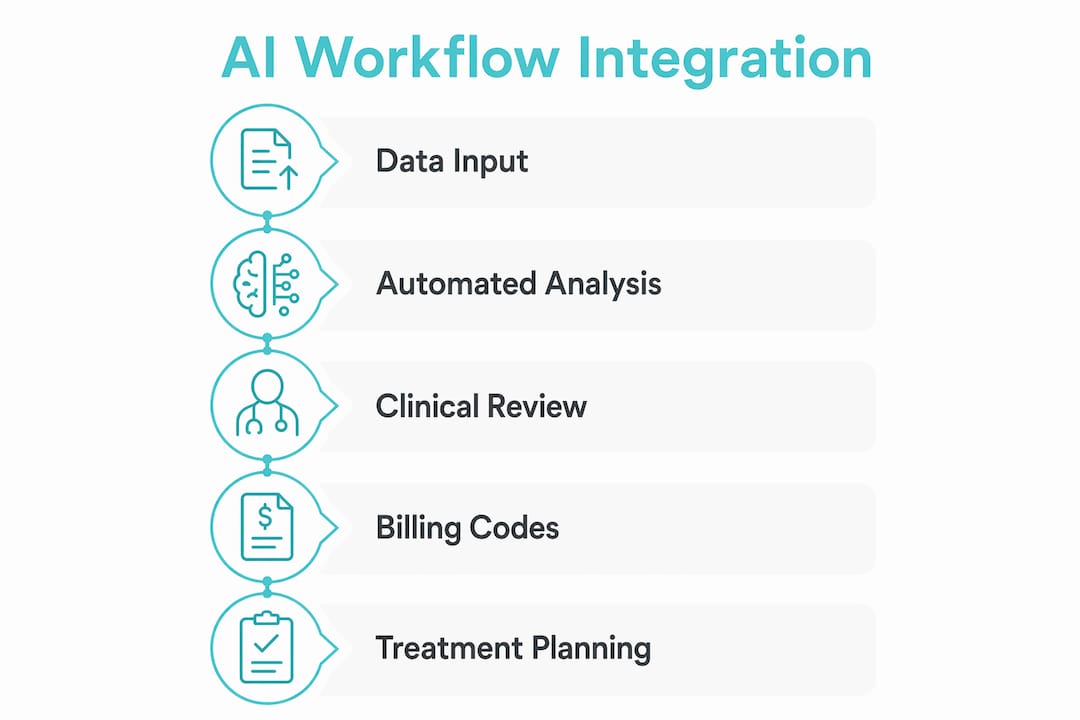
Adopting AI in dentistry works best as a phased process rather than a full-scale overnight switch. The following steps give you a structured path from evaluation to daily use.
-
Audit your current workflow. Identify where diagnostic delays, documentation errors, or billing inefficiencies occur most often. AI delivers the clearest return where repetitive, data-heavy tasks slow your team down.
-
Choose integrated over standalone. Embedding AI tools directly into your practice management system enables real-time image analysis without separate data uploads. Standalone platforms create friction and reduce adoption rates among clinical staff.
-
Evaluate FDA clearance status. Only deploy tools that carry FDA 510(k) clearance for their specific intended use. Clearance status is publicly searchable through the FDA’s 510(k) database and confirms the tool has met minimum safety and effectiveness standards.
-
Train your team before go-live. AI output is only useful if your clinical staff understands what it means and how to act on it. Schedule structured training sessions before the tool goes live, not after.
-
Measure outcomes from day one. Track diagnostic yield, recall efficiency, and billing accuracy before and after AI adoption. Cost-benefit evaluations are necessary because high upfront costs and maintenance fees mean return on investment varies significantly by practice size and case volume.
Automated tooth numbering and billing code suggestions are two workflow tasks where AI delivers fast, measurable gains. Both reduce administrative time and coding errors without requiring clinical staff to change how they examine patients.
Pro Tip: Request a pilot period from any AI vendor before committing to a full contract. Run the tool on a sample of historical cases and compare its findings against your documented diagnoses to assess real-world accuracy in your patient population.
What limitations and challenges does dental AI currently face?
AI in dentistry is genuinely useful, but its limitations are real and worth understanding before you commit budget or clinical trust to any platform.
-
Data quality dependency. AI performance depends strongly on the quality and consistency of the imaging datasets used for training. Variability in sensor hardware, exposure settings, or imaging technique reduces accuracy and generalizability. A model trained on high-end CBCT data from academic centers may underperform on images from a general practice using older equipment.
-
Lack of multi-institutional validation. Current AI integration is limited by inconsistent data standards and insufficient validation across diverse patient populations and practice settings. A tool that performs well in one clinical environment may not generalize to yours.
-
Blind reliance risk. Clinicians must retain responsibility and critically evaluate AI outputs. Accepting AI findings without clinical verification can cause diagnostic errors, particularly in edge cases the model was not trained to handle.
-
Regulatory and legal ambiguity. Liability for AI-assisted misdiagnosis is not yet clearly defined in most jurisdictions. You remain the licensed clinician of record, which means you bear the legal responsibility for every diagnosis, regardless of what the AI suggested.
-
Patient acceptance. Some patients are uncomfortable knowing an algorithm reviewed their records. Transparent communication about how AI is used in your practice, and what role it plays versus your clinical judgment, reduces resistance and builds trust.
-
Ethical governance gaps. Few practices have formal policies governing AI use, data consent, or algorithm auditing. Establishing those policies before adoption protects both patients and the practice.
Tools like Grad-CAM visualization help address the blind reliance problem by showing clinicians which image regions drove an AI finding. That transparency makes it easier to accept or reject a suggestion based on actual evidence rather than a confidence score alone.
What future trends are shaping AI in dentistry?
The next generation of dental AI moves beyond single-task image analysis toward systems that synthesize multiple data types simultaneously.
| Emerging trend |
What it does |
Clinical relevance |
| Multimodal AI |
Combines imaging, biomarkers, genetics, and clinical notes |
Enables personalized treatment planning beyond radiographic findings |
| Large language models (LLMs) |
Analyzes health records and patient interaction transcripts |
Supports documentation, coding, and patient communication |
| AI-powered teledentistry |
Screens patients remotely using smartphone photographs |
Expands access and flags urgent cases before in-person visits |
| Robotic-assisted dentistry |
Uses AI guidance for implant placement and endodontic procedures |
Improves surgical precision in complex anatomical situations |
| Real-time follow-up monitoring |
Correlates diagnostic data across appointments |
Improves patient self-management and long-term treatment outcomes |
Multimodal AI systems that integrate imaging with genetic and biomarker data represent the most significant shift coming in the near term. These systems will not just detect disease. They will predict disease risk at the individual patient level, allowing you to intervene before pathology becomes visible on a radiograph. For practitioners who want to stay ahead of that curve, building familiarity with AI-assisted workflows now is the most practical preparation available. Onewd’s on-demand course library includes emerging technology topics that help clinicians build that foundation at their own pace.
Key takeaways
Dental AI augments clinical accuracy and workflow efficiency, but it requires clinician oversight, validated tools, and structured adoption to deliver consistent results.
| Point |
Details |
| Diagnostic accuracy is high but not absolute |
AI reaches 82%–95% sensitivity for caries and pathology; always verify findings clinically. |
| FDA clearance is the baseline standard |
Only deploy AI tools with confirmed 510(k) clearance for their specific clinical use. |
| Integration beats standalone deployment |
Embedding AI in your practice management system reduces friction and improves adoption. |
| Clinician judgment remains the final call |
Blind reliance on AI output creates diagnostic risk; use AI as a second opinion, not a verdict. |
| Future AI will be multimodal |
Next-generation systems will combine imaging, biomarkers, and clinical records for personalized care. |
Why I think most dentists are approaching AI adoption backward
Most conversations about AI in dentistry start with the technology. Which platform has the best accuracy? Which one integrates with my software? Those are valid questions, but they are the wrong starting point.
The practices I have seen get the most out of AI are the ones that started with a clinical problem. They identified a specific gap, whether that was missed interproximal caries on bitewings, inconsistent bone level measurements across hygienists, or billing errors on perio codes, and then evaluated AI tools against that specific problem. That approach produces measurable outcomes. Buying AI because it sounds forward-thinking produces expensive underutilization.
The other thing I would push back on is the idea that AI adoption is primarily a technology decision. It is a training decision. The tool is only as useful as the clinician interpreting its output. A dentist who understands what a convolutional neural network can and cannot detect will use AI far more effectively than one who treats it as a black box. That is exactly why continuing education on technology integration matters as much as the technology itself. Onewd’s advanced clinical training is built around that principle: real-world skill development that keeps pace with how dentistry is actually changing.
Start narrow, measure everything, and expand only when you have evidence that the tool is improving outcomes in your specific patient population.
— Jake
Build the clinical skills AI cannot replace
AI identifies findings. You decide what to do with them. That gap between detection and treatment is where clinical expertise, surgical skill, and patient communication determine outcomes.
Onewd’s training course catalog includes advanced programs in implants, clear aligners, and cosmetic dentistry, all built around mentorship and live surgical experience. As AI handles more of the diagnostic groundwork, the premium on precise clinical execution only grows. Whether you prefer structured in-person training or flexible online formats, Onewd gives you a tiered path from foundational technique to complex case management, so you can apply AI-assisted diagnoses with the hands-on confidence they require.
Recommended