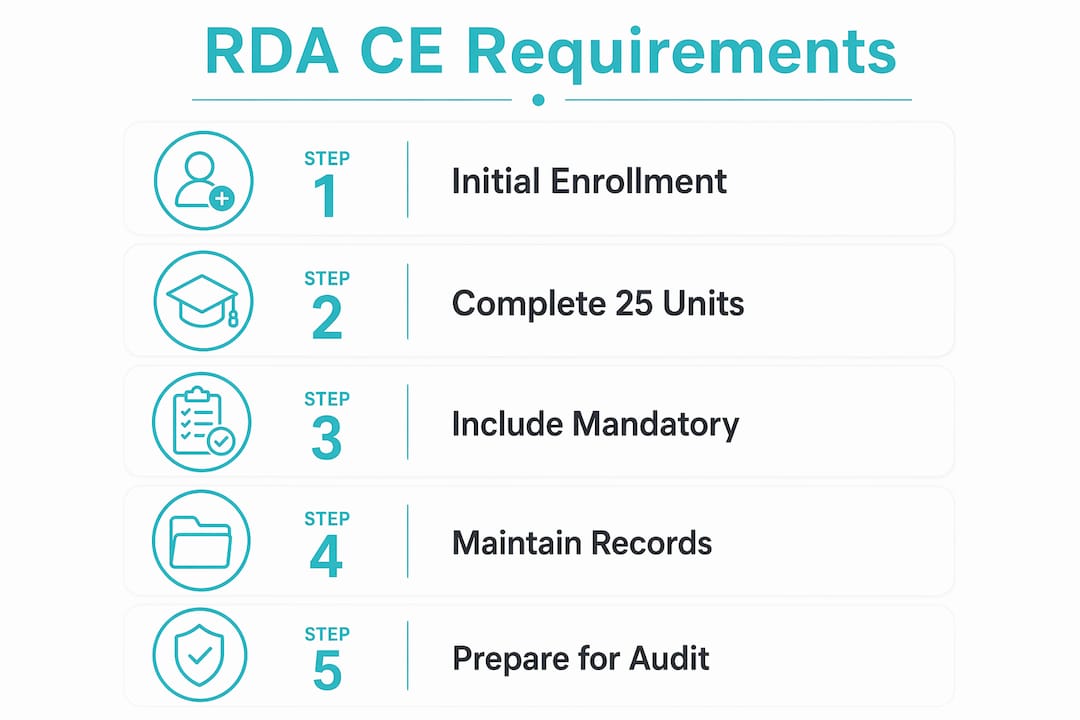
California RDAs must complete 25 CE units every two years for license renewal, with one CE unit equaling one hour of instruction. Those 25 units include specific mandatory courses you cannot skip: 2 units in California Infection Control, 2 units in the California Dental Practice Act, and a current Basic Life Support (BLS) certification that counts for up to 4 units. One more hard rule: no more than 50% of your total units (12.5 units) can come from non-live or correspondence courses. If you were just licensed, you get a pass on CE for your first renewal cycle, but the full biennial requirement kicks in after that.
At a glance, your mandatory CE checklist:
- 25 total CE units per two-year renewal period
- 2 units: California Infection Control
- 2 units: California Dental Practice Act
- Up to 4 units: current BLS certification
- Maximum 12.5 units from non-live or correspondence courses
Which CE providers are approved for California RDAs?
The California Dental Board approves providers, not individual courses. That distinction trips up a lot of RDAs. You can take a perfectly relevant course from an unapproved provider and have every unit rejected at audit.
Three categories of providers meet Board standards:
- Board-approved Registered Providers: Organizations that have applied directly to the California Dental Board and received formal approval to offer CE for California licensees.
- PACE providers: Approved through the Academy of General Dentistry’s Program Approval for Continuing Education, recognized nationally and accepted by the Board.
- CERP providers: Recognized through the American Dental Association’s Continuing Education Recognition Program, also accepted for California RDA CE credit.
“The board has determined that the public health and safety will be served by requiring all holders of licenses granted by the board under the Code to continue their education after receiving such licenses.” — Cal. Code Regs. Tit. 16, § 1015
Pro Tip: Before enrolling in any course, verify the provider’s approval status using the California Department of Consumer Affairs license lookup at search.dca.ca.gov. A two-minute check now prevents a failed audit later.
Mandatory courses (Infection Control and Dental Practice Act) carry an extra layer of scrutiny. The Board does verify that these specific courses come from providers explicitly approved to teach them, so confirm that approval separately from general provider status.
Not all online learning is treated equally under California rules. Live webinars and live video conferences count as live courses and do not eat into your 12.5-unit non-live allowance. On-demand and self-paced courses fall into the correspondence category and count against that cap.
Key format rules to keep straight:
- Live courses (in-person, live webinars, live video conferencing): no cap, count freely toward your 25 units
- Non-live/correspondence courses (on-demand, self-study): capped at 12.5 units total
- Daily maximum: no more than 8 CE units per single day of attendance; any excess gets rejected at audit
- Content relevance: courses must relate to dental practice scope, even when taken from an approved provider
Planning your CE across the full two-year cycle is smarter than loading up at the end. The 8-unit daily cap means you cannot realistically complete your requirements in a single weekend conference.
How does the California Dental Board audit CE compliance?

Audits are random, and the Board does not announce them in advance. When you get selected, you need to produce your CE completion certificates on the spot. The Board requires you to retain certificates for at least three renewal cycles, which works out to six years. Discarding records early is one of the most common reasons audits fail.
The other leading cause of audit failure: unapproved providers or insufficient unit counts. Failing an audit can result in license non-renewal. That is not a fine you pay and move on from; it means you cannot legally practice until the deficiency is resolved.
Pro Tip: Keep a running log in a spreadsheet or folder with the course name, provider name, provider approval type, date completed, and units earned. Attach the certificate PDF to each entry. When an audit notice arrives, you will have everything ready in minutes.
Best practices for staying audit-ready:
- Save CE certificates immediately after course completion, not at renewal time
- Confirm provider approval before you enroll, not after
- Track your live versus non-live unit split throughout the cycle
- Never claim more than 8 units for a single day of coursework
Official resources and regulatory references for California RDAs
The primary source for all CE requirements is the California Dental Board’s CE page, which covers unit totals, mandatory course specifics, and provider approval criteria. The underlying legal authority sits in Cal. Code Regs. Tit. 16, § 1017, which sets the biennial unit requirements for each license type, and § 1015, which establishes the Board’s authority to require ongoing education.
For provider verification, use the DCA’s license search tool at search.dca.ca.gov. Check the Board’s pages periodically since requirements can change between renewal cycles.
How Onewd supports your California RDA continuing education
Onewd offers accredited CE courses built for dental professionals who want more than checkbox compliance. The course catalog covers mandatory topics alongside advanced clinical areas like implants, clear aligners, and cosmetic dentistry, organized into tiered learning paths from foundational to advanced levels.
Live webinars through Onewd count as live courses under California rules, so they do not reduce your non-live allowance. On-demand options give you flexibility within the 12.5-unit correspondence cap. Every completed course comes with a documented CE certificate ready for your audit file.
Pro Tip: Use Onewd’s online webinar courses to satisfy live-course requirements without traveling, then reserve your non-live allowance for self-paced specialty content that fits your schedule.
Key Takeaways
California RDAs must complete 25 CE units biennially, including mandatory Infection Control and Dental Practice Act courses, with no more than 12.5 units from non-live sources.
| Point |
Details |
| Total CE units required |
25 units every two years; one unit equals one hour of instruction. |
| Mandatory courses |
2 units Infection Control, 2 units Dental Practice Act, up to 4 units BLS. |
| Non-live course cap |
No more than 12.5 units (50%) from correspondence or on-demand courses. |
| Daily unit maximum |
No more than 8 CE units accepted per single day of attendance. |
| Record retention |
Keep CE certificates for at least three renewal cycles. |
Recommended