CE units for RDAs are state-mandated continuing education credits that registered dental assistants must earn to renew their license and maintain legal practice. No national standard governs these requirements. Each state dental board sets its own rules, and the average CE hours required per renewal cycle is 15.9, though individual states range widely. Tennessee requires 24 hours every two years. New Mexico requires 30 hours over three years. Understanding your state’s exact rules is the first step to staying compliant and keeping your career on track.
What are common CE requirements for RDAs across states?
Most states require between 12 and 30 CE hours per renewal cycle, but the subject matter matters just as much as the total count. State boards do not let you fill all your hours with electives. They mandate specific topics, and those categories are non-negotiable.
Common required subjects include:
- Infection control: Maryland requires a minimum of 3 dedicated infection control hours per renewal cycle.
- CPR and Basic Life Support (BLS): Most states require current CPR certification as part of the renewal package, not just as a one-time credential.
- Ethics and jurisprudence: California mandates law and ethics training as part of its 25-hour renewal requirement every two years.
- Opioid awareness: Several state boards now include opioid training as a mandatory topic, reflecting updated public health priorities.
The critical detail most RDAs miss is that hours in one required category cannot substitute for another. If your state requires 3 hours of infection control, a 3-hour ethics course does not fill that slot. State CE requirements specify categories separately, and your renewal application must reflect each one independently.
Pro Tip: Download your state board’s CE requirement checklist at the start of each renewal cycle. Map your planned courses to each required category before you register for anything.

Acceptable formats for dental assistant continuing education fall into three main categories: live in-person courses, approved online courses, and college-level coursework. Each format carries different rules, and states impose limits that prevent RDAs from rushing all their credits at the last minute.
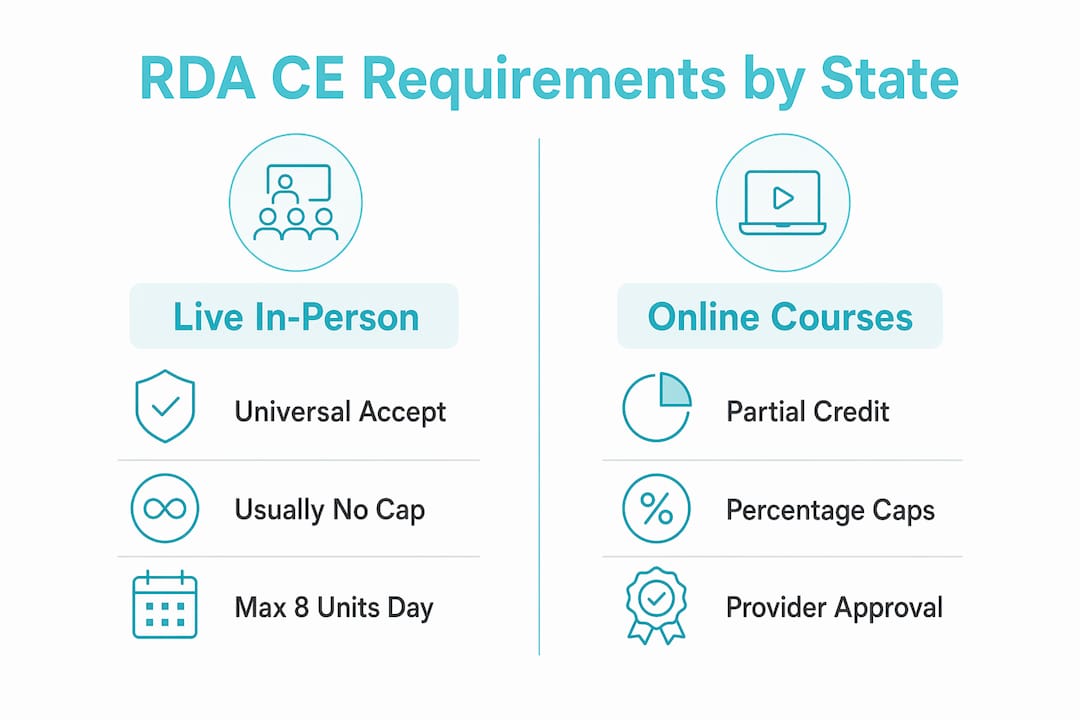
- Live in-person workshops and courses count fully in every state. These include hands-on labs, lecture-based seminars, and live surgical observations. There are no caps on live hours in most jurisdictions.
- Approved online courses are widely accepted, but states often cap the percentage of total credits you can earn this way. Nevada limits self-study CE hours to 50% of your total required credits. That means if your state requires 20 hours, no more than 10 can come from self-paced online formats.
- College coursework counts in many states, typically at a conversion rate tied to credit hours or clock hours. Check your board’s conversion formula before enrolling.
Daily accumulation limits add another layer of complexity. California prohibits crediting more than 8 CE units per day, regardless of how many hours you actually attend. That rule exists to prevent binge-learning marathons that do not produce real skill retention.
| Format |
Typical acceptance |
Common cap |
| Live in-person |
Universal |
None in most states |
| Approved online |
Widely accepted |
Up to 50% of total hours |
| College coursework |
Accepted with conversion |
Varies by state |
| Self-study reading |
Limited acceptance |
Often 25% or less |
Pro Tip: Never assume an online course counts just because it looks professional. Verify the provider’s approval status with your state board before you pay or start the course.
How can RDAs use CE courses to grow their careers?
Continuing education for RDA license renewal is a compliance floor, not a ceiling. The RDAs who advance fastest treat their CE hours as a skills investment, not a paperwork obligation.
Choosing advanced topics opens doors that basic compliance courses do not. Specialized training in areas like implants, nitrous oxide monitoring, or cosmetic dentistry techniques qualifies you for expanded clinical duties in many states. Those expanded duties translate directly into higher pay and greater value to your employer.
- Implant assisting: Training in implant procedures positions you for roles in oral surgery and specialty practices, which typically pay above general dentistry rates.
- Nitrous oxide monitoring: Many states require a separate permit for this function. Earning it through CE adds a billable skill to your profile.
- Clear aligner coordination: Orthodontic and aligner-focused CE prepares you to take on case coordination duties, a growing role as aligner treatment volume rises.
- Cosmetic dentistry support: Courses in veneers, whitening protocols, and smile design make you a stronger candidate in cosmetic-focused practices.
Advanced CE skills translate directly to higher pay and broader clinical functions. The salary gap between a general dental assistant and one with specialized certifications is real and measurable. Online and weekend course formats make it possible to pursue this training without leaving your current position.
What compliance tips help RDAs avoid CE credit problems?
Completing CE hours is only half the job. The other half is proving you completed them in a way your state board will accept. Compliance failures almost always come down to documentation and provider verification, not effort.
Follow these practices to protect your license:
- Verify board approval before registering. Only courses from board-approved providers count toward renewal. A provider number on your certificate is the proof your board needs. Generic certificates without a provider number can fail audits even if the course content was legitimate.
- Retain all certificates for at least three years. Most states enforce a minimum three-year retention rule for CE documentation. Audits can happen after renewal, and missing certificates mean missing credit.
- Build a dedicated compliance folder. Experienced RDAs keep a single folder, digital or physical, containing their current CPR card, active license, and all CE certificates organized by renewal cycle. This makes audit response a matter of minutes, not days.
- Check your state board website at least six months before renewal. State boards update CE rules regularly. New mandatory topics like opioid training can appear mid-cycle. Discovering a new requirement two weeks before your deadline is a serious problem.
- Track your hours as you go. Waiting until the final month of your renewal cycle to count your credits is the most common reason RDAs scramble or miss requirements.
Pro Tip: Set a calendar reminder six months before your license expiration date. Use that time to audit your CE folder, confirm your hour totals by category, and register for any remaining courses you need.
Key Takeaways
Registered dental assistants who treat CE requirements as both a compliance task and a career tool consistently outperform those who treat it as a checkbox.
| Point |
Details |
| No national CE standard exists |
Each state board sets its own hour totals, required topics, and renewal cycles independently. |
| Required topics are non-substitutable |
Infection control, CPR, and ethics hours must each be fulfilled separately, not interchanged. |
| Format limits cap online credits |
Many states limit self-study or online CE to 50% of total required hours per cycle. |
| Documentation is as critical as completion |
Retain board-approved certificates with provider numbers for at least three years after renewal. |
| Advanced CE expands earning potential |
Specialized training in implants, cosmetic dentistry, or nitrous oxide monitoring adds clinical value and pay. |
CE as a career move, not just a checkbox
Most RDAs I talk with treat their CE renewal like a tax filing. They wait until the deadline is close, grab whatever courses are available, and check the box. That approach keeps your license active, but it does nothing for your career.
The RDAs I have seen advance quickly do something different. They plan their CE at the start of each renewal cycle with a specific skill goal in mind. One year it might be implant assisting. The next, it is nitrous oxide monitoring or clear aligner coordination. Each cycle, they come out with both the compliance hours and a new clinical capability. That compounds over time in ways that a random collection of courses never does.
The documentation piece is genuinely underrated. I have seen experienced assistants lose sleep over audits because their certificates were scattered across email folders and old binders. A single organized compliance folder, updated after every course, eliminates that stress entirely. It takes ten minutes to maintain and saves hours of panic when an audit notice arrives.
The real opportunity in CE is that your state board is essentially paying you to get better at your job, as long as you choose courses that actually build your skills. Online CE courses in surgical and implant topics are now good enough that you can build real competency before you ever step into a live case. Use that.
— Jake
Onewd courses built for RDAs who want more than compliance
Onewd offers board-approved dental CE courses designed for RDAs who want to meet their renewal requirements and build real clinical skills at the same time.
The Onewd training course catalog includes both online and live options covering infection control, implants, cosmetic dentistry, and surgical assisting. Courses are structured in tiered learning paths, so you can start with foundational credits and progress toward advanced clinical training as your career grows. Flexible scheduling means you can accumulate required CE units without disrupting your current work schedule. Check the upcoming course schedule to find options that fit your renewal timeline.
Recommended